
By Henry Leonel Sales Hernandez
Blocked roads, closed schools, changed expectations
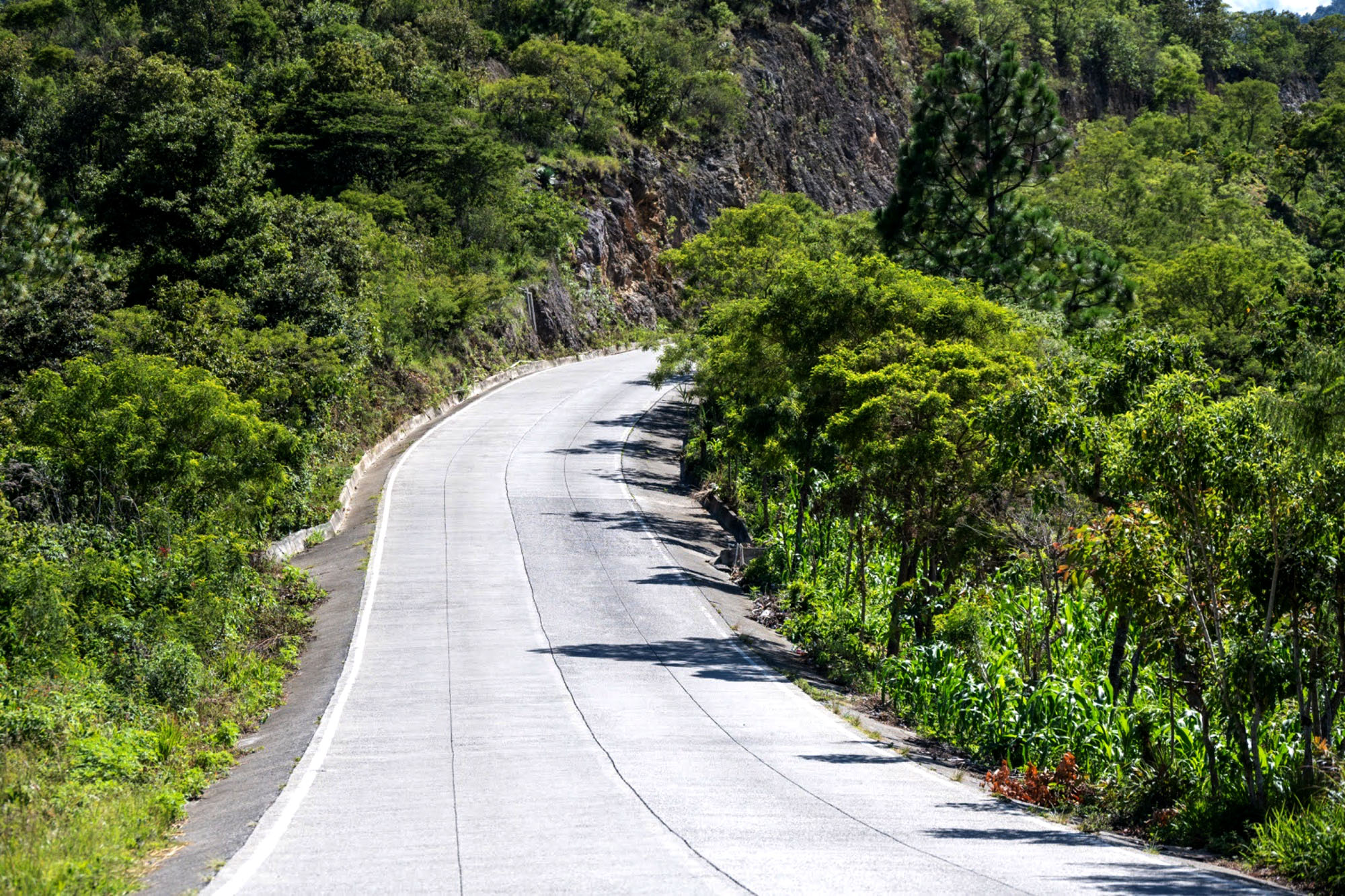
When I arrived in Guatemala in July 2025, I expected to begin observing classrooms for my research on Indigenous Maya Mam pedagogies. Instead, on the long drive to San Juan Atitán, I encountered blocked roads caused by a national strike by teachers. I soon learned that the strike had already closed public schools across the country and reshaped everyday educational life in profound ways. What initially felt like an interruption to my carefully planned research quickly became the story itself. The school closures changed not only my schedule, but also my understanding of what it means to study education in a moment of political uncertainty. Rather than observing formal classrooms as I had intended, I found myself paying closer attention to how teachers, students, and families were responding to disruption and finding other ways to sustain learning.

Teachers refused to let learning stop
In San Juan Atitán, I connected with the Instituto Nacional de Educación Básica Jornada Vespertina (INEB, National Institute of Basic Education, Afternoon Session), where I had hoped to observe teaching more closely. When I first reached out to the school principal, whom I refer to as Profe. Javier, he was cautious, unsure whether I might be connected to the media or to a government agency. Only after I explained my purpose and shared documentation about my research did he agree to speak with me. What stayed with me most was not only that caution, but the commitment toward their students he and his colleagues continued to show. Even though official classes were suspended because of the strike, teachers still made sure students received weekly assignments. As Profe. Javier told me, they did not want students to remain at home without learning anything. In a moment shaped by fear, pressure, and uncertainty, teachers were still finding ways to keep educational life moving forward.
Students kept Mam language alive through joy and practice
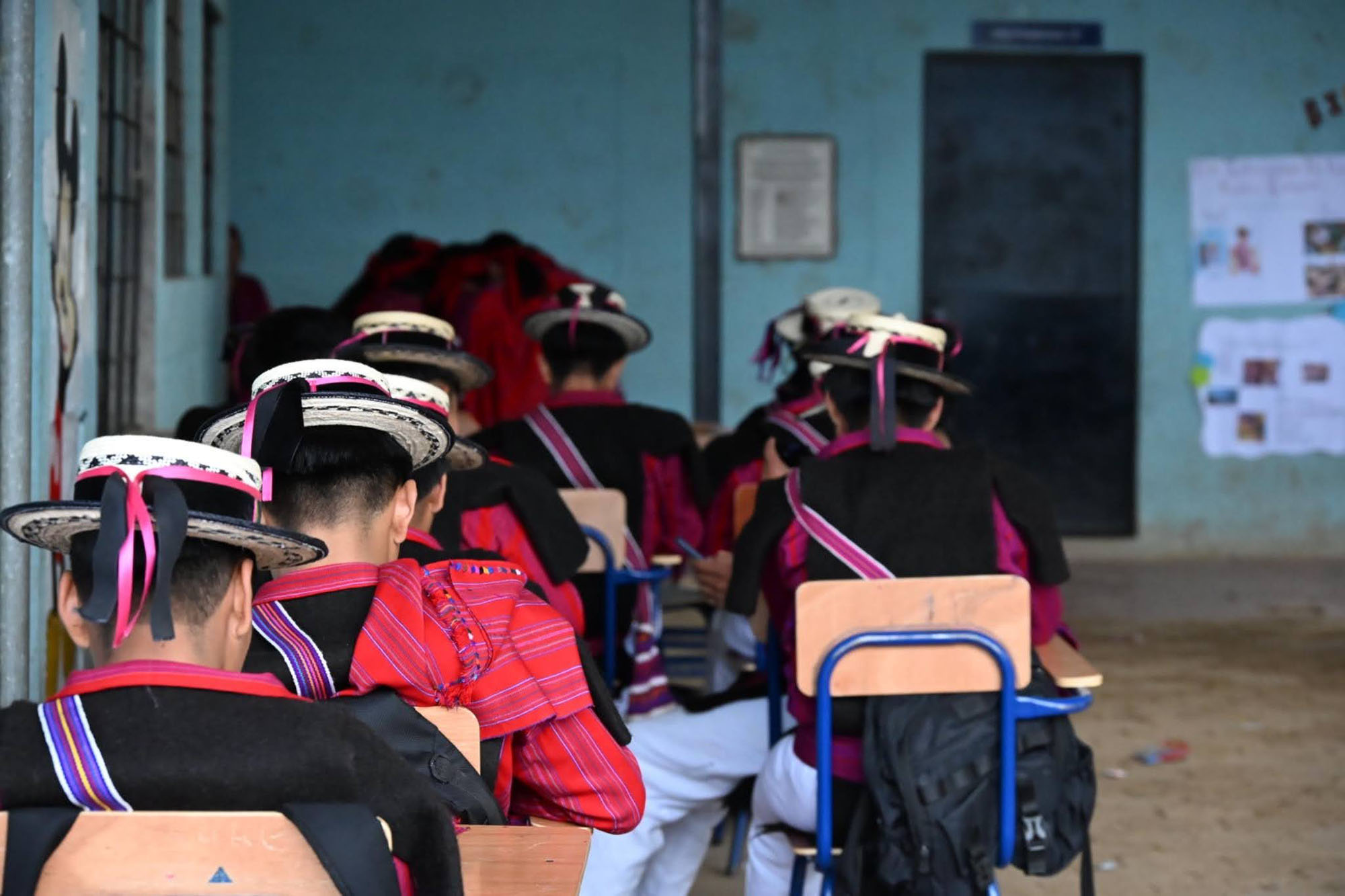
When teachers were permitted to return, I observed Profe. Javier as students gathered outside the classroom to pick up and drop off assignments. It was not a regular school day, but the lesson that unfolded was full of energy. He introduced adverbs of time in Mam, and students debated meanings, tested out expressions, and built sentences from their daily lives. At one point, a student wrote a sentence about having gone to steal corn, and the group erupted in laughter. “Ew xi aj qini q’alq’al kjon” (“Yesterday, I went to steal corn”). That moment stayed with me because it revealed that language learning was not simply about grammar or correctness. It was also about humor, shared cultural knowledge, and the confidence to make meaning together. Even in the midst of educational disruption, students were keeping Mam alive through joyful practice, everyday experience, and collective interaction.
Girls and festivals showed culture as hope and healing
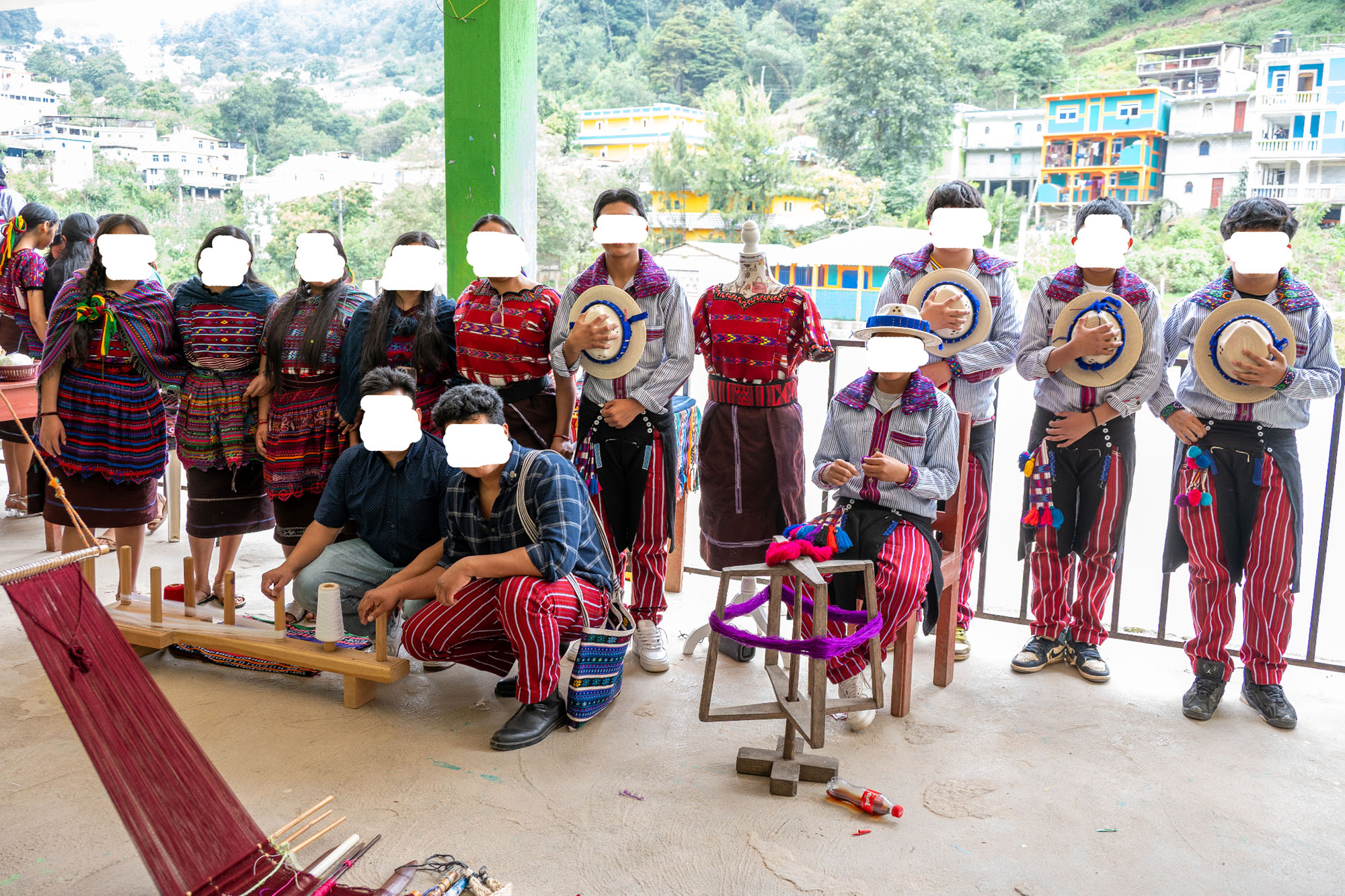
Later, as students continued arriving for homework, three young girls approached me and shared words I have not forgotten: “Aj huelga me’n we’ qiy qxnaq’tzbil ex a qiy qchwinlal ex qxe’chl ntzaj q’amant tu’n thaw qin qib’i ex tu’n tb’aj qon qib’i” (“The strike won’t stop us from learning because our culture teaches us to strive and to heal our people”). They asked me to photograph them making a heart with their hands, a simple gesture that carried so much meaning. In that moment, they offered not despair, but love, unity, and hope. I saw a similar spirit the following day in Todos Santos Cuchumatán, where teachers and students marked their return to school with a festival filled with traditional clothing, weavings, performances, food, and language. Although one teacher spoke candidly about exhaustion and discouragement after the repeated strikes, the celebration itself made visible another truth: culture was helping hold the community together. These moments showed me that in Maya Mam communities, cultural expression is not separate from education. It can also be a source of healing, continuity, and strength.

The strike revealed what education really is in Maya Mam communities
In both San Juan Atitán and Todos Santos, the strike revealed much more than a simple disruption of schooling. It made visible the cultural, relational, and emotional labor through which Maya Mam teachers, students, and communities continue to sustain learning. What I came to understand is that education in these communities is not confined to classroom routines, attendance sheets, or formal lessons. It is carried through language, humor, ceremony, responsibility, and collective care. Teachers are not only instructors; they are also keepers of culture and language. Students are not only learners; they are participants in the ongoing work of sustaining identity and community. Families, too, play an active role in encouraging children and supporting educational continuity. The strike made these foundations more visible. What I witnessed was not simply an interruption to school, but a powerful reminder that education can remain alive through culture, community, and ancestral strength.
Henry Leonel Sales Hernandez is a Maya Mam Ph.D. student in the School of Education at UC Berkeley whose research focuses on Indigenous language revitalization, Maya Mam education, and community-based learning in Oaklad, California. He is also a co-founder of Unión Maya, where he supports Mam youth, families, and cultural programming in Oakland. His work brings together research, photography, teaching, and community organizing to document and strengthen Maya Mam language, culture, and education.

Leave a Reply