
By Andrés Caicedo
During fieldwork in Tumaco, one of Colombia’s main oil palm regions, I began tracing how gendered discourses about agricultural diseases, plant reproduction, and plantation labor articulated by oil palm scientists have redefined labor regimes in the agroindustry. In the early 21st century, Colombian palm plantations declined dramatically during an agricultural epidemic of Bud Rot disease. This story unfolds in the aftermath of that epidemic.

Over the last two decades, scientists have responded to this crisis by designing a new palm species capable of resisting Bud Rot, but that is highly dependent on human-assisted pollination. This hybrid, known as OxG, cannot bear fruit, aborting them unless workers manually pollinate its female flowers. In this context, oil palm scientists and managers repeatedly describe assisted pollination as the perfect labor for, in their words, “women and single mothers,” claiming that their values and hand skills are best suited for the task. (Fedepalma 2011)
Bud Rot itself remains the most fatal disease affecting oil palm plantations in Colombia. It gained global notoriety in the early 2000s when it came close to collapsing the national oil palm sector, with Tumaco being among the most severely impacted regions. The introduction of the OxG hybrid is therefore not only a technical solution to a contagion, but also a transformation that reorganizes both the natural and labor environments.

The OxG results from crossing two species of oil palms, Elaeis oleifera and Elaeis guineensis. (Alvarado et al. 2013; Romero and Ayala Díaz 2021; Romero and Ayala Díaz 2019; Romero 2022; Romero and Ayala Díaz 2023; Niño et al. 2021).The E. oleifera tolerated Bud Rot from the beginning, producing good quality oil but only in very small amounts, because its female inflorescences rarely turned into bunches. (Alvarado et al. 2013; Romero and Ayala Díaz 2021; Romero and Ayala Díaz 2019; Romero 2022; Romero and Ayala Díaz 2023; Niño et al. 2021).The E.guineensis, in contrast, was the species that Bud Rot almost wiped out. Before the epidemic, it was the predominant palm in Colombian plantations, largely because it produces more female inflorescences than male ones, and therefore produces more oil.
In the eyes of oil palm industry scientists, the OxG carries the best of both lineages: tolerance to Bud Rot and a stronger tendency to produce female flowers. (Fieldwork notes, 2021-2022) The hybrid has therefore been identified as the most feminine and productive palm in Colombia’s history. Yet these ideas of femininity and productivity contain many layers. Plantation scientists say, “the hybrid also inherited its parents’ biological impairments.” The first is that the female inflorescences show what scientists call “flower abortion”; just before reaching full reproductive development, they wither and decay. As one expert told me, “Pues sí … es cierto que el OxG produce más flores femeninas, pero en realidad es una mala madre que como algunas mujeres se la pasa abortando a todos los hijos.” (“Yes, the OxG produces more female flowers, but she is a bad mother who spends her time, like some women, aborting all her children.”) (Personal interview, 2021).

As I continued my conversations with plantation workers and experts, the assigned femininity of the palm extended further. For oil palm experts, the hybrid has “an ugly physiology” (Personal interview, 2021), so its flowers are rarely visited by insect pollinators. As one plantation technician explained, “OxG inflorescences are closed and shy; she is a snobbish palm.” (Personal interview, 2021). These descriptions refer to the thicker fibrous bases that wrap around each flower, making passing through it difficult for insects. Another concern emerged in similar terms: “The OxG is dry and tasteless.” (Personal interview, 2021) Even when insects reach the flowers, “she offers no nectar and no sweetness.” The hybrid, as one expert put it, “is like a frigid palm; she does not have sexual appetite at all.” (Personal interview, 2021)
These “easy terms,” often presented as explanatory shortcuts, do more than describe the plant. They shape how scientific knowledge about plant reproduction is produced, how expertise relates to palm trees, and how plantation labor is organized. During fieldwork, another formulation stayed with me. A woman pollinator described the hybrid as “a very demanding palm (…) You have to have everything ready for her: clean, fertilize, and check her every day.” (Personal interview, 2021) In these accounts, care becomes constant attention. If this attention fails, the palm becomes stressed. As a plantation manager told me, “When this palm gets stressed, she stops being feminine and turns into a machorra, a tomboy.” (Personal interview, 2023)
Under these stressed conditions, the hybrid may stop producing female flowers and begin producing male ones. In other cases, it produces both simultaneously. These forms were described to me as “ugly, abnormal, and deformed bunches,” sometimes even as “monsters.” (Personal interview, 2023). When I asked whether these monstrous inflorescences were used for anything, a technician responded, “Maybe they are just good for making fun. They are just objects of curiosity.” (Personal interview, 2023)

It is within this broader transformation that assisted pollination takes on its central role. During fieldwork, a plantation manager told me, “The OxG is a more feminine palm not only because of its biology but also because it gives space to women in the industry.” (Personal interview, 2021) Managers and scientists often explain that pollination is suited for women because of their supposed manual dexterity. Yet after accompanying pollinators for several days, this claim seems questionable.
Pollination engages the whole body. Hands, but also eyes, legs, arms, and back. Two pollinators described it simply: “It is a painful job. Everything hurts after hours of walking. Your arms, legs, and your back especially. It weakens your body.” (Personal interview, 2022)
In daily conversations during fieldwork, a different explanation for the feminization of this labor emerged. One afternoon, after lunch, a formerplantation manager told me, “When we discovered that the new palm needed assisted pollination, it was a big problem. It meant new costs and people who could endure a job that demands all your responsibility. The solution we imagined was that women, especially those in charge of their children, accepted less money and did not quit because they needed the job.” (Personal interview, 2021) When I asked whether companies still followed this logic, he answered ambiguously. Over time, he said, companies learned that women also quit and that hiring them could mean additional costs, such as maternity leave. Still, women remain the major force in pollination. As he put it, “Women know how to love and care for real, and these things are the most important for being a good pollinator.” (Personal interview, 2021)
Feelings, then, become central to how this labor is understood. During long walks across the plantations, pollinators told me, “Our work is about loving and caring for flowers, even though our feelings never appear in the work diaries.” (Personal interview, 2022) Yet these same workers also emphasized the physical toll of their labor. Care and pain coexist.
To make sense of this entanglement, I pay attention to the semiotic materialities that link love and care with exhaustion and bodily strain. These relations are often articulated through animal narratives. In Tumaco plantations, workers frequently describe themselves as bees. “We are like bees,” they told me, “we pollinate all day without stopping.” (Personal interview, 2022) A plantation manager added that a woman working as a pollinator must have “the strength of a buffalo, the agility of a deer, and the eye of an eagle.” (Personal interview, 2022)
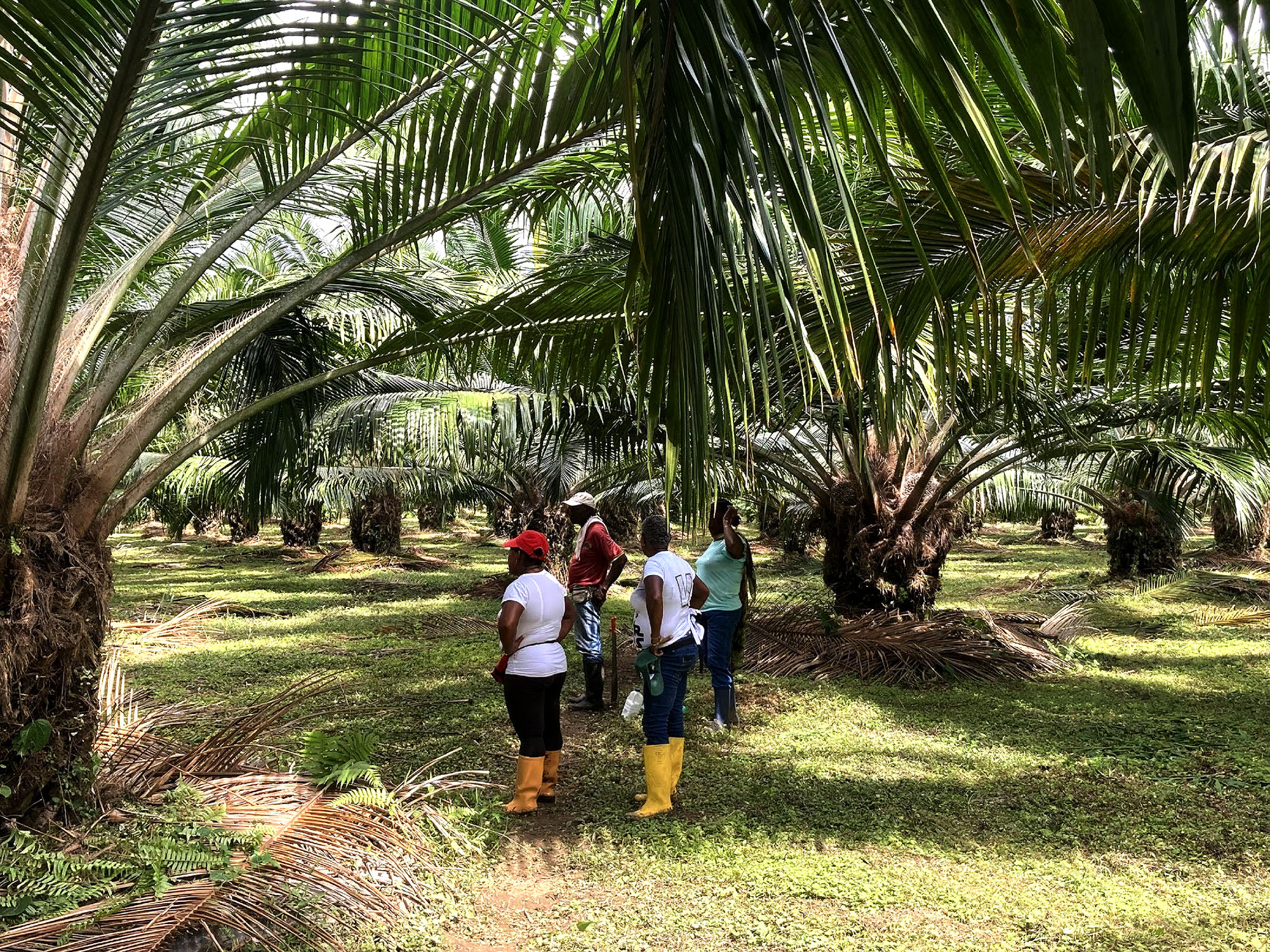
These comparisons are not merely metaphorical. They organize a labor regime in which human bodies are shaped through expectations drawn from animal life. Pain and exhaustion are reframed as signs of productivity, while traits such as loyalty, docility, and endurance are valorized.
The love for the palms, as workers often say, is a love that also hurts. Care and pain coexist in the daily practice of pollination. This tension recalls what Radhika Govindrajan (2018) describes as “animal intimacies”: relations of affection and dependency entangled with power, exhaustion, and violence. I refer to these dynamics as animal labor narratives, a way of naming the intersection of metaphors, material practices, and disciplinary regimes that conflate gendered bodies with animal life.

Andrés Caicedo is a Ph.D. candidate in Society and Environment in the Department of Environmental Science, Policy, and Management at the University of California, Berkeley, and was a 2026 CLACS Summer Dissertation Fellow. He holds designated emphases in Women and Gender Studies and Science and Technology Studies. His work intersects multispecies studies, science and technology studies, critical agrarian studies, and feminist and queer theory. His research examines how techno-scientific agricultural interventions, gendered and racialized labor regimes, and everyday encounters of plants, microorganisms, and humans converge in Colombian oil palm plantations.
Bibliography
Alvarado, A., Escobar, R. and Henry, J. (2013) “El híbrido OxG Amazon: una alternativa para
regiones afectadas por pudrición del cogollo en palma de aceite,” Palmas, 34, pp. 305–314.
Fedepalma (2011) “Nace la palma, la vida y la esperanza de manos de mujeres en Palmas de Tumaco,” Boletín El Palmicultor, 468, p. 11.
Govindrajan, R. (2018) Animal Intimacies: Interspecies Relatedness in India’s Central Himalayas. Chicago: University of Chicago Press.
Niño, A. et al. (2021) “Polinización, criterios de cosecha y procesamiento del híbrido OxG,” Palmas, 42(1), pp. 130–138.
Romero, H.M. and Ayala Díaz, I.M. (2021) “Cómo alcanzar 10 toneladas de aceite por hectárea,” Palmas, 42(1), pp. 55–64.
Romero, H.M. (2022) “Los híbridos interespecíficos OxG,” Cenipalma Congress, Cartagena.
Romero, H.M. and Ayala Díaz, I.M. (2023) “Los híbridos interespecíficos OxG en palma de aceite,” Cenipalma.

Leave a Reply