
By Kate Altemus Cullen
Globally, 2.1 billion people (1 in 4) still lack access to safely managed drinking water.1 Community-managed water systems, in which neighbors communally manage wells, taps, and distribution systems, have long filled the gap where state and private services do not reach, especially in rural and informal communities. The volunteer community managers and operators of these systems are frontline workers and caretakers in their communities, fielding calls and fixing leaky pipes late into the night to ensure the water flows again. However, their work is becoming increasingly difficult as climate change makes water more variable and scarce, and water-intensive industries continue to drain already stressed supplies. Communally-managed water systems remain largely overlooked in the broader discourse on drought, water security, and climate resilience, despite delivering the human right to water on the ground every day.
In Chile, these systems are known as Asociaciones de Agua Potable Rural (APRs, Rural Potable Water Associations). Over nine months in 2023, I had the opportunity to partner with the APRs of Chile’s Metropolitan Region as part of my Ph.D. research on climate change and drinking water access. I want to share what APR managers taught me about how climate change is deepening water access inequalities, and how community leaders are rising to meet the challenge.

The Experience of Megadrought in central Chile
Across the rural areas of the Santiago Metropolitan Region, APRs describe an unprecedented shift from dependable groundwater and surface water sources to scarcity since the region’s megadrought began in 2010. Groundwater levels that had been stable for over 40 years suddenly dropped, drying up APR wells. Norias, shallow artisanal wells, have dried up. The Andean snowpack, which supplies the region’s riverflow in summer, remains historically low: “there is no snow in the mountains” (APR leader). APRs across the region report mass die-offs of natural vegetation, declining wildlife, and dwindling surface and groundwater sources. One municipal official noted, “Chile was a country that generally did not have water problems… the water issue today is critical.” The severity of hydrological and landscape change can’t be overstated: “it is causing a desert here… before this area was a beautiful garden… willow trees, canals, everything green… now we have arrived on Mars.” (APR leader)
APR managers consistently link these losses to the megadrought, emphasizing that it has “altered” the hydrological cycle and their drinking water access: “I have never seen 17 years with such little rain.” (APR leader) Another noted simply: “We have not had rain in years, but rather drought after drought.” (APR leader) Lake Aculeo, the region’s largest freshwater lake, dried up from 2010 to 2023 and remains historically low. A lifelong resident nearby argued that the lake dried up “because of the drought,” emphasizing that although local farms draw from the lake, “it didn’t rain normally… the tributaries to fill the lake never came down… the fundamental thing was the ten years of drought.” (APR leader) He voiced: “The lake was beautiful. There was work. We had pejerreyes (silversides fish)… it all died. It all went away.” Aculeo is now “unrecognizable.” People have migrated away, farmers have stopped planting the area’s staple crops, and those who remain are only beginning to “reinvent themselves” as the lake slowly returns.
The hardest-hit APRs are in the north and southwest of the Metropolitan Region, Tiltil, Colina, San Pedro, Melipilla, and Alhué, where a coastal mountain rainshadow limits precipitation and aquifer recharge from the Maipo River is minimal. This is also where some of the region’s largest mines and agro-industrial production are located. In recent years, groundwater levels have dropped from historically stable depths of 12–15 meters to over 200 meters. Even in the comparatively wetter central valley along the Maipo River, changes are notable. Groundwater levels in Isla de Maipo, a region along the river south of Santiago, have steadily dropped, and APR leaders report visible declines in the river’s flow, vegetation, and riverine wildlife. In Curacaví, groundwater has fallen from a historical average depth of 9 meters to 17 meters: “We are fortunate to be among the few who have water… the water is of very poor quality, but at least we have it.” (APR leader)
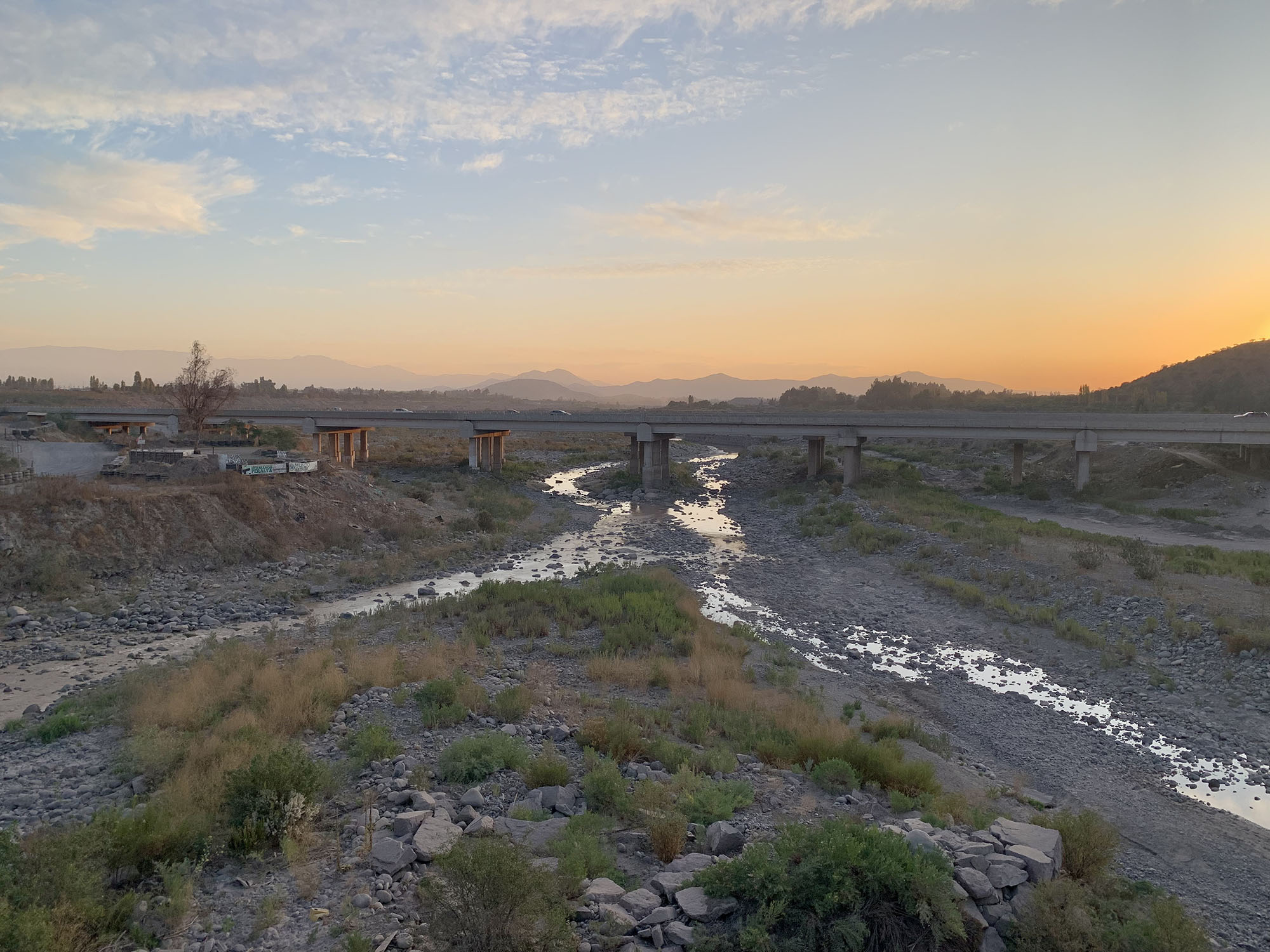
These water source losses are also shaped by Chile’s neoliberal water governance, which prioritizes economic uses over rural drinking water needs. The Santiago Metropolitan Region supports some of the country’s largest copper mines, a major irrigated agricultural export economy, and industrial processing plants. As these demands have helped to dry up traditional sources, rural communities have become reliant on a patchwork of tanker truck deliveries from municipal and national governments and private suppliers.
The Fight for a Dignified Life
The disruption in water access has reverberated through daily life in ways both intimate and structural. As one APR leader in Isla de Maipo put it, water access is “an issue of a dignified life… to go to take a shower in the morning when it is very cold or after work, and the water heater does not turn on because of the water pressure.” The historic disruption in APR water access has upended daily routines, intensified pressures on APR managers and households, and generated community tension over scarce supplies and expectations of rapid resolution.
The weight of the water crisis falls disproportionately on APR managers, not government officials. APR managers live in the communities they serve, bound daily to the reality of their neighbors’ water problems. One APR manager describes how her father, a former APR president, is reminded of unresolved pipe issues every time neighbors pass his home on the way to church or the doctor. State officials, by contrast, can leave the water crisis behind when they return to their Santiago homes at the end of the day.
The government’s lack of political will and allocated resources to address the problem shifts the responsibility for fixing this drinking water crisis on to the APRs. In Chile, APRs have long had to be self-sufficient from necessity, but also out of choice. Leaders emphasize pride in their autonomy and self-organized nature; while the state makes upfront infrastructure investments, “the management is entirely our own.” At the same time, APR leaders voice that due to a lack of institutional, political, financial, and legal support, the region’s rural drinking water crisis “bounces back to the APRs.” (APR leader) APR leaders voiced that this dynamic has been present since their founding: “the genesis [of APRs] is the people, the organized community.” In Paine, one manager recounts: “Despite being only 35 kilometers from Santiago, we never had drinking water… until the people organized themselves.” Most APRs in the region were founded by communities of campesino farmworkers and by factory workers. For example, in Tiltil, cement plant workers “got together and formed this.” (APR leader) These histories have cultivated a culture of self-reliance: when threats to water access arise, “we are not waiting for the government.” (APR leader)
APRs see themselves as more than water providers; they are a social foundation of their communities. As one president put it, “this [the APR] is one of the most important, transcendent social entities of [the village].” (APR leader) They supply water without charge to local schools and neighborhood councils, build community meeting spaces, and host exercise classes, senior citizen committees, and arts workshops. Their leaders are unpaid and community-elected, volunteering “out of social conviction,” “to give back,” and to do something “as neighbors for neighbors.” (APR leader)
The experience of APRs in Chile is not isolated, but shines a light on the realities of community-managed water systems across the world. These systems are contending with extractive industries draining their water supply, colonial and authoritarian legacies that endure through inequalities in access to resources, and a worsening climate crisis that further deepens their vulnerability and exposure to harm. APRs are central to the global fight for the human right to water and a dignified life for all. Globally, that means institutionalizing support, protecting their water access, and ensuring their full participation in decisions on water governance, rural development, and climate adaptation.
–
I would like to express my deep gratitude to Professor Anahí Ocampo-Melgar and Cecilia Gonzalez who have been close mentors and thought partners on this project, as well as Arlé P. Kröll, Eduardo Panguinao, Daniel González, Tamara Escobar, and Sebastián Orellana Pesse who have provided much valued support and collaboration along the dissertation research journey.
- JMP. (2025). Progress on household drinking-water, sanitation and hygiene 2000-2024: Special focus on inequalities. https://www.who.int/publications/m/item/progress-on-household-drinking-water–sanitation-and-hygiene-2000-2024–special-focus-on-inequalities ↩︎

Kate Altemus Cullen is a Ph.D. candidate graduating from the Energy & Resources Group in 2026. Her dissertation looks at drinking water access and extreme drought in a changing climate through participatory and community-engaged research methods in the Maipo River Basin of Chile. Her collaborations and research in Chile have been gratefully supported by Fulbright 2018, Fulbright-Hays 2023, NSF IRES Pathways, and the Lau Climate Equity Grant. She holds an MSc in Water Science and Policy from the University of Oxford and BA in Earth & Environmental Sciences and History (focus: Latin America) from Wesleyan University.

Leave a Reply