
By Pablo Eduardo Paredes Burgos
Before breaking the record for viewership and creating the social media sensation that Latinas have collectively and lovingly come to call Benito Bowl, Bad Bunny did something that feels just as important as singing on that stage: he went home.
In the summer of 2025, Benito Antonio Martínez Ocasio, aka Bad Bunny, hosted the historic No Me Quiero Ir de Aquí residency at the Coliseo de Puerto Rico José Miguel Agrelot, colloquially known as “El Choli.” From July 11 to September 20, Benito staged thirty sold-out shows that can best be understood as love letters to Puerto Rico. From the location, to the musical choices, to the guests brought up on stage day after day, this extraordinary residency was deeply rooted in Boricua pride and traditions, with its first days exclusively reserved for Puerto Rican residents.

Every epic night of that summer started with something fundamental, something that paved the path for what the world saw on Super Bowl Sunday. Before Benito could trust-fall from his Super Bowl stage into the hands of his culture, before Bad Bunny could scale symbolic telephone poles to restore power to our people, a very specific journey had to take place. A personal pilgrimage in search of his roots was a necessary prerequisite to the confidence and poise that permeated Benito Bowl. Bomba, as she has always been for Puerto Rican freedom practices, was the true rehearsal for the Benito Bowl.
To be clear, Benito’s meteoric rise to stardom is a story that weaves resistance and growth seamlessly from start to finish. Debí Tirar Más Fotos (DtMF), as an album — and really every facet of Bad Bunny’s career leading up to the residency — marks a steady, iterative trajectory of growth. When Benito was uploading improvised music to SoundCloud while bagging groceries to pay bills in 2016, he was already embodying a long Boricua history of resistance, of refusing to stay in our plantation plots. When these tracks began to take over Latin trap in 2017, and explode into global circuits in 2018, Benito’s gender-bending aesthetics in a genre dominated by masculinist bravado continued to manifest this fierce freedom force. By the time of the mass popular mobilizations that dethroned a corrupt governor in Puerto Rico in the rebellious summer of 2019, Benito was prepared to pen protest verses that became the theme music to the island-wide movement that coalesced under the hashtag #RickyRenuncia. Ricky Rosello indeed resigned, and the people of Puerto Rico felt power like they hadn’t in generations. Through it all, San Benito, as he is often called, was center stage, supplying the soundtrack. The larger than life Boricua figure who became the first artist to win the Album of the Year Grammy award for a Spanish-language release in 2026 has, in fact, become a symbol of Latino power. In an era of intolerance and xenophobia, he embodies a refusal to translate style or speech for a place at the table.
But if Benito has taught us anything, it’s that we grow and find freedom only in our own unique voice, our own sound, our own percussion, and our own dance. Bad Bunny pours so much intention into his spectacles, his stage designs, his theatrical timing and symbolism, that this is no stretch of the imagination, no hot take or conspiracy theory. When I say that Bomba was the rehearsal for the Benito Bowl, I cite the choices that Benito made night in and night out during his residency. The opening, in particular, remained consistent throughout the residency. Benito staged a search for Bomba, a dramatic rerooting of our collective identity through our island’s oldest, most fierce freedom practice. The quest for Bomba was the clearest metaphor on stage at El Choli that summer.
Every evening, the young genius Afro-Puerto Rican percussionist Julito Gastón introduced the night with a frantic search for the barriles, the traditional Bomba drums. Gastón’s anxiety center stage at Puerto Rico’s largest event in decades embodied the Puerto Rican Nation on the move, the post Hurricane Maria exodus and the diasporic angst over the “lost decade”.1 The show could not officially begin until that moment when Julito found his barriles. We, as an audience and as a people, were reconnected with the technology of resistance, the instrument of freedom, and the rhythms of real Boricua power: Bomba.
Some have pointed out that there were no barriles on stage, nor Bomba rhythms or dances during the halftime show. I would argue that the 30-day Bomba batey2 built at El Choli is where we witnessed the work that transformed Super Bowl Sunday into our Benito Bowl.
Bomba and HerStory

When I opened a recent panel at UC Berkeley’s Latinx Research Center on October 9, 2025, I asked a simple question that underscores Benito Bowl and the unsung role that Bomba played on that stage:
“What is Bomba? What does she teach us about sovereignty beyond the nation-state?”
What came back was something more alive than any definition. Professor and Puerto Rican Bomba dancer/practitioner Dr. Jade Power-Sotomayor3 acknowledged first that what we know of Bomba today probably isn’t what she looked like centuries ago — and that’s okay. Because Bomba is alive.
For Power-Sotomayor, Bomba can be understood as a “technology of relation,” one that facilitates a unique style of communication. This is embodied and made visible in the tight relationship between the dancer and the primo (lead drummer), where the drummer attempts to mark exactly what the dancer’s body speaks in real time. In effect, the dancer’s body becomes an instrument and a composer. Beyond the intimate exchange between dancer and drummer itself, Power-Sotomayor argues this technology constitutes a way for the entire community to figure out how to communicate with each other and how to preserve knowledge. Bomba is thus a kind of versatile set of praxes that evolves alongside, in protective intimacy with, Puerto Rican subjectivity. Bomba has a herstory.
Benito, as apparent in the collaboration with Jorell Badillo Meléndez for historical visualizers to the songs from his album DtMF, is no stranger to a bottom-up history of Puerto Rico. His opening at El Choli could stand in as a multimedia history lesson. Before Julito Gastón took the stage, a long, thick, black-haired and caramel-skinned woman emerged. She evokes Taína aesthetics and is in search of a camera — a material dispossession. She suggests it was stolen, and with it her images of ancestors and family. All she has left is her memory. She never finds her camera, but she keeps her memory of her traditions and land, and she finds Julito. Julito is a Black Puerto Rican who has also lost something: his drum, los barriles. Julito explains to her that when he is troubled, the drum can help heal. Only together do they find their way to the batey and the drums, and then, and only then, the show can start. These are not the African Drums Julito’s ancestors were dispossessed of during middle passage, these are barrilles. Barriles are the unique Caribbean hybrid technology that recreates the ancestral African drum in a colonial Antillean materiality. Julito’s narration at the start of the residency, quite explicitly links this journey to that of the Boricua nation needing the barril to root itself.
In this dramatization we witness how Benito’s journey has become a collective Boricua journey. As he learns his history, he shares it. As he reconnects with his traditions, he embeds them in his music and we reconnect. Our oldest sources suggest Bomba and the barril were present as early as the 17th and possibly 16th century, before any massive sugar plantations were present on the island.4 Too often the narrative of Bomba being born on slave plantations erases this deeper past. Black history doesn’t always begin in chains, even in the Caribbean, and Native history matters. Traditional narratives of the Caribbean are often defined by sugar plantations, slavery and Spanish power, pero PR es otra cosa, (but PR is something else). In Puerto Rico, Bomba was in all likelihood born in peasant maroon spaces throughout the island, where freedom was being envisioned and embodied in resistance to the colonial power of Spanish elites cowering behind the walls of the urban military port of San Juan.
For nearly three centuries, those elites were a small minority. The vast mountainous island was populated in large part by peasants, subsistence farmers, and maroons whom we often refer to as jíbaros.5 When Taíno resistance met African maroons in the mountains, Bomba was the birthchild of traditions and technologies such as the griots6 of West Africa and the areytos7 of native Taínos. Languages were lost, but cultural technologies were hybridized. Soon peasants from Andalucía and the Canary Islands also joined these maroon communities free from the San Juan elite, and these disserters of the Spanish crown brought their tonelero (cooperage) technologies as well.8 These jíbaro communities coalesced and rehearsed their revolutions against colonialism and slavery in the earliest Bomba bateyes of the island. In fact, and ironically, it was a man named Benito who hosted one of the first bombazos9 ever documented in 1797 at his hacienda in Loíza.10
In the 19th century, when major sugar plantations arrived, the barril was sought again, a journey that was echoed over all 30 evenings of Bad Bunny’s residency in El Choli. Bomba, as well documented by Jalil Sued Badillo, was present at numerous slave rebellions during the peak 40-year period of sugar plantation slavery in 19th-century Puerto Rico.11 She was the drumbeat to the first cry for independence, El Grito de Lares, which was both abolitionist insurrection and peasant uprising.12 The Bomba of 17th-century Afro-Taínos, 19th-century slave rebellions and the 1868 Grito, were likely measurably different aesthetic experiences. But her roots were intact. This Afro-Indigenous technology of relation, of freedom fighting and rehearsal for revolution, is a defining Boricua cultural continuum. She is continuously repackaged and repurposed to the challenges of the day, but she is consistently present.
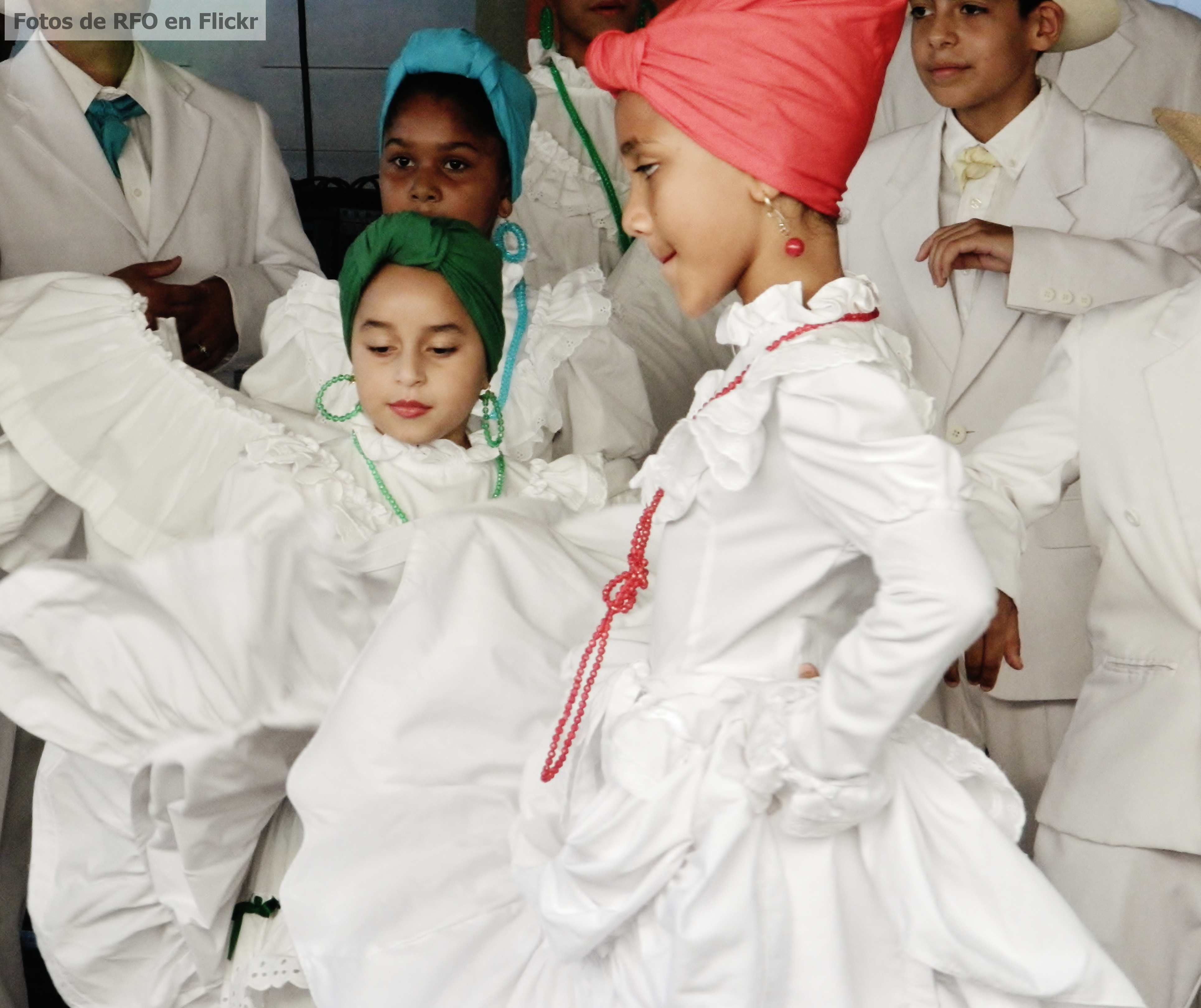
Bomba, Pedagogy of Empowerment
Bomba is not a spectacle staged for passive consumption, rather a community ceremony grounded in collective praxis. Bomba facilitates an embodied exchange in which all present are implicated as participants rather than observers. Augusto Boal once described Theater of the Oppressed in similar terms. He drew a genealogical trajectory beginning with Greek theater, in which a pacified audience was disempowered, straight through to the practice of Theater of the Oppressed, which creates “spect-actors” who are actively implicated in solving conflicts and exercising agency. Boal called Theater of the Oppressed the “rehearsal for the revolution” (Boal 1979). Bomba is our unique Boricua cultural form with its own genealogy, which echoes this potential. It traces its roots back to West African Griots who came to the island in chains and Taíno natives who were dispossessed and also enslaved by colonialism. This neo-griot/areyto praxis is our culturally appropriate rehearsal for revolution, our own unique space of agency and liberation.
When you enter un batey Boricua as a dancer, your community supports you in call-and-response singing. Your body is invited to take space at the center of a collective ceremony. Your movements are transformed into thundering percussion that resonate with your entire community in sync, in unison. Bomba is an empowerment praxis. In the liminal space of a Bomba batey, your body feels its own power reflected back by the whole of your community. Once you experience this, empowerment moves from abstract ideas to embodied understanding. Bomba teaches you how to be powerful before you have to go out into the world and stand up to your Mayoral. El Mayoral, or the overseer, can be plantation chains, colonial abuse, gendered violence or xenophobia. Whatever oppresses you, Bomba teaches you how to rehearse freedom before you have to enact it.
You could call Bomba an epistemology—a way of knowing.
You could call Bomba a pedagogy—a way of teaching. You could call Bomba an ontology—a way of being.
We call Bomba life.13
Before the Super Bowl, There Was “El Choli”
Bad Bunny naming his residency No Me Quiero Ir de Aquí — “I don’t want to leave here” — wasn’t just marketing speak. It was a cultural assertion of roots.
He didn’t go straight to the Super Bowl with a Latin Trap or Reggaetón set list plucked from global charts. He spent a summer at home in Puerto Rico, surrounded by his people, rhythms, place, and history. That residency was not just a concert series — it was a cultural rehearsal. People came from across the diaspora. The stage evoked Puerto Rico’s landscapes. The shows were grounded in local culture first, global spectacle second.
Right there, in the context of that residency — before the Super Bowl ever happened — Julito Gastón’s moment searching for the barriles pointed to something deeper:
Before we can do anything, we have to find Bomba first.
Before we can sing in Spanish on a world stage.
Before we can claim pride and power and visibility.
Before we can rehearse our concept of community in front of millions.
We have to find the place where the drum lives.
There was no Bomba on the Super Bowl stage. Benito chose to represent our traditional music through the pandero and the cuatro. These instruments travel better and speak across spaces but Bomba was not absent. Derivatives of Bomba origin, rootedness, and cultural memory were implicit in the choices made — singing in Spanish, centering Puerto Rican musical forms, bringing salsa, plena, and jíbaro aesthetics to millions.
In the 19th century Bomba was outlawed in fear of its potential role in fomenting slave rebellions. Yet Bomba musical signatures appear in the most elite compositions of Danza and in the rhythmic guitar riffs of our popular Musica Jíbara of this prohibition era. Black Puerto Rican musicians embedded Bomba rhythms in these more acceptable genres and hid them using a strategy Dr. Angel “Chuco” Quintero-Rivera calls the “camouflaged drum.”14 Bomba was indeed on stage at Benito bowl, hidden in plain sight through the timeless Puerto Rican tradition of camouflaging our Bomba drum, el Barril.
Benito walked confidently onto a global stage embodying the Bomba roots that nourished his stem, and his blooming body of work. But as he will readily admit, the Super Bowl moment doesn’t belong to Bad Bunny, it was a collective brown moment.
Too often political scientists, pundits, and even social movement leaders ignore the power of culture. But as Jeff Chang argues, culture acts as a kind of dress rehearsal for political change; it prepares the public discourse for policy shifts to manifest. In the 1960s, Nina Simone’s music gave a raw penetrating voice to the early civil rights struggle. She sang pain, pride, and resistance into existence before mass marches and sit-ins filled the streets. Sam Cooke followed with anthems like “A Change Gone Come,” that birthed hope in the movement. Curtis Mayfield and James Brown then carried this forward into the Black Power era, providing a soundtrack for self-determination and people power. Meanwhile, antiwar protests in the late 1960s were incubated and amplified in cultural containers of folk music and counterculture like Woodstock. Joan Baez, Phil Ochs and Bob Dylan’s protest music trained a generation to imagine and demand change, preparing the emotional and moral landscape for political action.
At the turn of this century, it is the Latino community in the crosshairs of empire. ICE leads raids on brown communities to detain and deport disproportionately brown people. CBP and Border Patrol hunts along the US/Mexico border. DHS oversees it all and the Courts and ICE officers systematically deny relief. A change gone come for us too, I am convinced of it, and Benito Bowl may be just the beginning.
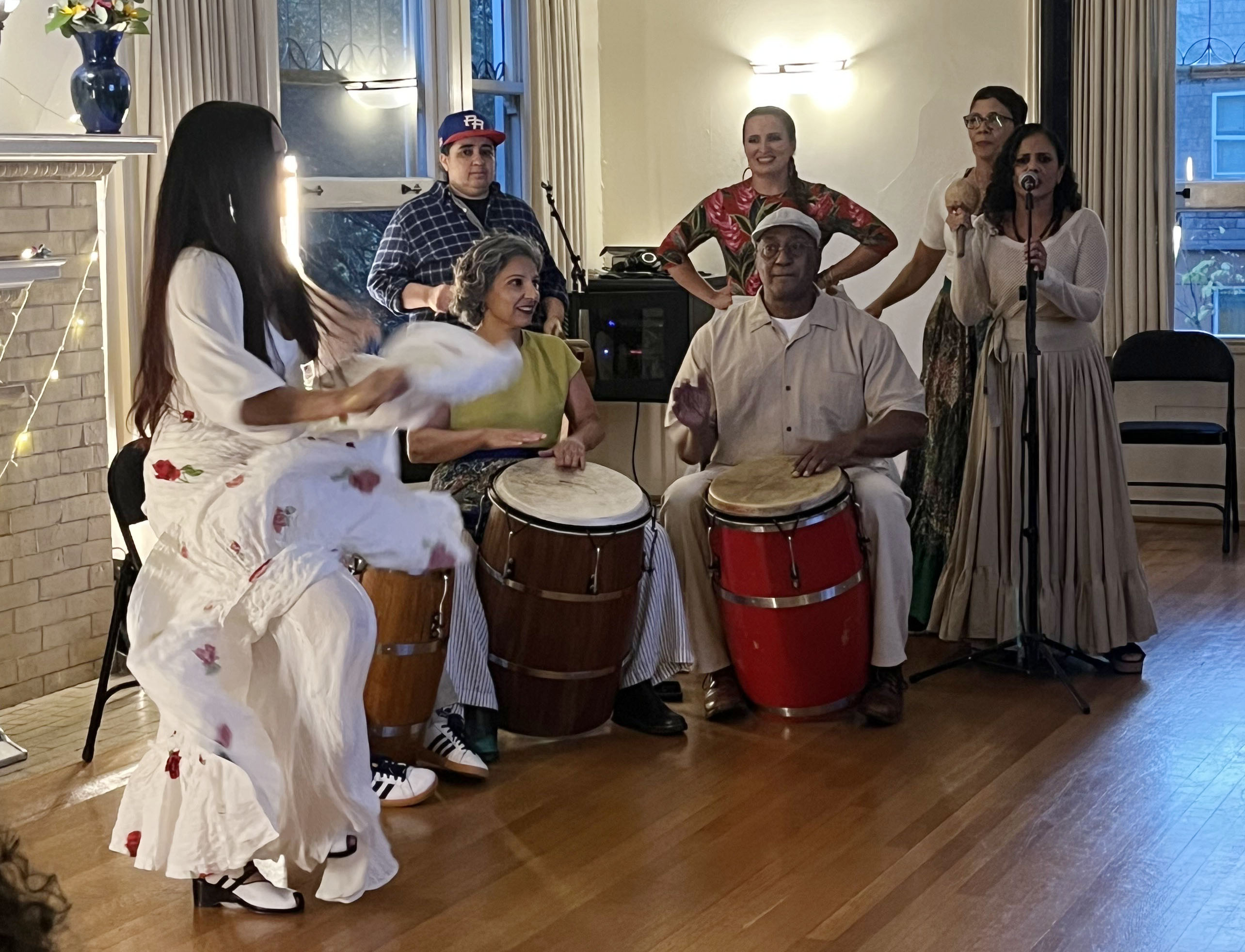
In Bomba circles, the dancer leads and the drum responds. Power is negotiated in real time. The dancer moves. The drum learns. The circle listens. That’s not just music — that’s practice in collective agency.
That’s why we saw Bomba in the protests on the island of Vieques after U.S. Navy munitions killed David Sanes Rodríguez in 1999.
That’s why it was central after Hurricane María left 2,975 Puerto Ricans dead and led to an island-wide blackout that lasted nearly 11 months.
That’s why it showed up in the Ricky Renuncia mobilizations in 2019 that led to the resignation of a corrupt governor.
That’s why, in the Bay Area and across the diaspora, Bomba spaces hold community and are often the central node for organizing around political issues of Puerto Rican solidarity.
Before you claim a stage — local, global, ancestral —
you have to find the drum.
You have to find the place where the circle waits.
Once you find that — once you feel the beat respond to your movement —
you know where your power comes from.
This summer a sonic cultural wave of Boricua power flooded El Choli and through live-streaming it reached shores across the entire globe. Even without the physical presence of barriles playing overt Bomba rhythms, we felt that same ancestral power on stage at Benito Bowl. That wave came to reverberate across the full Americas, across all the nations and cultures Benito made it a point to name and bless on that stage. That power has a protocol.
We find the drum.
We find each other.
And then, we move — together.
Brown Power!

Pablo Eduardo Paredes Burgos is a Ph.D. student in Theater, Dance, and Performance Studies at UC Berkeley. Born in the Bronx and raised between Puerto Rico, Ecuador, and New York, he is a Bomba practitioner, poet, and cultural worker grounded in Caribbean roots traditions. Following five years in the U.S. Navy, he became a conscientious objector and a community organizer, co-founding BAY-Peace and 67 Sueños, two Bay Area youth empowerment collectives. A Mellon Mays Fellow and graduate of UC Berkeley’s Ethnic Studies program, Paredes’ research explores the ways Bomba practices in the Puerto Rican diaspora of California enact identity, healing, and resistance.
Notes
- Scholar Marie T. Mora and colleagues examine Puerto Rico’s prolonged socioeconomic downturn—triggered by the expiration of tax incentives and deepening fiscal crisis—and the resulting mass out‑migration that began in the early 2000s and continued through the post‑María period. Their analysis situates this extended era of stagnation, demographic loss, and economic contraction within what many describe as a “lost decade” of crisis and transformation, during which Puerto Ricans relocated in large numbers to the U.S. mainland, shaping diasporic anxieties about the island’s future.
↩︎ - The term batey originally referred to the central plaza in Taíno communities, where rituals, meetings, and the ceremonial ball game took place (Arrom 1965; Rouse 1992). Today, in Bomba communities, batey is used for the performance space where dancers, drummers, and participants gather, keeping alive the idea of a communal, ceremonial gathering place (Bilby 1998; Morales 2004).
↩︎ - Dr. Jade Power-Sotomayor, Performance Scholar out of UC San Diego, and Dr. Barbara Abadia Rexach, who teaches at SF State and was the original intended speaker for this series, are phenomenal Bomba scholars in California and among the leading experts worldwide. These scholars join a powerful group of women practitioners who have largely led the Bomba revival since the late 1990’s.
↩︎ - Correspondence associated with the Afro-Puerto Rican corsair Miguel Enríquez points to already established Afro-Caribbean musical and communal practices in the capital city of San Juan and the use of barrel drums at these events (Campos 2004).
↩︎ - The term jíbaro is used here broadly to describe the dispersed rural population. These were peasants, small farmers, free people of mixed ancestry, and maroon communities, who made up the majority of Puerto Rico’s inhabitants for much of the early colonial period. Historical demographic studies show that before the rise of the plantation economy, most people lived scattered across the interior highlands practicing subsistence agriculture rather than plantation labor (Scarano 1989; Curtis and Scarano 2012).
↩︎ - Griots were and are hereditary oral historians, storytellers, and musicians in West Africa, serving as keepers of history, genealogies, and cultural memory while also performing music for ceremonies and social events (Hale 1998; Charry 2000). Like the Taíno batey, the griot’s performance space is both social and ceremonial, a site where community, history, and ritual intersect. Like the indigenous Areyto in the Americas, Griots provided an alternative knowledge tradition to western logocentric systems.
↩︎ - Areytos were Taíno ceremonial songs and dances performed to honor ancestors, recount history, and mark social or spiritual events. As Scolieri notes, they combined music, movement, and storytelling, making them both performative and communal experiences (Scolieri 2016). In contemporary practice, elements of areyto resonate in Puerto Rican Afro-Indigenous traditions like Bomba, where music and dance continue to serve as spaces for memory, community, and ritual.
↩︎ - Toneleros (from tonel, barrel) were Iberian coopers. These were artisan barrel makers whose craft was essential to early modern Spanish Atlantic trade, particularly for transporting wine, oil, and other goods. These cooperage technologies circulated widely through Andalucía and the Canary Islands and accompanied rural migrants to the Caribbean, where barrel-making knowledge could be adapted to local uses, including the wooden barrel drums later recycled and refurbished by artisans for the practice of Bomba (Wheat 2018; Macleod 1984; “Tonelería” IAPH).
↩︎ - Bombazos refers to community‑centered gatherings and performances of Puerto Rican bomba that re-emerged in the late 20th century as part of the genre’s resurgence, especially when groups like Emmanuelli‑Náter brought the music back into the streets so people could participate directly rather than only seeing Bomba on formal stages (Abadía‑Rexach 2019). These bombazos helped expand bomba beyond its traditional family circles and formal folkloric presentations into open, participatory cultural events that keep the music, dance, and communal spirit alive. In the earliest documentation of Bomba before colonial prohibitions the bombazo style seems to have been popular.
↩︎ - One of the earliest written descriptions of a proto-bombazo appears in the account of French naturalist André-Pierre Ledru, who visited Puerto Rico in 1797 as part of Captain Nicolas Baudin’s scientific expedition. Ledru describes an evening gathering hosted by Don Benito at his hacienda in Loíza, where enslaved and free Afro-Puerto Ricans gathered for drumming, dancing, and communal celebration—an encounter widely interpreted as an early documented Bomba gathering.
↩︎ - Historian Jalil Sued Badillo documents the presence of Afro-Puerto Rican musical gatherings, including Bomba, within the social worlds of enslaved communities and in connection with acts of resistance and rebellion throughout the nineteenth century, when plantation slavery reached its peak in Puerto Rico (Sued Badillo 1979; 1986).
↩︎ - The 1868 uprising known as El Grito de Lares brought together enslaved people, free Afro-Puerto Ricans, artisans, and rural peasants in what historians describe as both an abolitionist revolt and an independence movement. Contemporary accounts and later historical interpretations note the presence of Afro-Puerto Rican musical traditions, including Bomba, within popular mobilization and rural political culture surrounding the rebellion (Quintero Rivera 1998; Sued Badillo 1986).
↩︎ - In the tradition of Bomba Cangrejera, the Familia Cepeda—one of the most influential lineages in Afro‑Puerto Rican Bomba—frames the art form as a way of life. Practitioners within the family describe Bomba not merely as music or dance but as an expression of identity and continuity, encapsulated in the phrase “La Bomba es vida”, which circulates in community workshops and bombazos taught and led by Cepeda elders and teachers.
↩︎ - Quintero Rivera, Ángel G. “The Camouflaged Drum: Melodization of Rhythms and Maroonage Ethnicity in Caribbean Peasant Music.” Music and Black Ethnicity: The Caribbean and South America, edited by Gerard H. Béhague, Transaction Publishers, 1994, pp. 47–64. ↩︎
References
Abadía‑Rexach, Bárbara I. “The New Puerto Rican Bomba Movement.” African and Black Diaspora: An International Journal, vol. 9, no. 1, Jan. 2016, pp. 32–43, https://doi.org/10.1080/17528631.2015.1055653
Arrom, José Juan. Mitología y Ceremonias Taínas. Editorial Universitaria, 1965.
Bilby, Kenneth M. “The Caribbean as a Musical Region.” Caribbean Contours, edited by Sidney W. Mintz and Sally Price, Johns Hopkins University Press, 1985, pp. 181–218.
Boal, Augusto. Theatre of the Oppressed. Translated by Charles A. and Maria‑Odilia Leal McBride, Theatre Communications Group, 1979.
Campos, Ángel López Cantos. Cartas de Miguel Enríquez: Música y Sociedad en el Puerto Rico del Siglo XVII. Instituto de Cultura Puertorriqueña, 2004.
Chang, Jeff. “Culture Before Politics.” The American Prospect, 6 Dec. 2010, The American Prospect, https://prospect.org/culture/culture-politics/. Accessed 20 Feb. 2026.
Curtis, Edward, and Francisco A. Scarano. “Puerto Rico’s Population Padrones, 1779–1802.” Latin American Research Review, vol. 46, no. 2, 2012, pp. 200–213.
“Tonelería.” Pacto — Paisajes Culturales y Conocimientos Tradicionales, IAPH (Instituto Andaluz del Patrimonio Histórico), https://www.iaph.es/paisajes-culturales-conocimientos-tradicionales-cambio-climatico/atlas/toneleria/. Accessed 20 Feb. 2026.
Hale, Thomas A. Griots and West African Oral Histories. Indiana University Press, 1998.
Ledru, André‑Pierre. Viaje a la isla de Puerto Rico en el año 1797: ejecutado por una comisión de sabios franceses, de orden de su gobierno bajo la dirección del capitán Nicolás Baudín, con objeto de hacer indagaciones y colecciones relativas a la historia natural. Translated by Julio L. de Vizcarrondo, 2nd ed., Ediciones del Instituto de Literatura Puertorriqueña, Universidad de Puerto Rico, 1957.
Macleod, Murdo J. “Spain and America: The Atlantic Trade, 1492–1720.” In The Cambridge History of Latin America, edited by Leslie Bethell, vol. 1, Cambridge University Press, 1984, pp. 341–388.
Mora, Marie T., Alberto Dávila, and Havidán Rodríguez. Population, Migration, and Socioeconomic Outcomes among Island and Mainland Puerto Ricans: La Crisis Boricua. Lexington Books, 2018.
Morales, Edgardo. Batey Practices in Contemporary Bomba Communities. Editorial Huracán, 2004.
Quintero Rivera, Ángel G. La Música Afro‑Puertorriqueña en el Siglo XIX. Instituto de Cultura Puertorriqueña, 1998.
Rouse, Irving. The Taínos: Rise and Decline of the People Who Greeted Columbus. Yale University Press, 1992.
Scolieri, Paul A. “On the Areíto. Discovering Dance in the New World.” Dancing the New World, University of Texas Press, 2021, pp. 24–43.
Sued Badillo, Jalil. La Conspiración de Esclavos de 1848 en Puerto Rico. Ediciones Huracán, 1979.
Sued Badillo, Jalil. Puerto Rico Negro. Editorial Cultural, 1986.
Wheat, David. Atlantic Africa and the Spanish Caribbean, 1570–1640. Omohundro Institute of Early American History and Culture and University of North Carolina Press, 2018.


Leave a Reply