
By Amber Galvano
Another quiet and clerical week was nearly underway for secretaries Temis and Martina when the doorbell rang, two hours prior to the start of the usual workday. Visitors at the Instituto de Lingüística in Buenos Aires were seemingly infrequent, but this guest was expected. Introducing myself as a traveling PhD student from Berkeley, I had arranged to use their library to run a phonetics experiment – another atypical occurrence in this context. This morning was the first of many scheduled appointments.
I arrived with research assistant Romeo Damico, a local undergrad, promptly at 11, and we exchanged polite introductions with the secretaries and a few doctoral researchers dissertating in the neighboring rooms. We then retreated to the institute’s quaint library, filled with a pleasing collection of historical texts in Hispanic linguistics, and set up shop for the day. This was still our first day meeting each other in person as well, so we took our time settling into the new environment and adjusting to working with one another. I had just finished my second year in the Linguistics graduate program at UC Berkeley, and, with the support of CLAS Tinker Grant funding, this was not only my first time doing “fieldwork,” but also my first travel south of Florida. Damico had just finished his first year of college, already with an established interest in all things philosophical – although initially he seemed a bit unsure what exactly he’d signed up for with me, he was inquisitive and excited to learn about the project.

Our first session together had actually been earlier that day, hosted by Damico’s sister, so we both had a chance to warm up to the flow of the experiment in the comfort of her home. From her apartment I had just taken my first ride on Subte (the Buenos Aires subway system), feeling a mix of satisfaction with the success of the initial session and frazzled by my innumerable tiny Spanish miscalculations, which I expressed to Damico, to his gentle bemusement. After a few fairly successful sessions with participants on my own, I was grateful to have him there to help put the remaining participants further at ease as a first-language Porteño Spanish speaker. The goal was to get each participant talking, about anything, really, especially if it would get them impassioned and focused more on the topic at hand than on how they were speaking. I would be looking at how they produced their “st” sounds in this informal setting, interested in how closely they might resemble Andalusian speakers (of southern Spain; e.g., Ruch and Peters 2016) in not only aspirating, but perhaps post-aspirating the “s” sound – think of the word “pasta” produced as patʰa, with a large puff of air after the “t”. (Galvano and Henriksen, 2023)
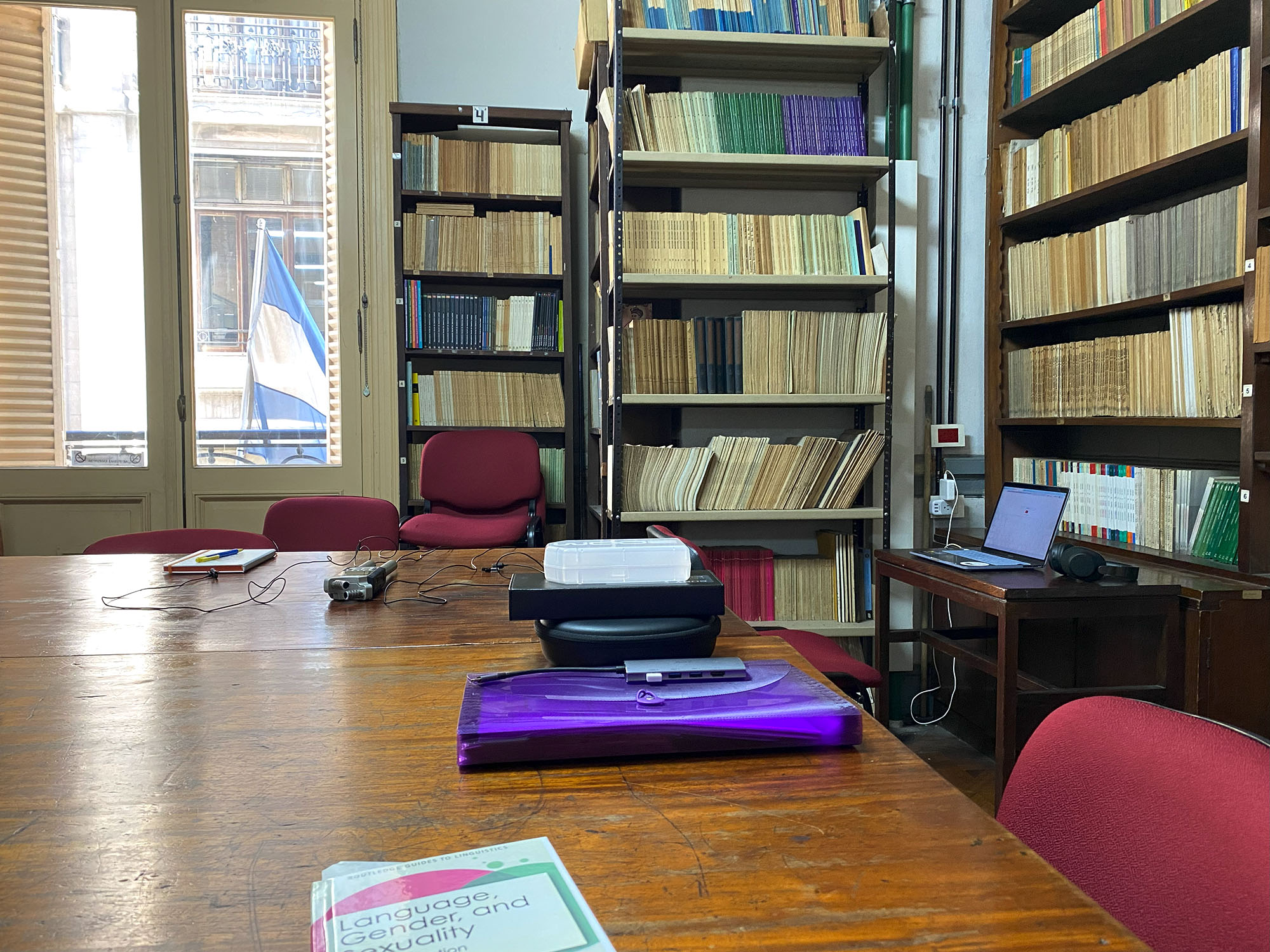
For our first appointment at the institute, I was pleased to meet with a participant who revealed he too was a linguist, pursuing his PhD in syntax. I quickly found I enjoyed sitting in as an observer for the sociolinguistic interviews conducted by Damico, always listening and keeping tabs, nearly as much as conducting them myself. It was encouraging to hear how comfortably the Porteño speakers opened up for casual conversation, as intended, despite the conspicuous Zoom recorder nearby and the somewhat stuffy library setting. This particular interviewer-interviewee pair needed a bit of encouragement to fill up the full 20-minute minimum, so I chimed in towards the end, asking additional questions about the syntactician’s world travels and recent poignant memories – a classic sociolinguistic interview approach.
Then it was on to the perception tasks, which participants tended to take more seriously than intended. That was alright, I thought, best to make space for each person’s reaction to the experiment rather than trying to introduce any bias into their approach, so long as they understood the task at hand. For this portion of the study, I would ask them to listen to stimuli reflecting the various ways other Spanish speakers produce the “st” sounds and inquire about their linguistic and social impressions of this variation. Our first participant strapped on the headphones and wrapped up neatly in 90 minutes, warmly bidding us farewell, and it was onto the next. Well, onto lunch first – Romeo had found a nearby grocery store to snag a quick sandwich – with alfajores for dessert of course.
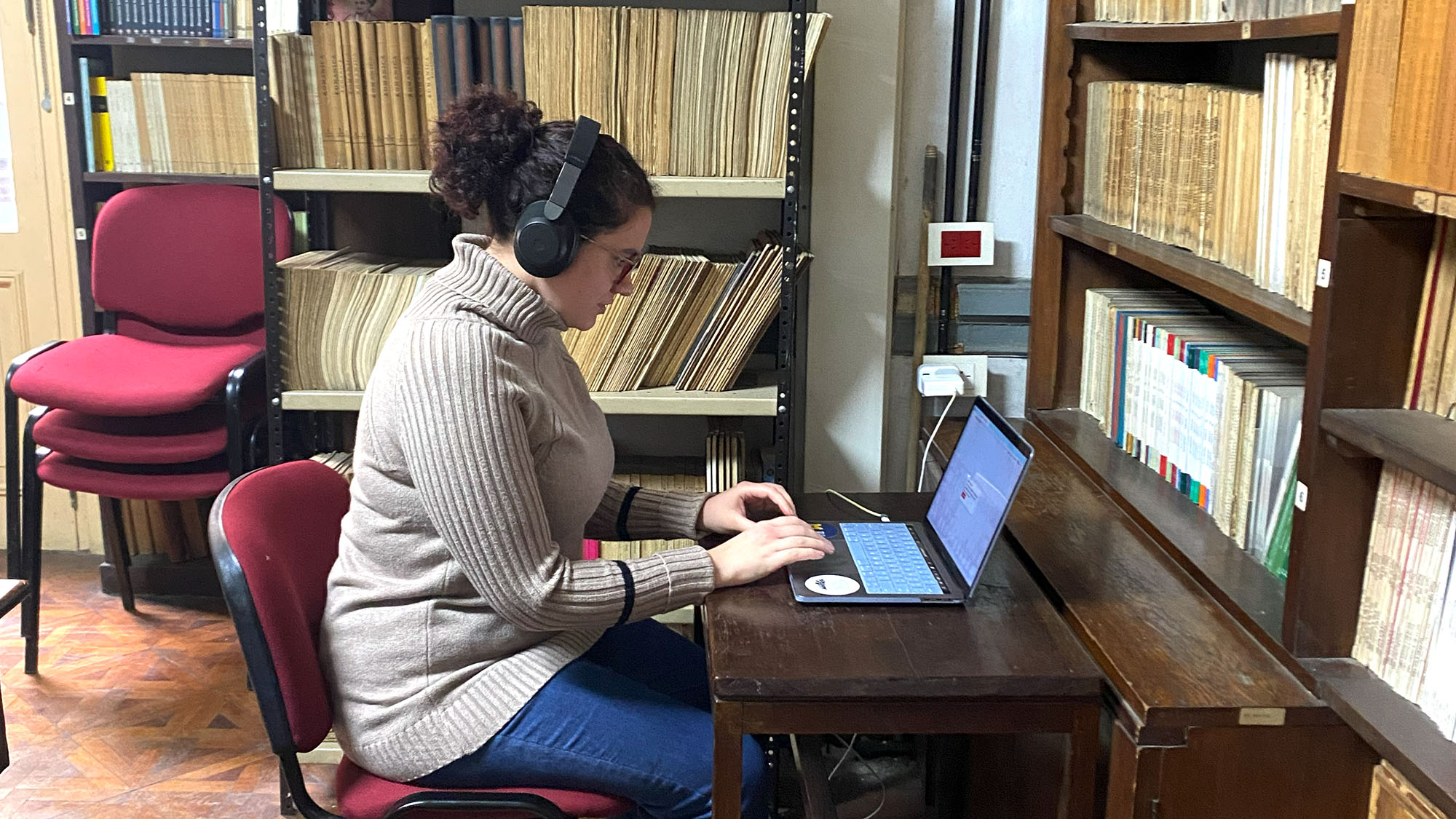
We re-lived slightly different versions of this process 3-4 times a day for the following week and eventually settled into our groove – I would greet the doorman on my way out, hop on the Subte at Palermo Station, and greet Romeo and the helpful coordinators at the institute. From these experimental sessions, I was able to meet and chat with 23 individuals, from 21 to an unexpected 64 years of age, who kindly shared their voices and impressions with me, offering more than enough food for thought to fuel a sociophonetic study and more clearly shape my future research. En route, I befriended a handful of Porteño linguistic students, gained the experience of both mentoring an undergraduate and being flexible in collecting data as part of a collaborative duo, and became a familiar face to the professors and administrators who graciously assisted me in carrying out this pilot work.

Amber Galvano (she/they) is a third-year PhD student in Linguistics at UC Berkeley, whose research is primarily in sociophonetics and phonology. They are broadly interested in how groups understudied in the literature (such as the Andalusians of southern Spain and the Lobi and Tonko Limba of West Africa) and often-relegated aspects of social identity (sexuality, gender normativity) can inform approaches to sociophonetic theories and methodologies, the role of variation in formal phonology, and how the interfaces between phonetics and other subfields are conceptualized. She is also interested in developing and comparing automatic phonetic methods, particularly for capturing fricative place and vowels as dynamic events.
References
Galvano, A., & Henriksen, N. (2023). Cross-dialectal comparison of /st/ clusters in Spanish: Implications for sound change. In R. Skarnitzl & J. Volín (Eds.), Proceedings of the 20th International Congress of Phonetic Sciences (pp. 3051-3055). Guarant International.
https://www.icphs2023.org/programme/proceedings/
Ruch, H., & Peters, S. (2016). On the origin of post-aspirated stops: Production and perception of/s/+ voiceless stop sequences in Andalusian Spanish. Laboratory Phonology, 7(1), 1-36.

Leave a Reply