
By Jair Jáuregui Torres
For the past three years, in the midst of the Covid-19 global pandemic, I have been researching the work of the Mexican writer José Juan Tablada (1871-1945). Some of the works I examined included his poems about art, or ekphrastic poems, from his early era; his art criticism of both already established and up-and-coming artists; and, more recently, his chronicles of his international trips, including to Japan in 1900, with a brief stay in San Francisco. With the support of the Tinker Foundation and the Center for Latin American and Caribbean Studies I embarked on the journey to Mexico City, in search of Tablada’s archive.
I had contacted José Luis Martínez González, the director of Biblioteca Rubén Bonifaz Nuño, where Tablada’s graphic archive is preserved in the Instituto de Investigaciones Filológicas at UNAM. Martínez González notified me that this library would close its doors shortly for an administrative summer break, limiting my time in the archive. I decided to only work on the most relevant items to my current research, approximately 12 materials from his 1900 trip.
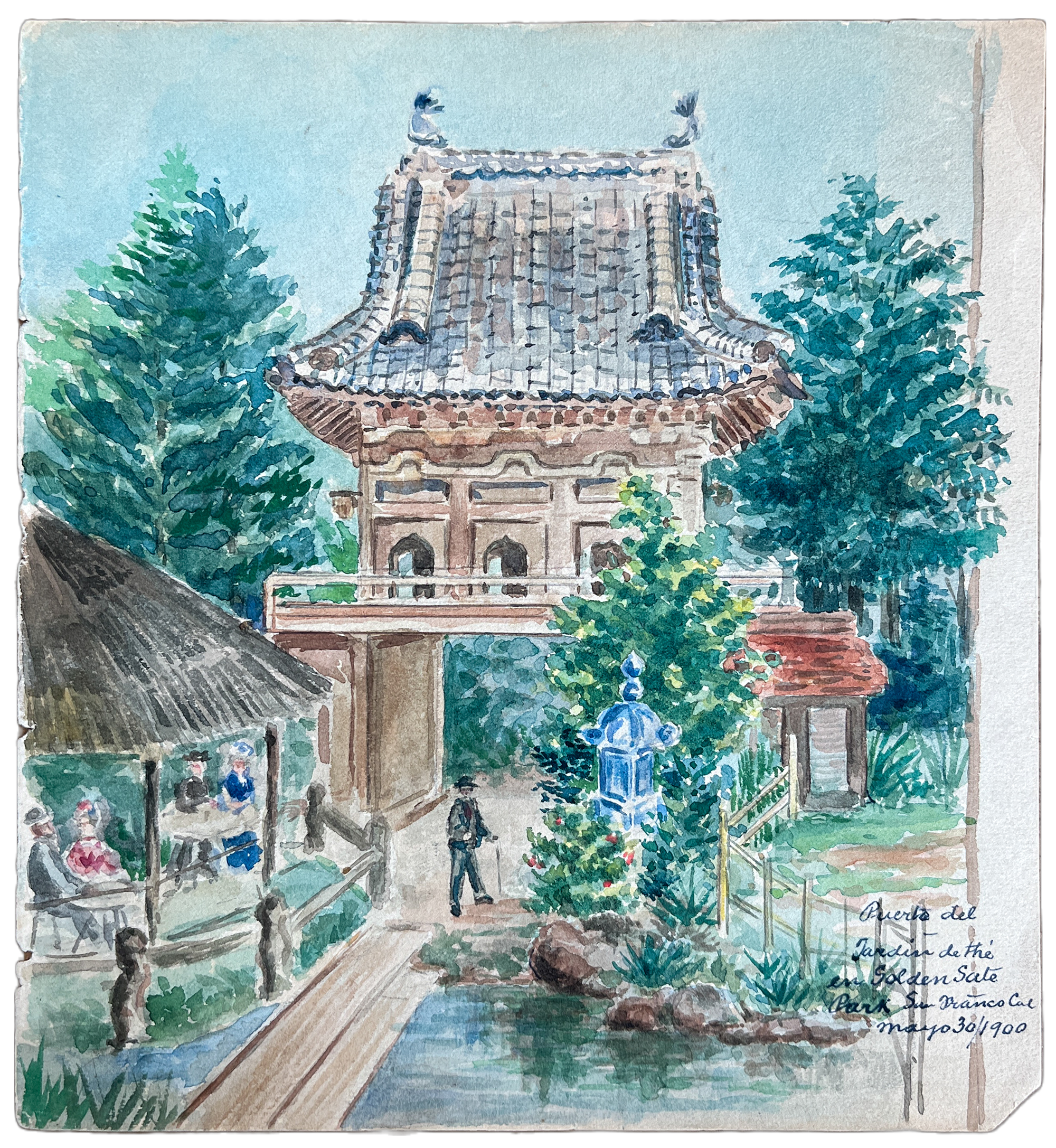
Prior to my visit, I had seen digitized and printed photographs of some of those materials. However, those photographic reproductions, even mine,1 cannot substitute for the sensory experience of seeing them a few inches away and touching them carefully, through a protective barrier. Immediately, I noticed that the true tones of the watercolors were not replicated accurately by many cameras or scanners. I also paid attention to the quality and technique of the brushwork. In his painting of the Japanese tea garden in San Francisco (fig. 1), the trees are made up of different layers and shades of green paint. These layers obviously give volume to the figures, but most importantly, they hint at Tablada’s painting process. Each shade of green does not bleed into the others, suggesting that Tablada let them dry before applying another one, or that he used a higher concentration of color and not much water.
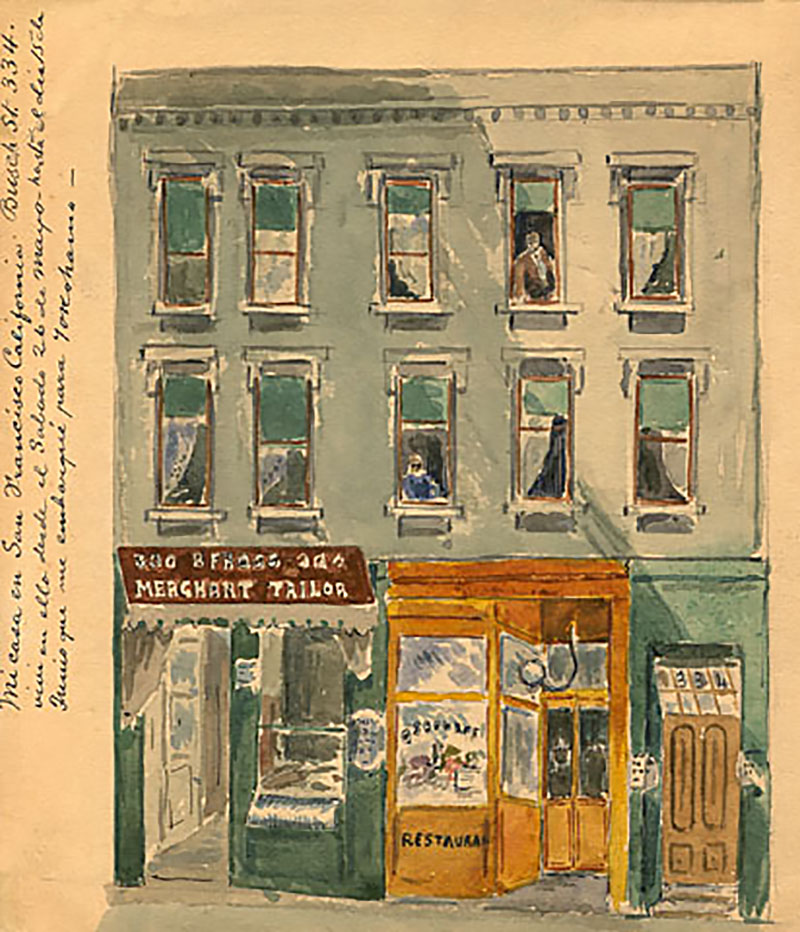
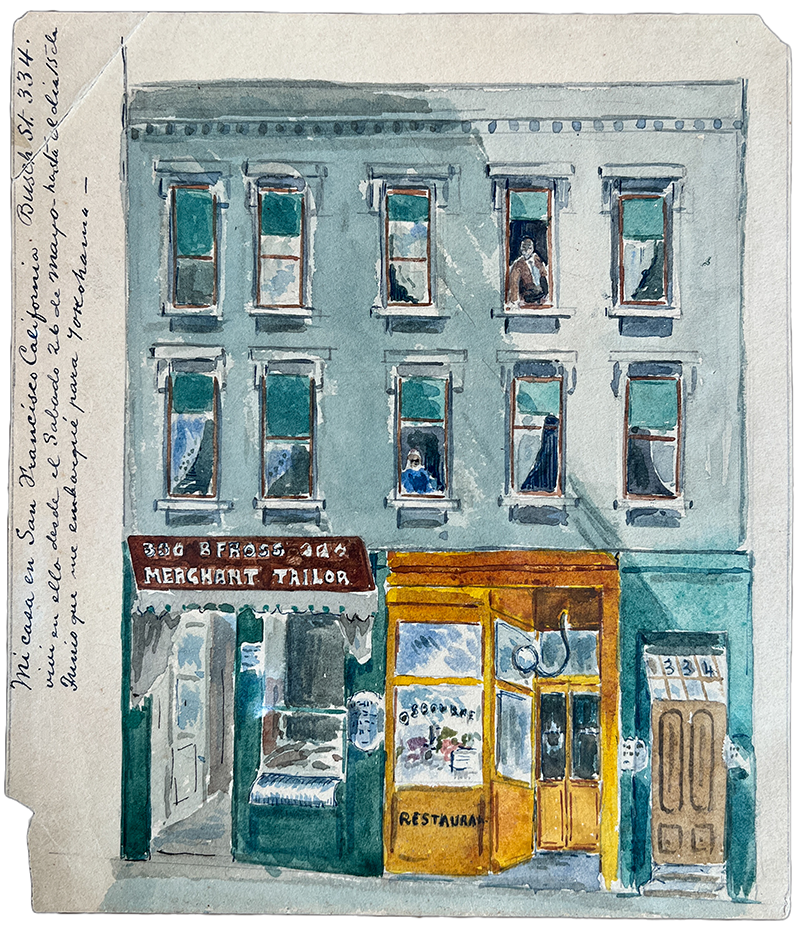
Besides interpreting how Tablada could have painted these images, observing these materials also reveal their own materiality and lifetime. One example is the watercolor depicting his lodging in San Francisco. The photographic reproduction posted on the website appears with a yellowish tone (fig. 2, image on the left), and is accompanied by a note stating that the watercolor contains “Dobleces, roturas y restos de cinta adhesiva (Bends, tears and tape remains).”2 When I looked at the original, I noticed that the color palette is not too saturated, especially the color of the empty space, which in reality is more of a grayish tone (fig. 2, image on the right). Additionally, two of the four corners had unfortunately disappeared. At one point, the right upper corner completely detached and was kept from being lost forever by taping it to the back of the piece. Many factors come into play over the lifetime of these images, including the materials themselves, the environmental and storage conditions, and most importantly, their handling by many people over more than a century. The staff of this library is very aware of their current state of deterioration. As a result, these materials are presented to visitors inside a clear page protector, like those commonly used in a binder. Although photographic reproductions like mine cannot record every single detail, they are another measure to preserve a copy that can last for posterity.
Another observation about my visit to this archive that I must emphasize is that some of these materials still preserve the remnants of erased inscriptions. In various watercolors, written words, perhaps with a pencil, were erased. Although they are now illegible to the naked eye, they are visible by tilting the surface at an angle, and may have left indentations that could be detected if the protector were removed. This act of erasure makes me question if they were removed by Tablada or by someone else, for example, an executor or researchers, and if those annotations were related to the painted image or completely unrelated.
The second stop in my search was the Fondo Reservado of the Biblioteca de México, located in Plaza de la Ciudadela. There I consulted some books that had once belonged to Tablada. On my first visit, I was surprised that not many staff members knew about the treasures preserved inside this library. Some librarians from the general collection thought that I was in search of books about Tablada. After some explanation, they finally redirected me to the Fondo Reservado. Once there, director Elvia Huerta Barrera and librarian Gabriel Huitrón García provided me with a folder recording all of Tablada’s books that were housed there. I confirmed 91 books in total, varying in language and covering topics from philosophy to the visual arts. The books that stand out concern China and Japan, two cultures that had a great impact on Tablada’s literary career, and in the latter case motivating him to embark on his journey in 1900.
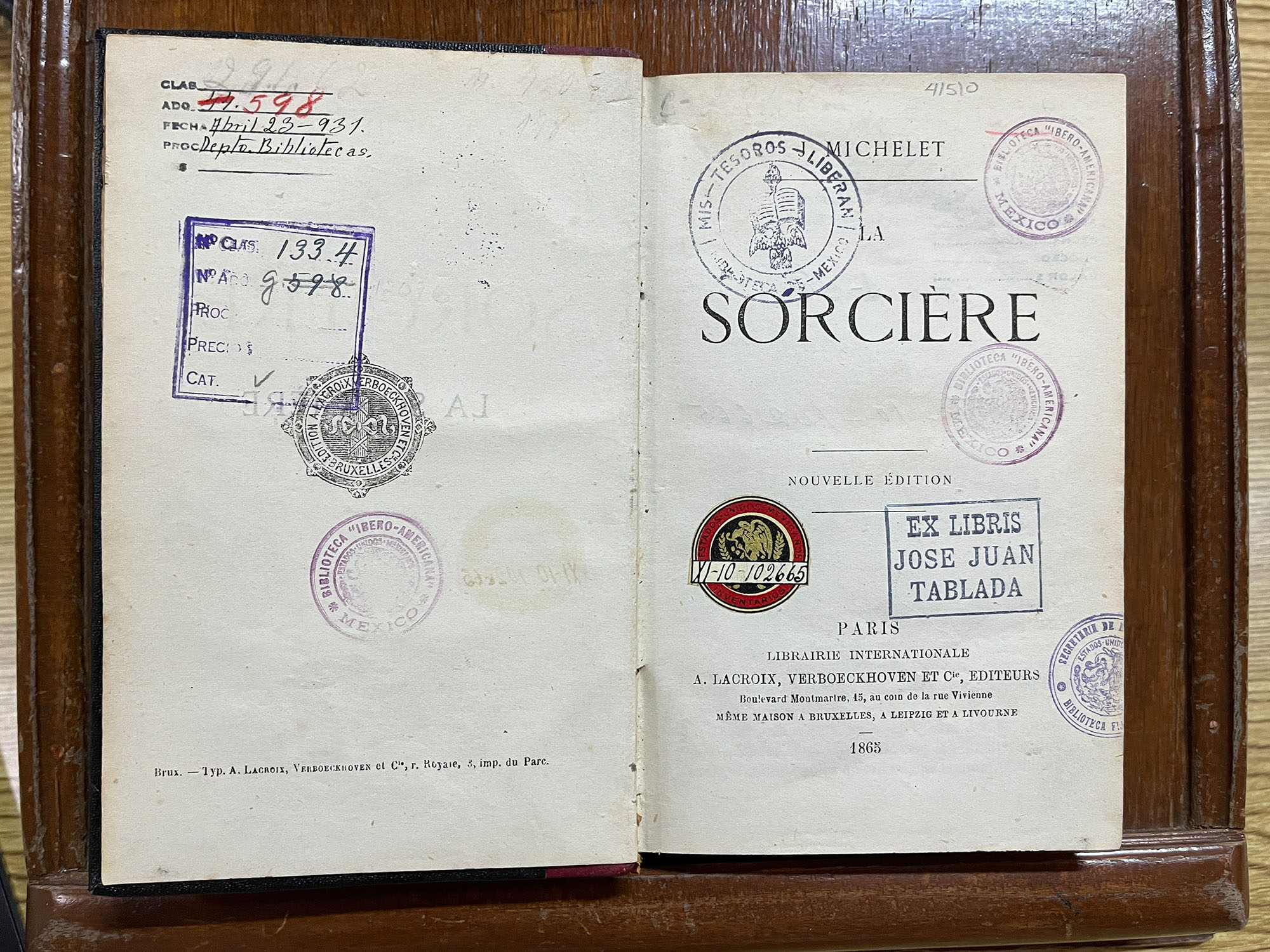
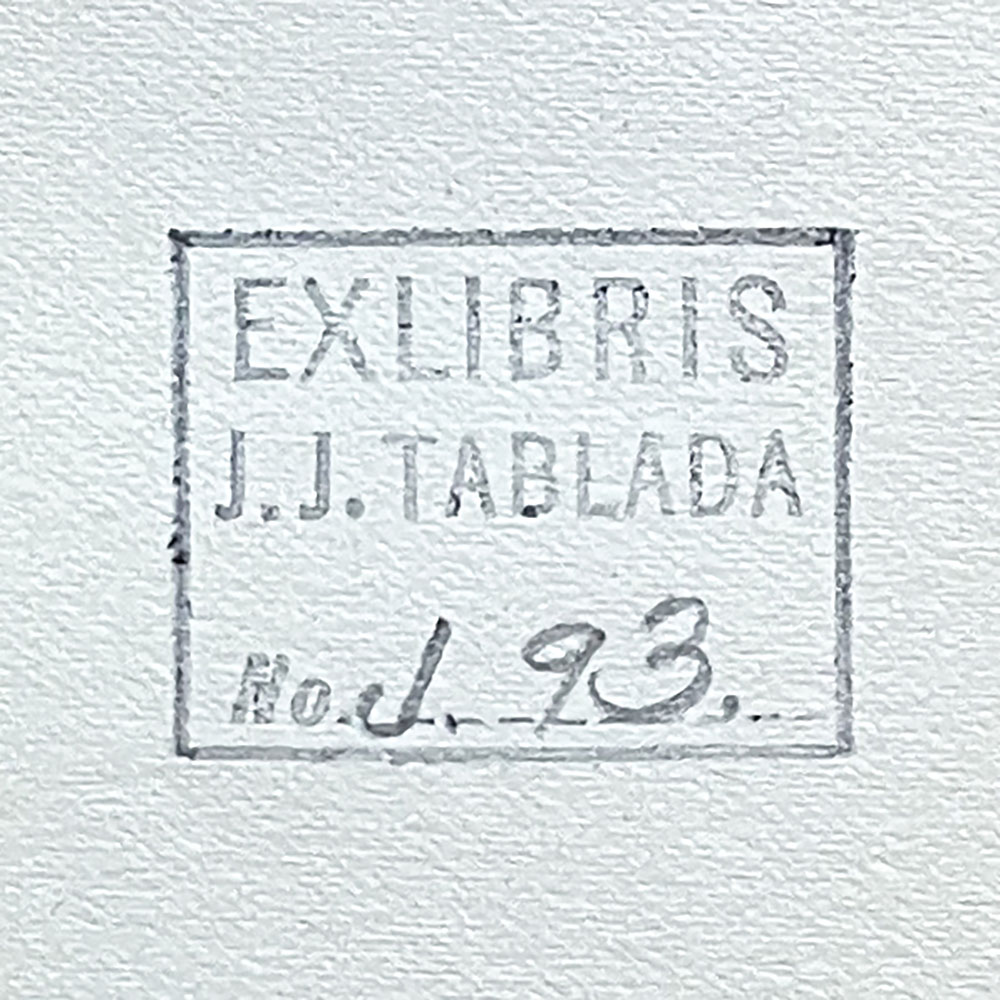
The first two books that I leafed through were by French philosopher Jules de Gaultier. The only signs of Tablada’s ownership were a bibliographic stamp listing “J. J. Tablada” as the provenance and the year “1946,” one year after his death. One variation of the provenance that appeared in other books was “C. Tablada,” which could be Nina Cabrera de Tablada, his second wife. Finally, in J. Michelet’s La sorcière from 1865, I saw the first ex-libris, or decorative label, by Tablada, with a simplified composition made of only words that fulfill the objective of marking the writer’s ownership (fig. 3). Interestingly, his ex-libris is surrounded by the stamps of other institutions that had owned or preserved this book, among them the Biblioteca de México, Biblioteca “Ibero-Americana,” and Secretaría de Educación Pública.
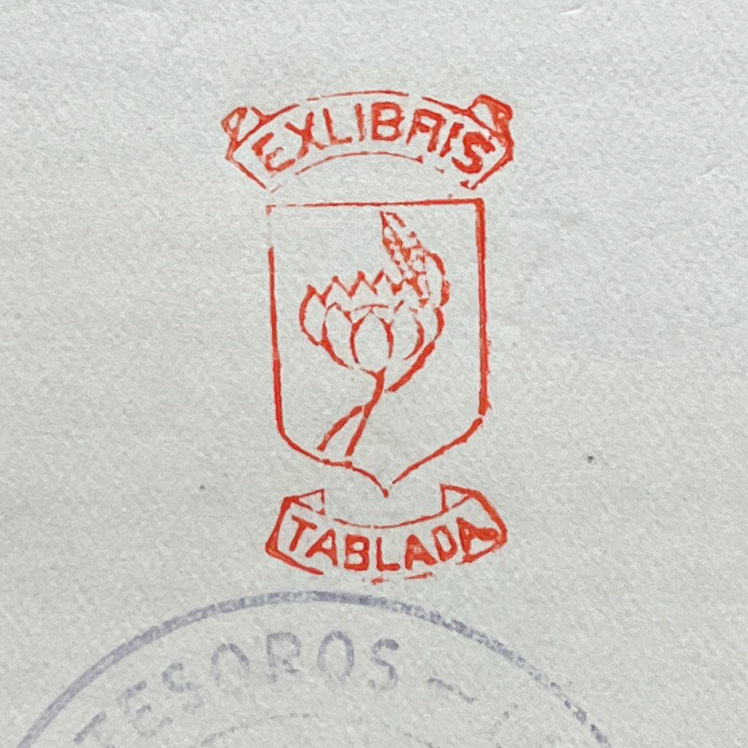
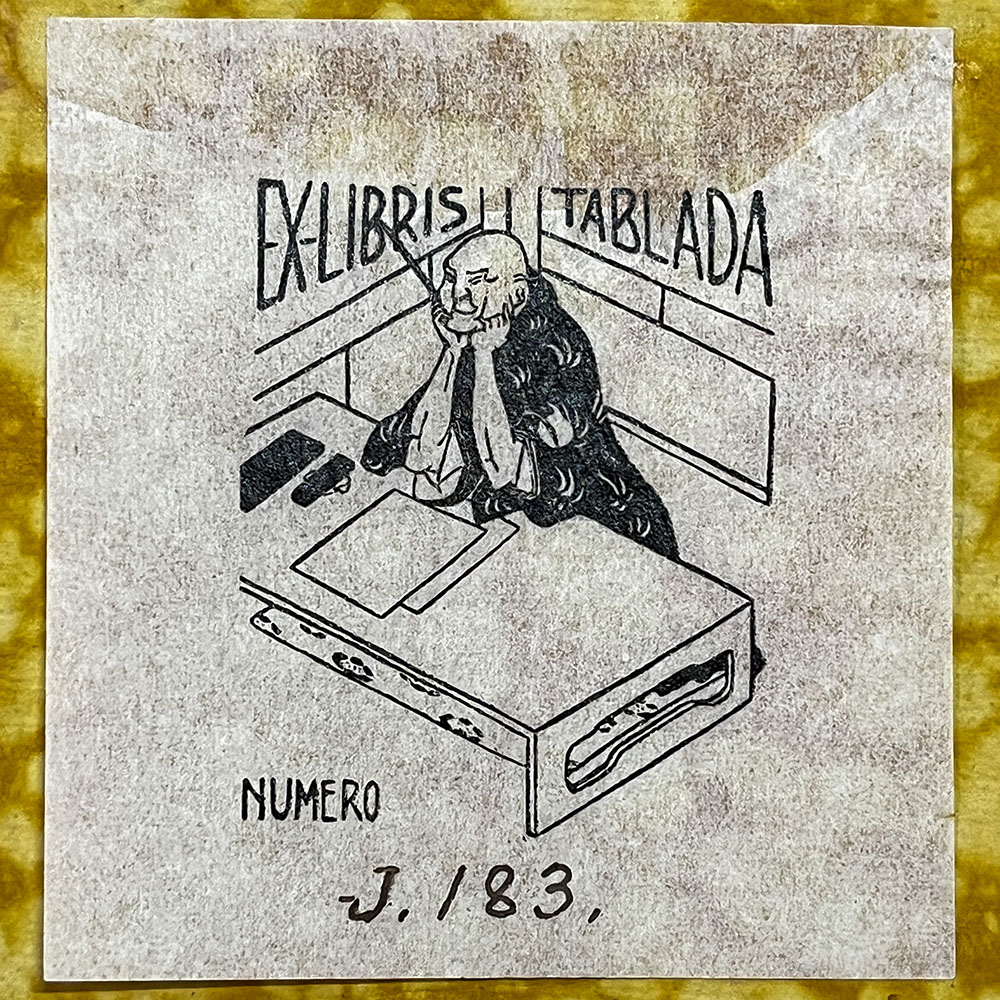
After encountering the first ex-libris, one after another appeared, either in the title page, the beginning of a chapter, or the margins. I found four of them, which many times also numbered the book as “No. J. ____.” They all vary in their size and design, from a simple stamp of black ink, made of only words (see figs. 3 and 4, a), to a stamp of orange ink that depicts a flower, possibly a lotus, surrounded by heraldic elements like a shield shape and scrolls (fig. 4, b). A third ex-libris represents a man dressed in black robes, perhaps a bonze, a Buddhist monk,3 with his head placed on his hands, while his arms rest on the surface of a low table (fig. 4, c). In comparison to the previous ex-libris, this version depicting the bonze was not stamped directly on the pages,instead it was on a square sheet of onionskin that had been glued to the book’s hardcover. This ex-libris was also reserved for books of larger dimensions that were more luxurious in their material quality and content, for example, high quality color reproductions of woodblock prints.
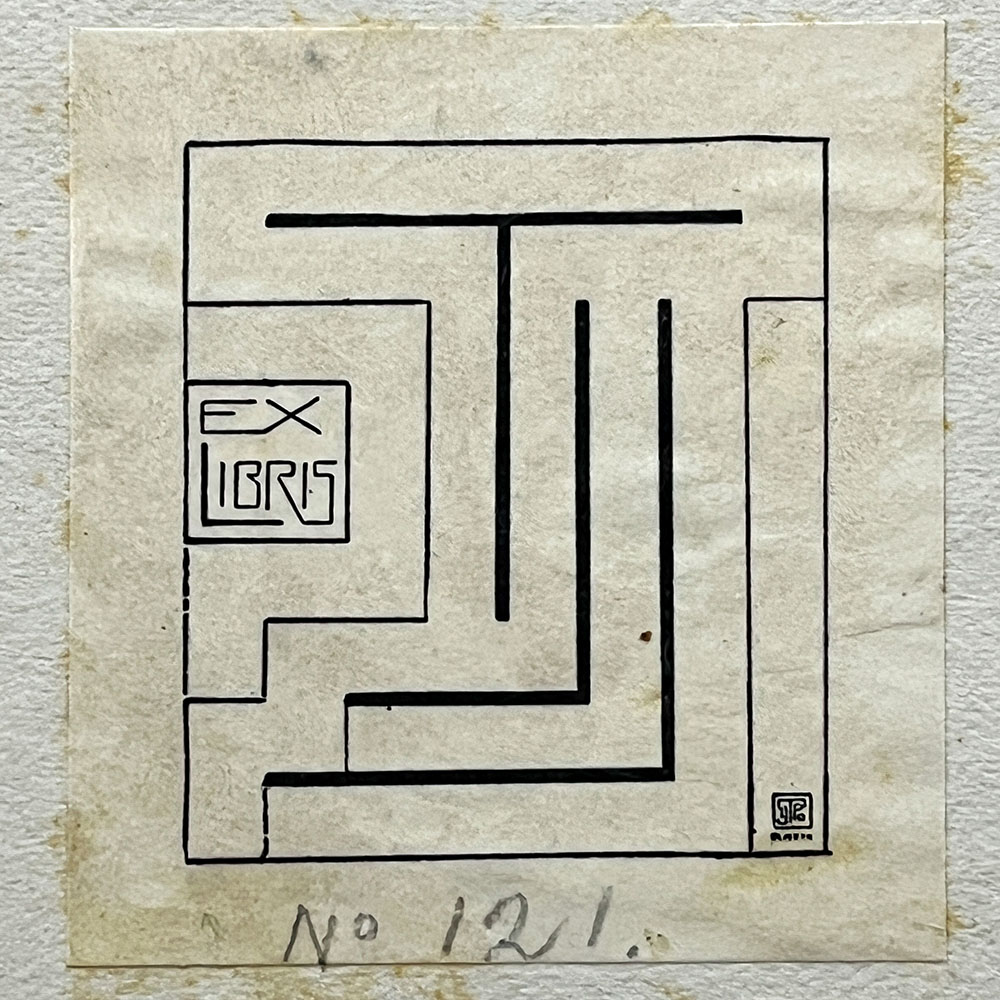
Lastly, I found an ex-libris in a more geometrical form (fig. 4, d). The author’s initials are the most prominent features for their dimension and black saturation. They are stacked on top of one another, forming a staircase. The word “ex-libris” is at a smaller scale and placed on the left side. Similarly to the bonze ex-libris, this fourth version was also stamped on an opaque paper and reserved for books of higher material quality and content. All of these different designs testify Tablada’s need to diversify and personalize his collection, and also reveal his aesthetic sensibilities, from Asiatic motifs to avant-garde forms of design.
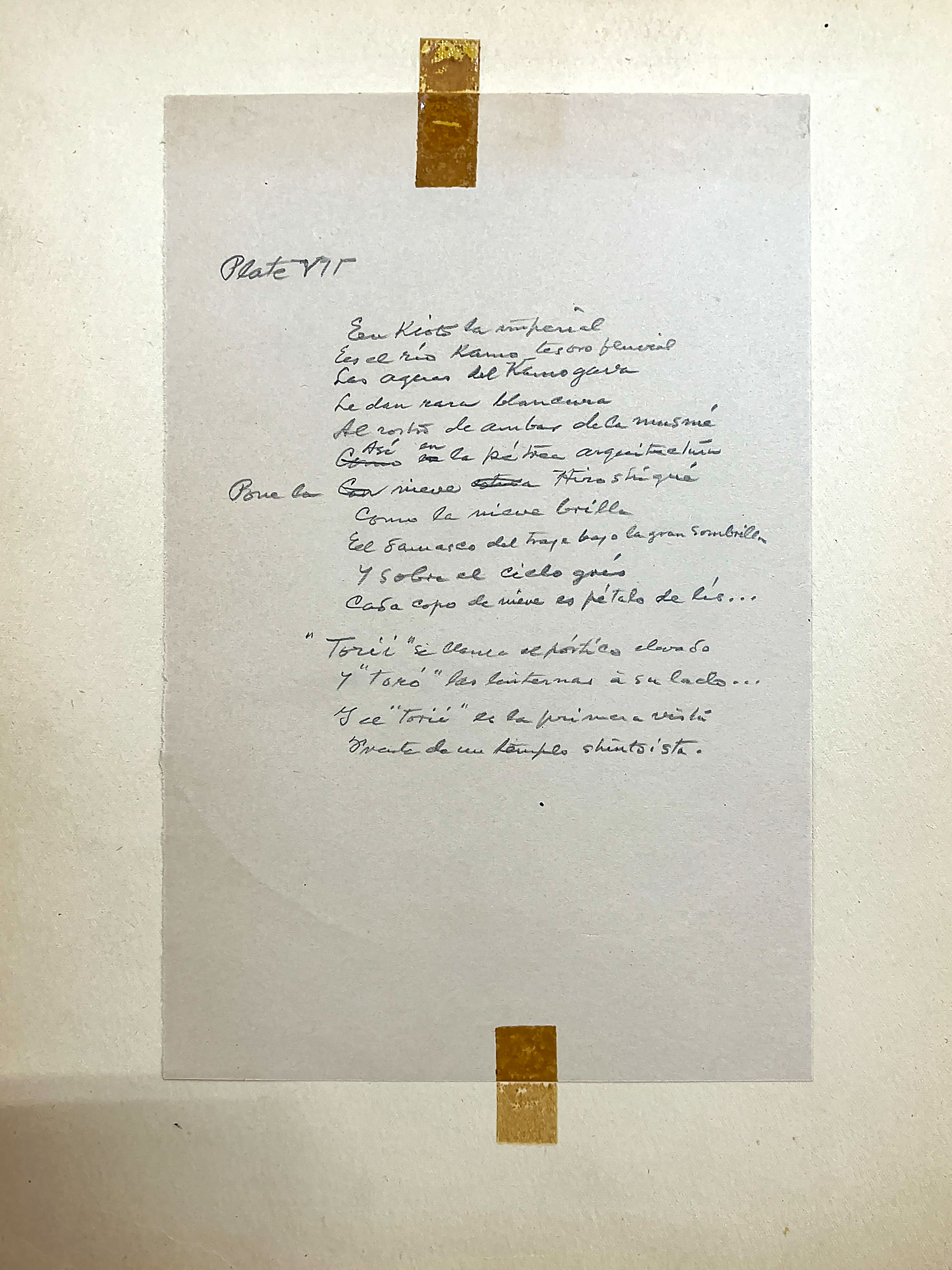
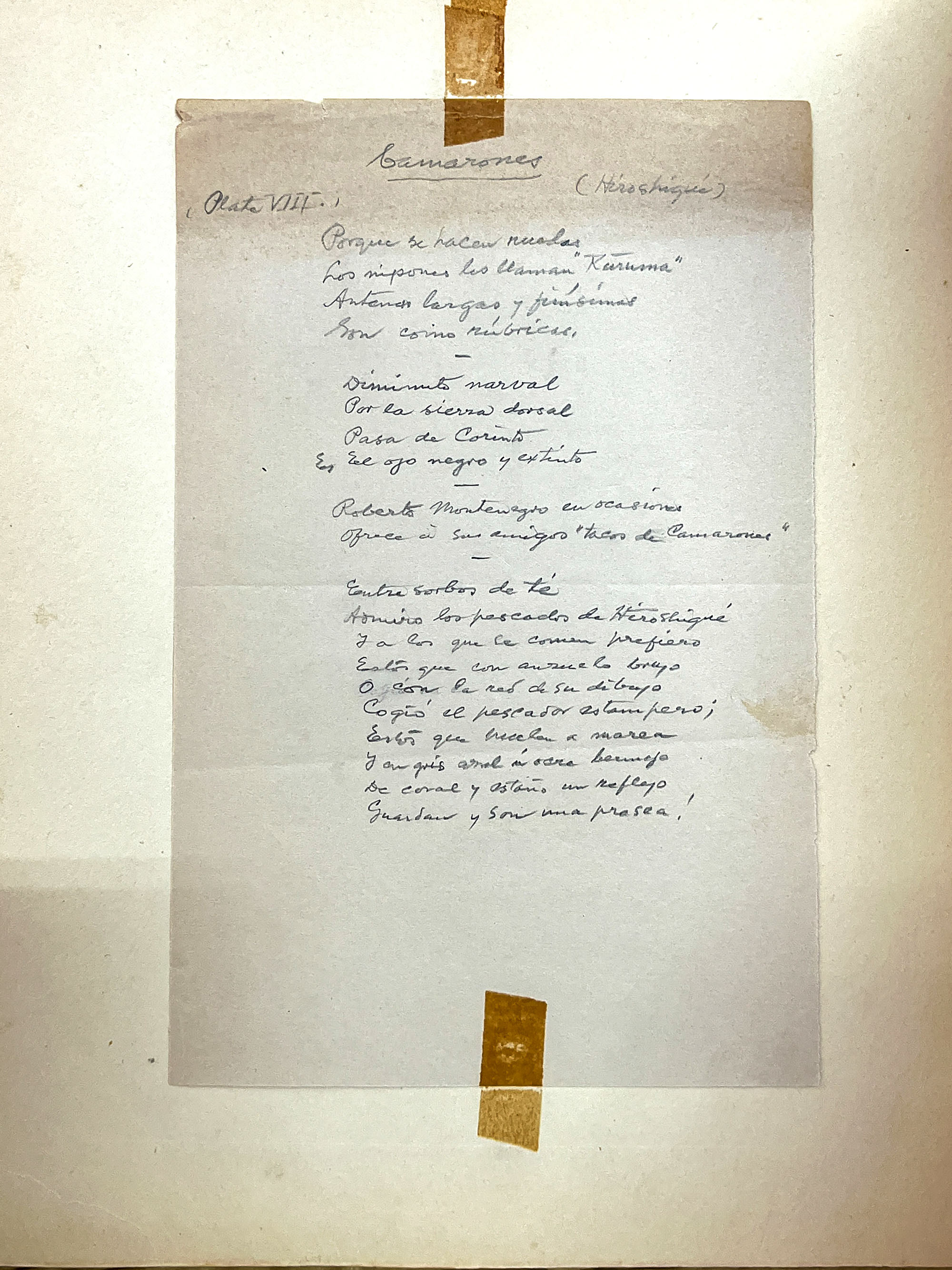
But the most surprising discovery occurred during my final visit to this collection. Two manuscript poems were hidden in the book Masters of the Colour Print. VI. Hiroshige (1929). Each poem faces the colored stamp that Tablada used as inspiration to write them. Like many other examples of his work, this is another case of ekphrasis at play by Tablada, but they stand out because he places the verbal representation right next to the visual representation. After reading the poems, I confirmed that only one researcher, Michele Pascucci, has written about them. As Pascucci states, these poems were not included in the celebrated anthology of Tablada’s complete works edited by UNAM in the 1970s.4 Discovering poems after more than 50 years opens up the possibilities of discovering more hidden manuscript works within the pages of his books scattered through other collections in Mexico City, and reportedly also in Cuernavaca, Morelos.5
In thinking about my research, I consciously ask myself why Tablada, why do I feel so inclined to research his work and his personal life? First, my work on him flourished during some of the most challenging moments of a global pandemic. He was my companion, the one whose work transported me to past epochs far away from the current world outside the pages of the book. In the summer of 2023, I had even closer contact with him through objects that he had left behind. These objects undoubtedly reveal his authorship or ownership over them, but most importantly represent his pursuit of singularity and personalization. The watercolors and other drawings are one-of-a-kind, and even though the books were mass-produced, they were altered by his own handwriting and are as a consequence irreplaceable. These fascinating objects, discoveries, and reflections simply reinforce my desire to continue to walk alongside Tablada and research his work, from the process of making images to the art of annotation.
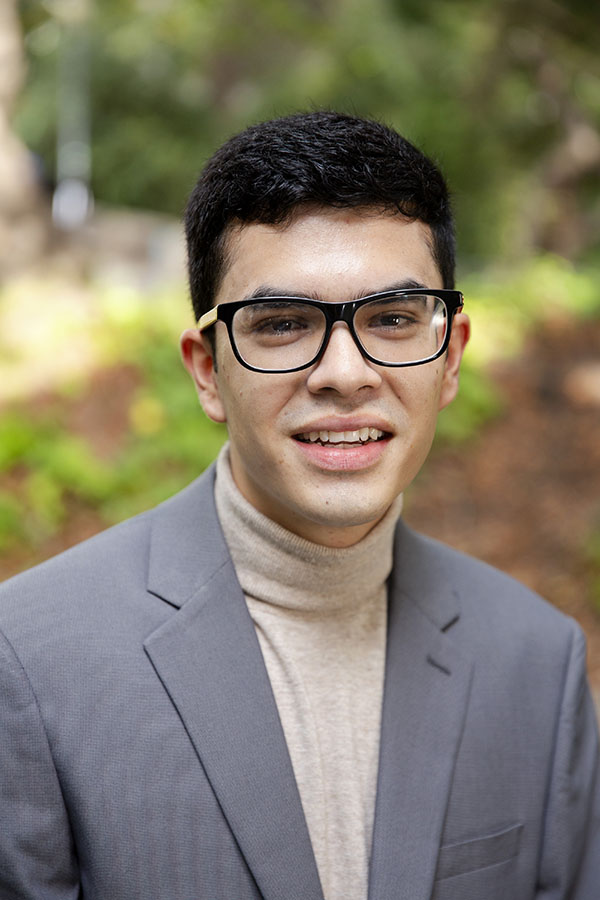
Jair Jáuregui Torres (he/him/él) is a Ph.D. student in the Hispanic Languages and Literature program in the Department of Spanish and Portuguese at UC Berkeley. His research focuses on 19th and 20th century Latin American literature and spans two main agendas. The first entails the intersection between literature and the visual arts, with a particular emphasis on ekphrasis, ut pictura poesis, visual poetry, and art criticism. The second retraces, recovers, and disseminates the border-crossing literary and transcontinental cultural exchange between the United States and Latin American countries, such as Mexico and Chile, through the Hispanic print culture in regions like California.
Notes
- All images included in this report were taken by the author, unless otherwise noted. ↩︎
- Instituto de Investigaciones Filológicas, “Mi casa en San Francisco,” José Juan Tablada, accessed July 17, 2023, https://www.iifl.unam.mx/tablada/interiores/iconoComp.php?pos=6&idTexto=1781&idColeccion=8. ↩︎
- Michele Pascucci, “Hiroshigué versificado: dos poemas manuscritos de Tablada,” Literatura Mexicana 23, no. 1 (2012): p.109. ↩︎
- Pascucci, p. 109. ↩︎
- Amaury A. García Rodríguez, “El Japón quimérico y maravilloso de José Juan Tablada. Una evaluación desde las artes visuales,” in Pasajero 21. El Japón de Tablada, ed. Museo del Palacio de Bellas Artes (México: Instituto Nacional de Bellas Artes, 2019), 63-99. ↩︎

Leave a Reply