
By Patricia de Nóbrega Gomes
Editors: This post is an excerpt from the author’s writing while she was a Graduate Affiliate at the Center for Latin American Studies.
The late Macuxi Jaider Esbell does not consider himself an artist; instead, he considered his work as a form of “artivism.”[1] Esbell coined the term artivismo, to which he has said “of this artivism thing, which is to position yourself as an artist, activist and to use all these languages to do politics and be present, and demarcate territories.”[2] Esbell was born in 1979 in Normandy, in the state of Roraima, where the Raposa-Serra do Sol Indigenous Lands are found today. Esbell came into his formal art practice as an adult, after having a career working for the government. He goes on to say “I am not, in fact, a artist, although within this performance everyone needs to embody this artistic persona to reach these very privileged places, such as the 34th Biennial of Sao Paulo itself, and not pass by as just another artist out there in the world.”[3] In an interview Esbell says “For us, artist and shaman, in principle, are the same person or being. We do not distinguish between those functions. Along with the advance of Eurocentric colonial thought in our milieu, we started to fall into the trap of believing that there was a distinction between those functions. With the notion of art in our favor, as indigenous peoples, we can discern the possibility of translation, or of bringing back together our own nature. Now, if you ask me if I am an artist or a shaman, I will say no, although I am aware that, by publicly tampering with the effects of genipap (Editor’s note: a tropical tree whose leaves are used to produce a dark pigment that Esbell uses in his art), I’m talking about everything at the same time.”[4]
This chapter addresses the rise of Indigenous visibility in the art world within the last 5-10 years; the timing does not seem to be a coincidence. Bridging this constructed gap between art and politics helps us to better contextualize the choice these artists make to engage with the art world directly. Working within the art world and using language such as artist here is a strategy that allows access into arenas that can provide visibility, a platform, and funding to get the messages of Indigenous fights out to the nation and the world. Creating works authored by Indigenous artists constructs a space of celebration of knowledges, stories, and practices that represent Indigenous peoples, authored by themselves, in spaces that have historically spoken for them, ignored them, and violently erased their contributions. One of the works that Esbell made for the 34th Biennial of Sao Paulo that speaks to these issues was a set of inflatable sculptures of serpent entities of Macuxi cosmology, who “cross several worlds and have no beginning and no end.”[5] The stories of the serpents were passed down to Esbell from his grandfather, who shared much of the Macuxi origin stories and cosmology. The serpents have shown up in his work before but only in 2-dimensional drawings, but in 2020 the serpents made their way off the page here from another world into inflatable forms. The two snakes are 17 meters long and 1.5 meters in diameter, multi-colored, and feature design work that can be seen in Esbell’s painting work. Unlike most of the work included in the Biennial, the serpents were not located within the gallery spaces – they had somewhere else to be. The serpents were called by Esbell to move outside of the museum walls and onto the lake in Ibirapuera Park, and to stand in attack against the sculpture of Portuguese explorer Pedro Álvares Cabral. This statue lies in the heart of Sao Paulo within the Ibirapuera Park, which is also home to the Biennial building. The word Ibirapuera means “‘An ex-tree’ or ‘what was once a tree.’ This is the meaning of Ibirapuera, a word of indigenous Tupi origin.”[6] The irony in the naming of the park is that in the urban metropolitan city of Sao Paulo, the park is the greenest part of the city. At the same time, it highlights the violence of land dispossession that has taken the land away from the Tupi people.
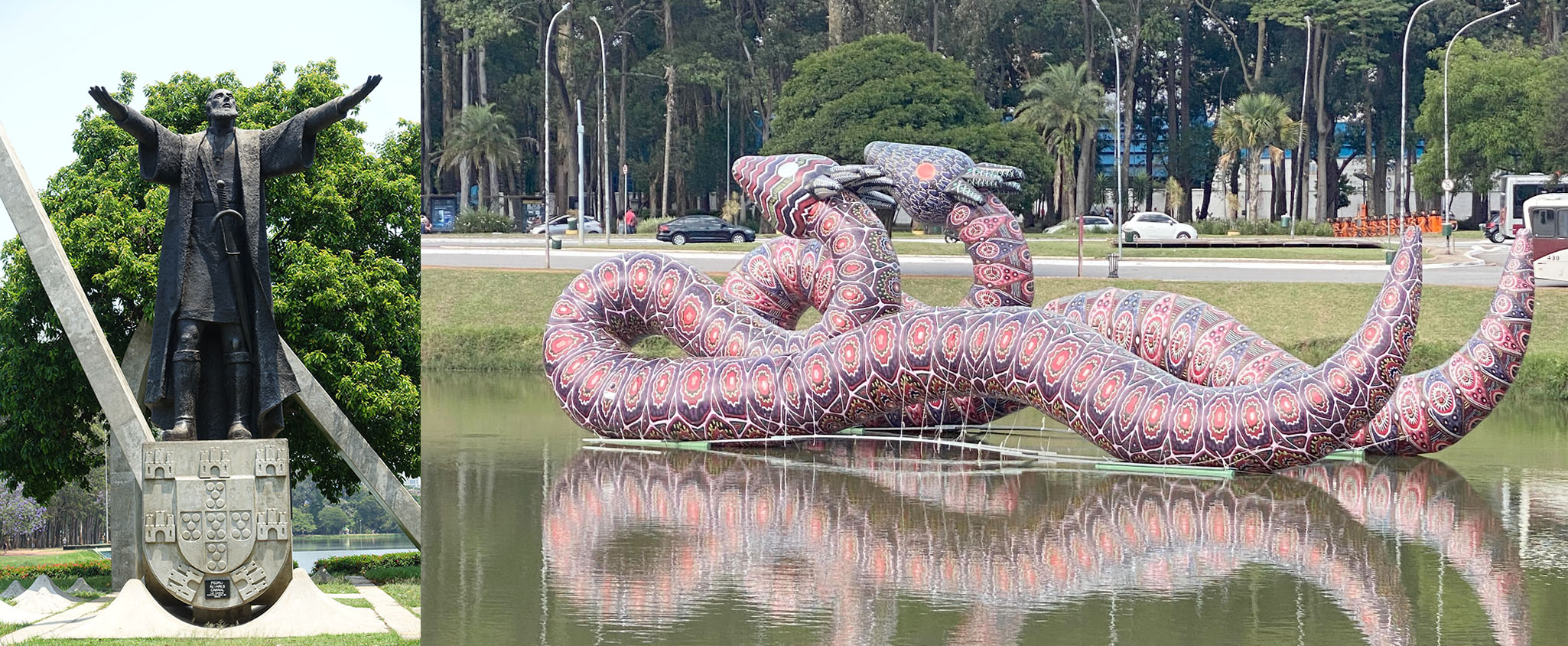
(Left: Photo by daderot. Right: Photo by Patricia de Nóbrega Gomes.)
The movement and life of the serpents displayed on this scale brings attention to the fact that while the land has been dispossessed, the presence of Indigenous history, epistemologies, and languages continues. Materializing the serpents in such a vibrant and large size is meant to call attention to the inflatables and make them difficult to miss. Upon the water, the serpents sway gently and yet never lose their focus, heads always watching Cabral closely. Given that the serpents are inflatables, their nature lends itself to the liveness that Esbell was trying to bring forth in these spirit entities. Their activation by the wind and the water reflect their connection to the natural world and they make more visible the sometimes subtle movements of the natural world that are happening all the time, a dynamism that we might not be aware of or overlook. And in this way, Cabral will not and the on-going Brazilian state cannot ignore that the original peoples of Brazil are continuing their work of resisting and fighting against the on-going neo-colonial order.

Patricia de Nóbrega Gomes is a Ph.D. Candidate in the Department of Performance Studies at UC Berkeley, with a Designated Emphasis in Women and Gender Studies. Her research is on contemporary Black and Indigenous artists in Brazil working in performance, mixed-media, sculpture, and photography. Her research interests also include Black Studies, Performance Theory, Feminist Theory, and Critical Indigenous Studies.
References
[1] https://www.artforum.com/print/reviews/202105/jaider-esbell-85507
[2] Arte & Ensaios, Vol. 27 No. 41, Jan-Jun 2021, p. 42.
[3] https://elastica.abril.com.br/especiais/jaider-esbell-bienal-mam/
[4] https://amlatina.contemporaryand.com/editorial/jaider-esbell/
[5] https://post.moma.org/jaider-esbell-fissures-between-worlds/
[6] https://news.artnet.com/opinion/the-34th-sao-paulo-biennial-review-2015655#:~:text=%E2%80%9CAn%20ex%2Dtree%E2%80%9D%20or,the%20visual%20arts%20in%20Brazil.


Leave a Reply