
By Juan C. Campos

When and under what conditions do governments exploit centralizing reforms to protect rather than repress organized criminal groups (OCGs)? This question strikes at the heart of state-building challenges across the Global South, where OCGs have become formidable threats to democratic governance. In Latin America alone, approximately 77 to 101 million people live under the effective control of organized criminal groups rather than elected authorities.1 These groups assassinate politicians, extort civilians, and generate violence that rivals armed conflicts. Yet despite these threats to citizen security and the rule of law, evidence suggests that many local governments use their coercive institutions to protect rather than combat criminal groups. This puzzling pattern of state complicity — where politicians publicly denounce criminal violence while privately enabling it — demands explanation.
The Conventional Story — and Why It Falls Short
The conventional wisdom in security studies predicts that states respond to criminal threats with repression. Theories of state capacity suggest that politicians adopt coercive policies against OCGs when facing challenges to their monopoly on violence. Consistent with this logic, Latin American governments have militarized law enforcement and enacted punitive legislation. Mexico and El Salvador purged thousands of police personnel with suspected ties to criminal organizations. Brazil, Mexico, and Colombia restructured local policing institutions to reduce infiltration. This threat-response framework assumes that rising violence and corruption create political incentives for crackdowns.
Yet this conventional account cannot explain systematic patterns of state forbearance toward organized crime. Across Latin America, local politicians frequently deploy security institutions to facilitate rather than disrupt criminal operations — providing intelligence to cartels, allowing corrupt officers to remain in their posts, and diverting enforcement away from criminal territories. This empirical reality challenges threat-based theories of security policy and raises a fundamental question: what explains subnational variation in state responses to organized crime?
Enter Mando Único
My dissertation focuses on the protective function of centralizing reforms — policies that integrate municipal police forces under a single command structure spanning jurisdictions. In Mexico, that reform is called Mando Único (Unified Command). I argue that centralizing reforms — ostensibly adopted to combat organized crime — can be exploited by politicians with ties to clientelistic parties to facilitate protection rackets, particularly in low-violence contexts where stable collusion is feasible.
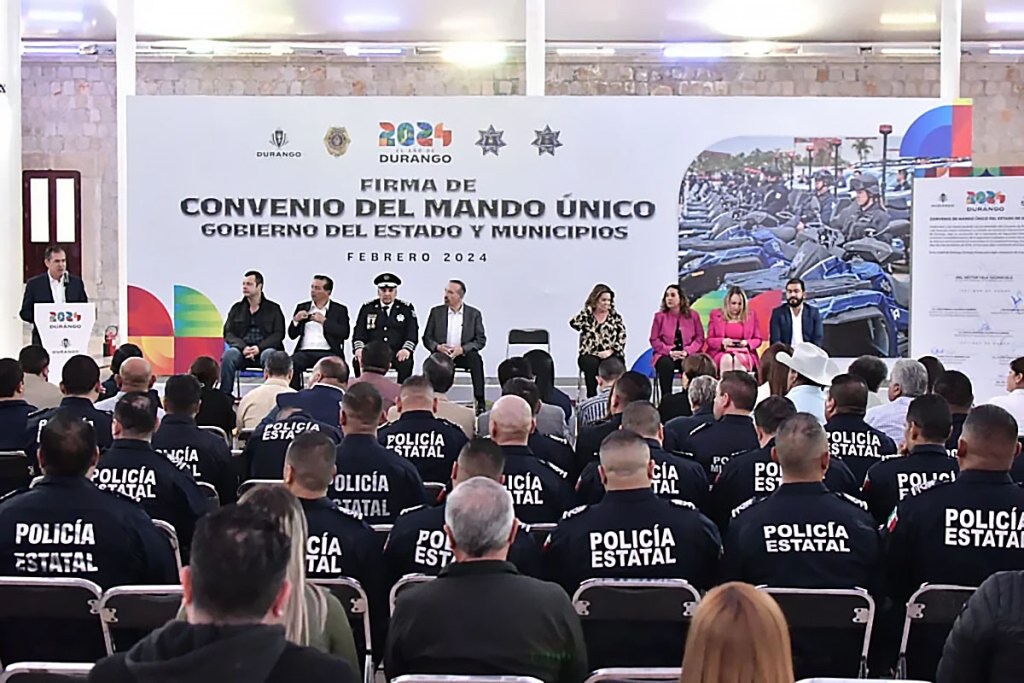
Centralization enables this exploitation by transforming fragmented local enforcement into what scholars describe as a “single protector” system.2 By consolidating control of municipal forces at the state level, these reforms replace multiple municipal arrangements with unified gubernatorial authority, reducing local oversight and enabling coordinated protection across jurisdictions. This shift strips mayors of operational autonomy over policing, allowing governors to more easily orchestrate stable collusion with criminal groups. Rather than many municipal players each cutting their own deals, only a state government actor must negotiate with organized crime. States can more efficiently regulate the illicit economy when “multiple protectors” are replaced by a “single protector” in a given territory (see Snyder & Duran-Martinez 2009).
The PRI Connection
To test this theory, I examine the implementation of Mando Único using original municipal-level data from Mexico. I find that centralizing reform is more likely to be implemented in localities narrowly won by the Partido Revolucionario Institucional (PRI), a party historically associated with protecting organized crime prior to democratization, particularly in localities with low levels of criminal violence.
Why the PRI? Politicians socialized into clientelistic networks are more likely to pursue the reform-as-protection strategy. Such politicians create bargains with criminal organizations by trading forbearance for rents — promising not to arrest or attack groups once local police are centralized. As one body of research explains, because clientelistic parties’ electoral victories do not depend on programmatic appeals, they are more likely to attract opportunistic politicians, cultivate stronger connections to specialists in violence, and selectively enforce the law based on political considerations.3 Clientelistic parties treat law enforcement and protection as political currencies: extending protection to criminal groups can be rational when those groups deliver political or material support, maintain local order, and operate within the party’s hierarchical networks.
While this arrangement disadvantages mayors by reducing their autonomy, local authorities within top-down institutional contexts often have little choice but to cooperate with central authorities, especially if their municipalities have limited taxation capabilities.4 Party alignment can be exploited by high-ranking officials to pressure mayors to accept reform, typically by offering political or financial incentives. If mayors do not comply with the directives of corrupt governors, they may be left “unprotected” from criminal threats.5 Meanwhile, local party organizations can reward compliant mayors with campaign financing and career-advancing opportunities.
Why Low Violence Is the Key Ingredient
The viability of protection arrangements depends on criminal market conditions. Prior research shows that politicians protect criminal groups when violence remains low, enabling a stable and profitable protection relationship.6 I extend this logic by arguing that centralizing reforms are unlikely to be implemented where multiple criminal groups compete violently. Inter-organizational conflict disrupts the stable rent extraction that makes protection profitable: violent competition creates unpredictable enforcement demands, generates public pressure for crackdowns, and undermines the credibility of protection agreements.
Although working with multiple criminal groups could enable governors to extract rents from various sources, too many organizations can generate excessive competition that dissipates profits and thus reduces the rents available to protectors. High levels of violence also damage incumbent parties politically, and adopting reform where other security policies have failed is a liability for all actors. Governors and mayors are thus more likely to accept reform if criminal groups can credibly commit to keeping violence to a minimum.
Time Horizons and the Unraveling of Deals
There is also a temporal element that determines the level of trust governors, mayors, and criminal groups develop toward each other under protection rackets. State-sponsored arrangements can emerge and remain stable if the time horizons of politicians are long-lasting. Long time horizons increase both the reciprocity and credibility of transactions, because the iterated interactions possible when officials have long-term appointments are more likely to generate trust and a reputation for compliance.
I find that Mando Único tends to be reversed in violent municipalities as governors reach the end of their tenures, suggesting that time horizons and credible commitments matter for reform persistence. Criminal groups are also attuned to the diminishing power and influence of governors, incentivizing them to renege on their original agreements with the state. Without a credible threat of enforcement, it makes little sense for organized criminal groups to pay for non-enforcement. If violence breaks out because of these commitment problems, politicians are more likely to repeal the reforms because the costs of maintaining them outweigh the potential benefits. Governors would reject the reform if levels of violence increase as the returns from illicit collaborations become less predictable. As for mayors, they are more likely to reject the reforms because sustaining centralizing reforms in high-violence settings can jeopardize their personal safety.
Does the Reform Actually Reduce Violence?
Once centralization reforms are implemented, politicians can decide how to use policing institutions to manage the illicit economy. Under a repression framework, violence is more likely to increase because reform can threaten pre-existing ties criminal groups have formed with local corrupt politicians and their police. Centralization is sometimes accompanied by mass “purges” in which hundreds of officers are fired at once, or by state-level police units pressuring municipal forces to participate in militarized joint operations. Through centralization, the corrupt links criminal groups have formed with local politicians may be severed, which can trigger a violent reaction.
However, under the reform-as-protection arrangement, violence can be contained if governors use police centralization to provide criminal groups with protection. According to a journalist I interviewed in the Mexican case, violence tends to break out among criminal groups because mayors, and their police, tend to protect different organizations. Through centralizing reform, the police forces of different municipalities are integrated under a single command structure that spans jurisdictions, enabling governors to more effectively mediate conflict among opposing groups.
Through my research, I find suggestive evidence that Mando Único reduced criminal conflict in PRI-controlled states — consistent with the protection hypothesis. In other words: the reform works. Just not in the way it was advertised.
What This Means for How We Think About the State
This analysis challenges the assumption that centralization enhances state capacity. Reforms designed to strengthen security institutions can produce opposite effects, depending on who controls them and under what conditions. While existing scholarship describes how institutional fragmentation shapes protection rackets, my analysis shows that unified control — achieved through centralizing reforms — can be strategically engineered to facilitate rather than disrupt criminal operations.
This finding inverts conventional wisdom in the state capacity literature: concentration of coercive authority does not necessarily translate into more effective crime control but can instead enable more efficient collusion when politicians face incentives to protect rather than repress organized crime. Moreover, partisan alignment alone is insufficient to explain patterns of state-criminal collusion. The same political alignment that enables repression can also incentivize institutional restructuring for protection — but only when criminal market stability and political time horizons align.
While measuring protection rackets remains challenging given their clandestine nature, this study demonstrates that centralizing reforms can be strategically exploited to shield rather than suppress organized crime. Future research should test whether this logic holds in other contexts where clientelistic parties control subnational governments. From a policy standpoint, central governments should establish safeguards promoting gubernatorial transparency and accountability, including independent oversight bodies, transparent personnel appointments, and enforcement audits.
Juan C. Campos is a Ph.D. candidate in Political Science at the University of California, Berkeley. He is a recipient of the 2022 Tinker Field Research Grant and the 2025 Summer Dissertation Writing Fellowship. His research focuses on the relationships between states and criminal organizations in developing countries, with a regional emphasis on Latin America. In 2026, he will join the Center for U.S.-Mexican Studies at the University of California, San Diego as a visiting fellow.
- Uribe, A., Lessing, B., Schouela, N., & Stecher, E. (2025). Criminal Governance in Latin America: Prevalence and Correlates. Perspectives on Politics, 1-19. ↩︎
- Snyder, R., & Duran-Martinez, A. (2009). Does Illegality Breed Violence? Drug Trafficking and State-Sponsored Protection Rackets. Crime, Law and Social Change, 52(3), 253-273. ↩︎
- Nieto-Matiz, C., & Skigin, N. (2023). Why programmatic parties reduce criminal violence: Theory and evidence from Brazil. Research & Politics, 10(1), 20531680231155615. ↩︎
- Diaz-Cayeros, Alberto (2006). Federalism, fiscal authority, and centralization in Latin America. Cambridge University Press. ↩︎
- Trejo, Guillermo and Sandra Ley (2019). “Multilevel partisan conflict and drug violence in
Mexico: when do criminal organizations attack subnational elected officials?” In: Inside
countries: Subnational research in comparative politics, pp. 181–213.
— (2020). Votes, drugs, and violence: The political logic of criminal wars in Mexico. Cambridge University Press ↩︎ - See Snyder & Duran-Martinez (2009.) ↩︎


Leave a Reply