
Derek Allen
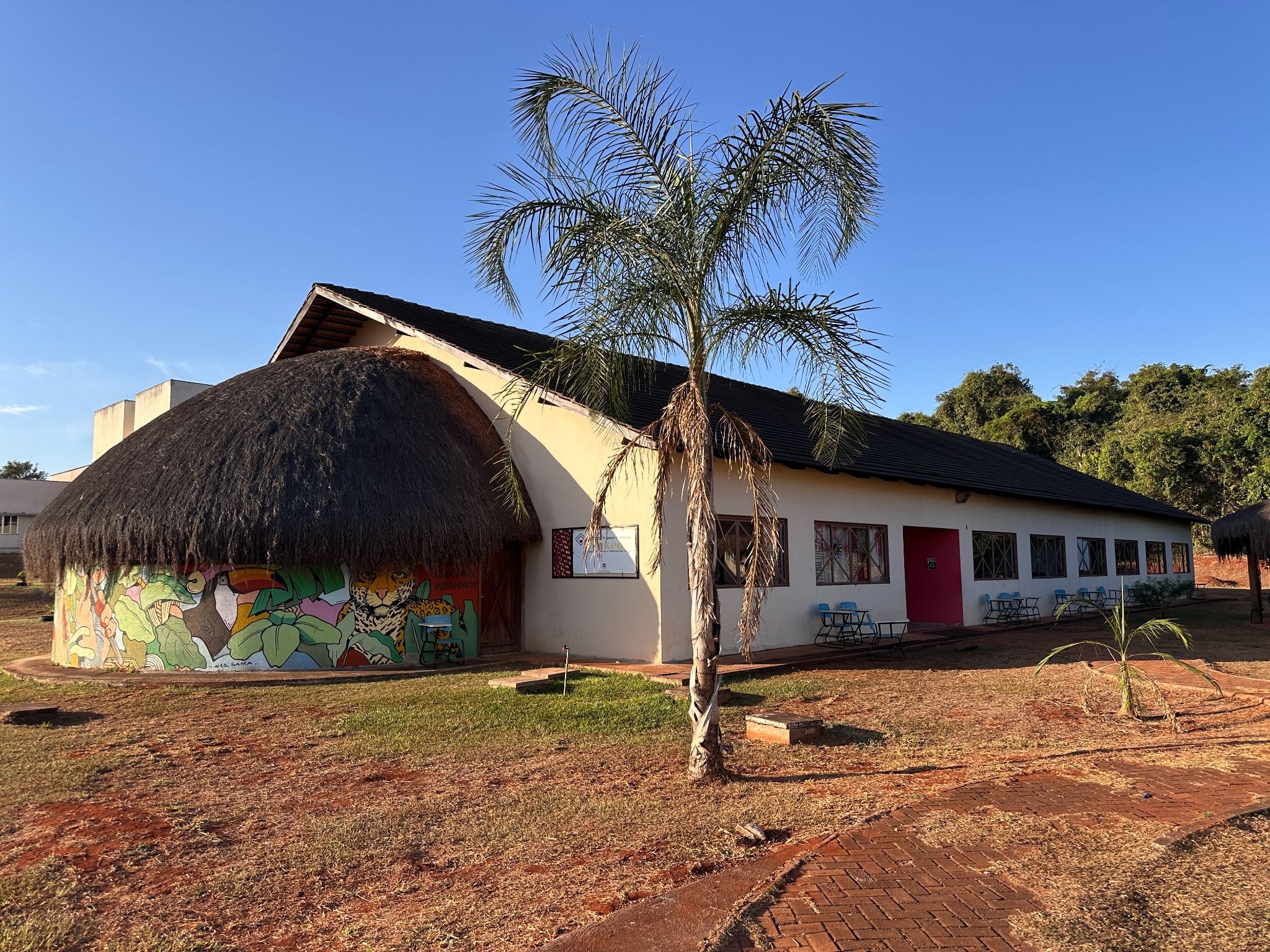
On July 29-30, 2025, four members of the Coletivo de Tradutores Berkeley-Brasil (Berkeley Brazil Translators Collective) — Derek Allen, Ana Claudia Lopes, Liam Seeley, and Luíza Bastos Lages — hosted a transmedia translation workshop with Indigenous Brazilian students of the Educação Intercultural Program at the Universidade Federal de Goiás (UFG, Federal University of Goiás) in Goiânia, Goiás, Brazil. Established in 2005, the undergraduate course in Intercultural Education was conceived in response to a demand from the Indigenous peoples of the Araguaia-Tocantins region, guided by the principles of the Federal Constitution and subsequent legislation regarding the importance and right to difference in Indigenous School Education.
In their workshop, as invited guest speakers, members of the collective discussed the challenges of translation between distinct languages and epistemologies and the collaborative methods employed by the coletivo in the translation of articles published in Revista Pihhy, a publication associated with the program, from Portuguese to English. In dialogue, student-teachers from the program also shared insights into the unique challenges faced in their own translation practices. Participants engaged in numerous translation activities, inviting student-teachers to translate across languages or types of media in a variety of formats. Activities included, among others: the composition and translation of personal biographies; a collaborative reading of a short story entitled “A festa dos animais” (“The Animal Party”); and a subsequent invitation to participants to translate the storyacross media, whether into drawings, musical interpretations, or written Indigenous languages. All participants then presented their interpretive modes of translation to the group.
Prior to this translation workshop, the aforementioned guests were also invited to attend lectures through the Intercultural Education program by Alexandre Herbetta, an Associate Professor of Social Anthropology, working at the Núcleo Takinahakỹ de Formação Superior Indígena (Takinahaky Institute for Indigenous Higher Education) and in the Postgraduate Program in Social Anthropology at UFG, and the coordinator and editor of Revista Pihhy, along with Gregório Huhte Kraho, a professor, musician, leader, and curator of Revista Pihhy, and José Cohxyj Krikati, a Cohxyj professor, musician, and author of the audiobook WYTY.
The Kitchen, The Garlic, The Beans
Liam Seeley
Our time in Goiânia was marked first and foremost by the learnings at the Núcleo Takinahakỹ at UFG, which has been wonderfully alluded to above; as our work with Pihhy continues to take new directions— striving, I hope, towards its titular word’s fulfillment as semantically and vitally plural, meaning seed, music, story, life, and more, as Gregório Huhte Kraho insisted during his teaching — I wanted to linger with the time that would conclude our days.
I recall retrieving a head of garlic from the fridge, intent on using it all, when Luiza — in good anti-vampiric fashion — announced somewhat emphatically that it would not be enough. We would have to go to the grocery store if we were to make good beans. We piled into the car. I think Ana managed to park in an absurdly tight parallel spot before we tumbled out of what often felt like our clown car of Goiânia. On our first day, on our way to our collaborator Alexandre’s slow-afternoon churrasco, we swung by a hortifruti (produce market) and picked up a few bell peppers to throw on the grill in his backyard. There we chatted with a few researchers who were intermittently typing away at their dissertations, and children chased cats around quintal corners. Goiânia on that Saturday had been eerily empty, and after many earlier attempts by Natalia to seek some basic sustenance, we were lucky to happen upon the hortifruti just before it closed for the day at 2 pm in the afternoon. Which is to say, while our initial days were full (of hospitality and other such warmths), by the time we made it to this grocery store on that particular evening, I was feeling a bit grocery-store greedy.
And so in a moment of personal hubris, having gone initially and primarily for garlic, I immediately selected and carried around what must have been a 30-pound watermelon, as we tossed other small items into the collective shopping basket. I would spend the next few days trying to serve watermelon at any moment possible, culminating in a final-day effort at batches and batches of breakfast watermelon juice. My colleagues, and especially Greg, were indeed polite to have consumed as much watermelon as I insisted upon; even Natalia, adhering strictly to the inter-generational wisdom that one must have a 4-hour buffer between watermelon-time and other-food time, managed to partake. I think we finished it, though I probably should have rolled away in a watery watermelon way before I was able to head to the bus terminal at the end of the week.
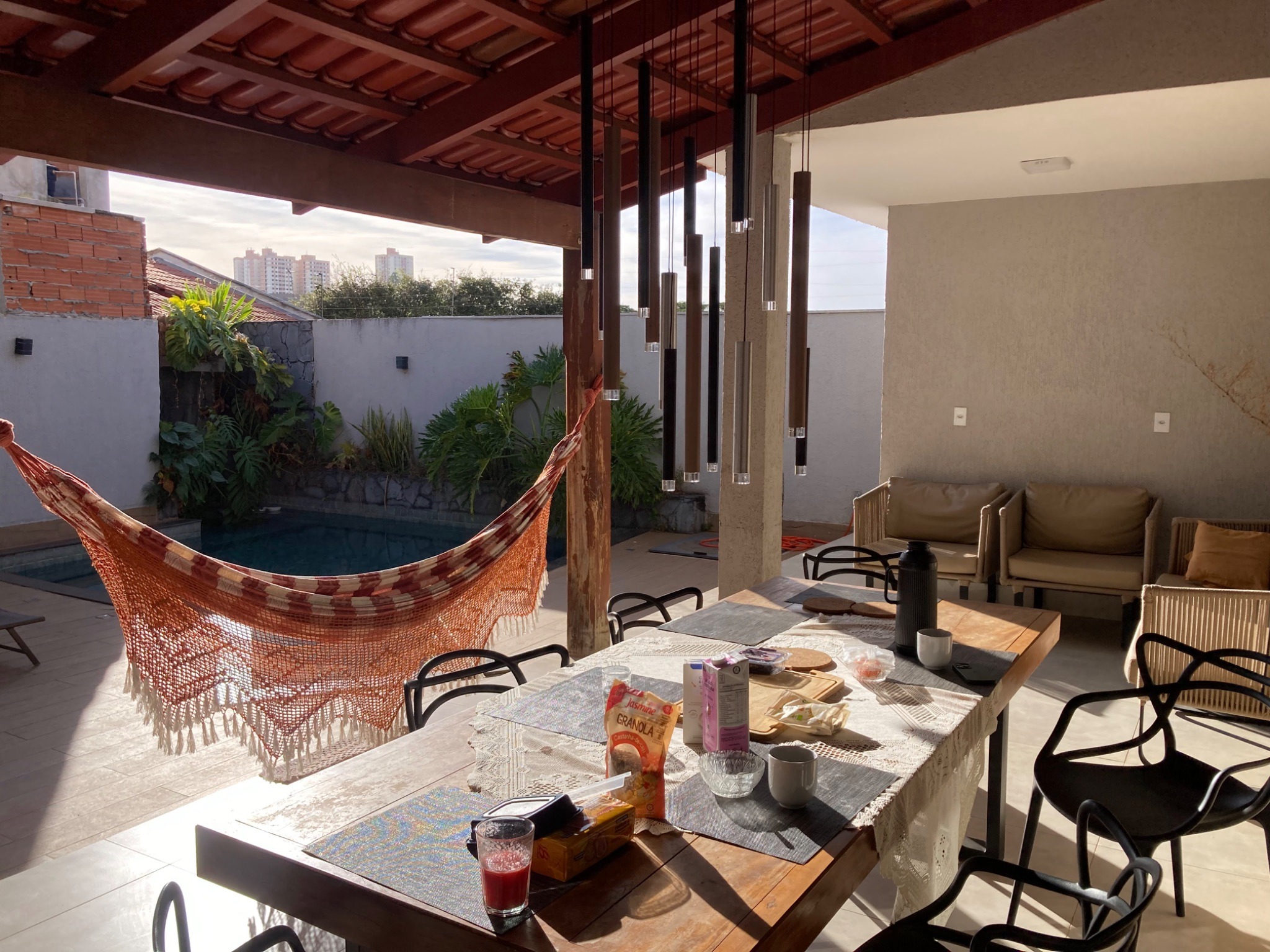
Anyway, we returned from the store, garlic and watermelon and a handful of other things rolling about in the now-heavy clown-car trunk. And, bean-fiends and kitchen friends we were, we proceeded to, as indeed many do, prep our dinner. I suspect that in that little outdoor kitchen, we peeled, chopped, and seasoned our fingers with at least four full heads of garlic, all for one pot of beans. I suspect that was also the day that Derek cooked for the non-vegetarians a handful of (suspicious) frozen chicken breasts that were ultimately, I hear, perfect after our day at the university. The beans, too, were a delight. We ate dinner and debriefed what we had learned from the researchers at the program, all while sharing what I will declare as home beans. (More things should be done, I think, while sharing home beans). In what was an otherwise strange and vacuous house (a description I would extent to much of the agribusiness metropolis that was Goiânia), the kitchen was the space to which we would return — always imperfectly, fatigued, probably never chewing enough and worrying too much about colchonetes — in order to sit around the table, wash dishes, and at last scrub the garlicky bean off the bottom of the pot.
The Aldeia
Luíza Bastos Lages
In the last days that concluded our stay in Goiás, we travelled to the Indigenous village (aldeia) Buridina Karajá, of the Iny people, by invitation of the aldeia’s Cacique and school principal Valdirene Mahudikè and of Professor Herbetta. During that weekend, the people from the aldeia would gather to watch and celebrate the launch of the film Matriz Lary rybé! directed by Cacique Valdirene and produced in partnership with the community of Buridina Karajá and the team from Revista Pihhy. We were invited to join the film screening and commemorate its launch alongside the community.
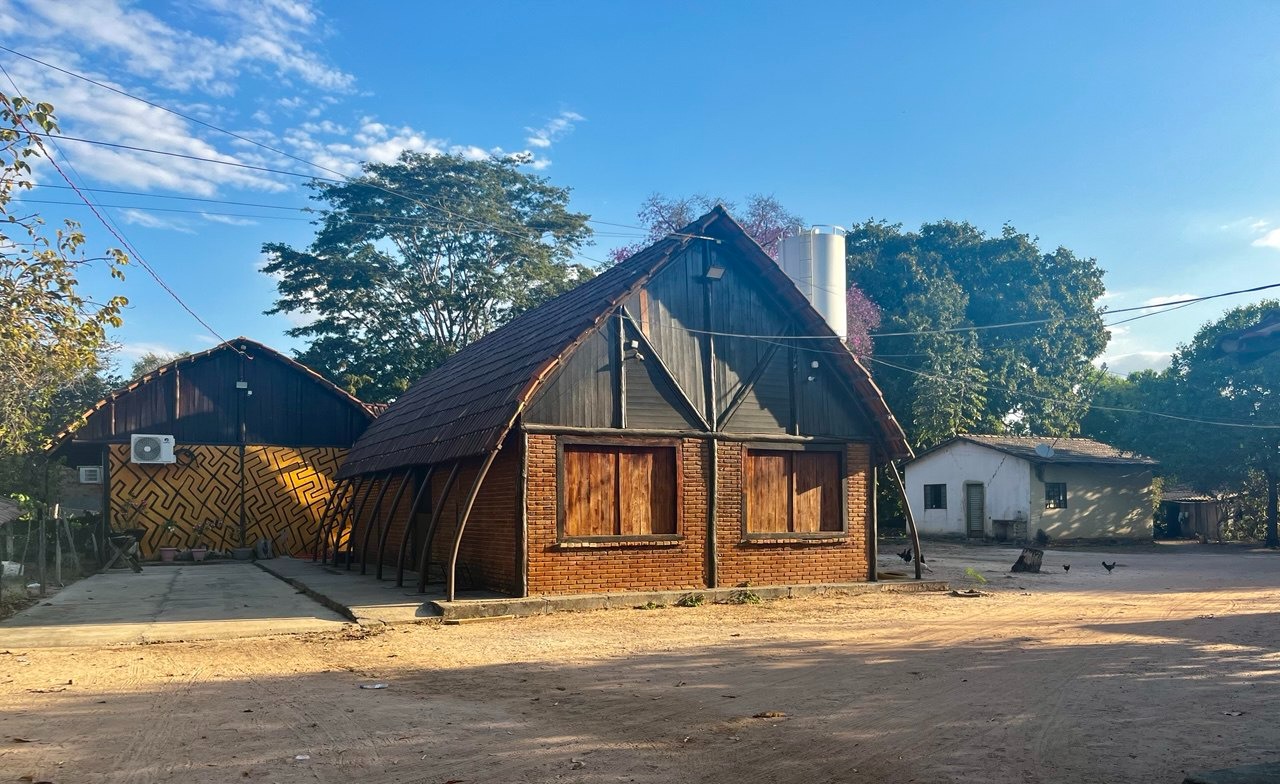
Cacique Valdirene kindly offered to host us in the main classroom of the Indigenous school Escola Estadual Indígena Mauheri. We were honored and enthusiastic about the visit. We left Goiânia heading towards Buridina Karajá early on a Friday morning. Our first stop was at a store to secure colchonetes (sleeping pads) for our sleeping arrangements in the classroom. After we could finally fit all 5 sleeping pads into our packed-to-the-brim car, we hit the road to the sound of a few (somewhat inappropriate) playlists Luíza had on her phone. From Goiânia we headed west, towards Rio Araguaia, on the bank of which lies Buridina Karajá.
We arrived in Aruanã early in the evening. Aruanã is a local tourism destination town that occupies the unceded lands of the Iny people. In fact, the town has been avidly advancing over the aldeia’s lands. In one of our first walks around Aruanã, we passed by a boat parking garage that was recently built on the lands of Buridina Karajá. At that time of the year, the last weekend of winter break, Aruanã was taken over by non-Indigenous families visiting the area to enjoy the riverbanks and to go fishing on the Araguaia River. With such dynamic tourism activity, the aldeia became surrounded by non-Indigenous small hotels and vacation homes, as well as bars and restaurants playing sertanejo (country) music at the highest volume. As the aldeia became enclosed by Aruanã’s development, Barudina Karajá became known as an urban Indigenous village.
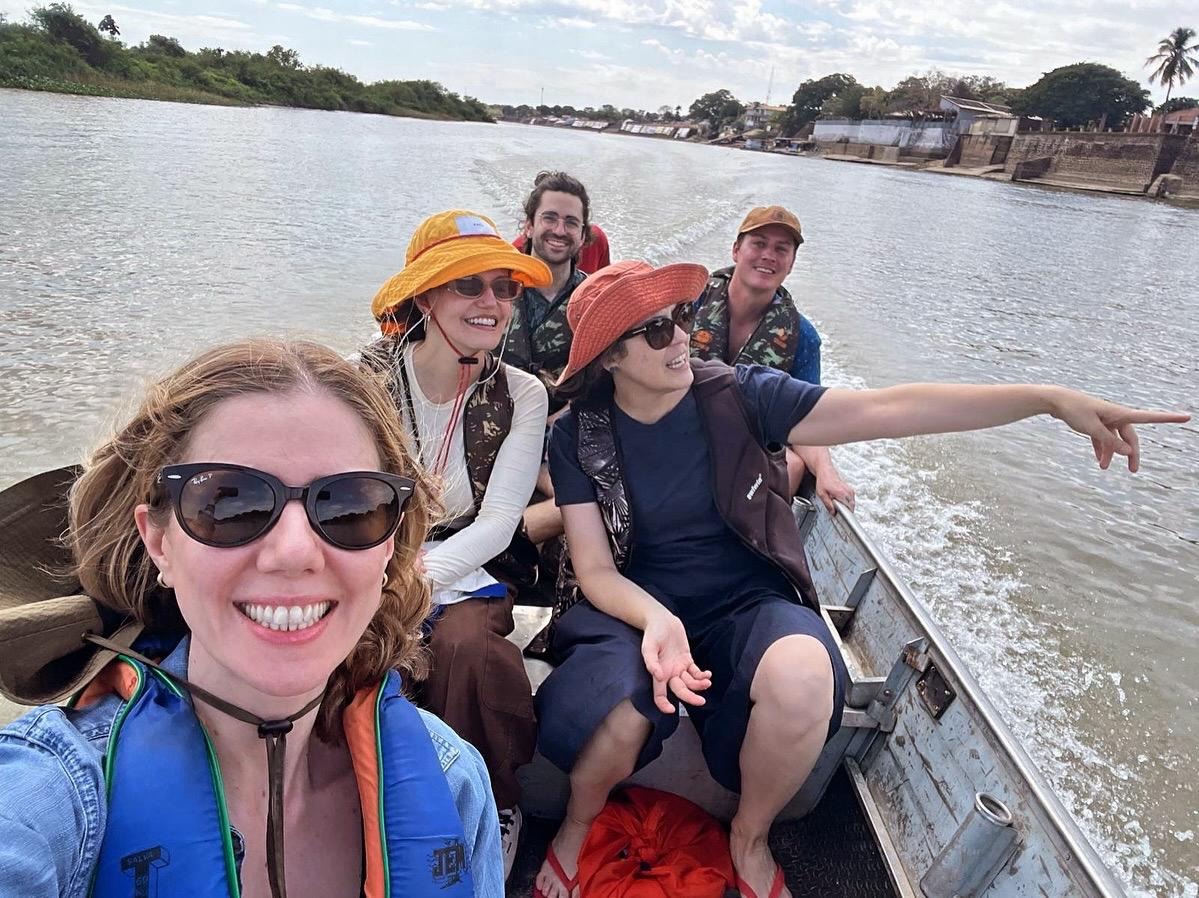
On that hot winter evening, we were welcomed by Cacique Valdiren and settled into the main classroom of Escola Estadual Indígena Mauheri. Lying on our colchonetes, we could hear frogs, crickets, and the sertanejo music from the town’s main drag, as well as boats navigating up and down the river. The next morning, we were welcomed by Albertino Wadiurema, one of the first Indigenous schoolteachers at the Escola Indígena Mauheri. Wadiurema walked us around the aldeia, told us about the traditional Iny-karajá ceramic practice, of which his elderly mother is one of the main references, and suggested that we take a boat trip down the Araguaia. As we walked along the river in the aldeia, we were greeted by a boto cinza (grey river dolphin). Wadiurema introduced us to Iny boatmen who would take us for a river trip. We were so excited by the botos and onças (jaguars) that are often seen by the Araguaia that we decided to take two trips, one during the day and one at night, when onças are often seen hunting by the riverbanks. The onças did not come out to greet us on our nightly navigation, but we were gifted many stories about the forest and the Iny, shared by Carlin Bebeto, the Iny boatman who gently guided us over the Araguaia waters.
The community seemed enthusiastic about the launch of Matriz Lary rybé! and so were we! A big pot of local fish moqueca (fish stew) was prepared throughout the day. A projection screen was set and plastic chairs were spread across the school’s gym court. A comunidade estava presente em peso. (The community was out in force.) The film narrates the history of struggle of the Buridina community in having Indigenous teachers teaching Iny knowledge and language at their local school, Escola Estadual Indígena Mauheri. A major challenge mentioned by Cacique Valdirene in the film is the Brazilian government’s requirement that Indigenous schools follow the same schedule as non-Indigenous schools. Such a requirement has a significant impact on the community’s possibility of practicing their rituals and mode of living that do not neatly fit into the time framework of the Western world. The launch of the film and the collective witnessing of the community’s many wins in this history of struggle were very moving, celebrated with moqueca, good conversations, and renewed spirits.


Translating Worlds in Goiânia
Ana Claudia Lopes
I’ve been going to Goiânia long enough that my memories of the city are braided into the story of my marriage. My husband is from there, and I started visiting it early in our relationship — about fifteen years ago. In those first trips, Goiânia seemed to me as a series of at times warm, ordinary discoveries — afternoons and playing with my nephews at Parque Vaca Brava, the late-night trips to feira da lua (moonlight market) with my mother-in-law. Most of all, I remember the slow education of the cerrado via taste, encountering flavors I didn’t even have words for, fruits I had never heard about in my native São Paulo. If you’ve ever gotten to know a place through family, you know the feeling when a city becomes about the rituals, names, jokes, routes, and especially the flavors. But I’ve also known just as intimately that Goiânia can be a complicated city to love. Not because it lacks charm or beauty, or because its people aren’t as generous as in other parts of Brazil. But Goiânia often feels like a concentrated microcosm of the country’s ideological polarities and social disparities; where certain kinds of conservatism are an audible soundtrack — either through political discourse, or in the typical sertanejo music of the region — and where problematic beliefs, the pride of being a monoculture capital and one of the largest conservative electorates, are an almost inescapable feature of the social air.
So when, in July 2025, I returned to that very city with my Berkeley colleagues for a translation workshop at the Universidade Federal de Goiás, I anticipated equal parts apprehension and excitement. I was about to introduce two universes I normally, and very much intentionally, keep separate, and, despite the honor of visiting the wonderful Intercultural Education program, I couldn’t keep myself detached from avoiding the feeling that that adventure was also about me.
I did not expect any sudden disaster, exactly, but I knew there would be no hiding the contradictions. This period in Goiânia would make things visible. Too visible.
My colleagues, who knew me as someone who could share the intellectual worlds, vocabularies, and commitments of UC Berkeley with them, would now have deeper access to a little, hidden corner of my world. Goiânia, for me, is where all the contradictions between the person I was brought up to be and the one that I became are fleshed out in the open. Bringing my colleagues there felt, at first, similar to inviting them into the messy storage room at the back of my house.
When ambivalence is woven into your history, you develop strategies for living with it. You learn where to exhale and where to brace yourself. You find out which conversations you can have and which ones you shouldn’t. You learn to constantly translate yourself depending on what room you are in. That’s how I survived 15 years of visiting Goiânia. Introducing others to that landscape can feel like exposing the bargains I’ve made along the way. But this trip was not about me and my compromises, and something far greater was about to be thrown in my face.
Part of why we were all in Goiânia, invited by the Núcleo Takinahakỹ and the Educação Intercultural program, was to present a workshop on our translation of the pieces originally published in Revista Pihhy. During our presentation, we discussed the collective methods we’ve been developing to translate Indigenous texts from Portuguese to English, and, more importantly, we listened as Indigenous students and teachers shared the dilemmas they themselves face in translating their native languages into the much drier Portuguese.
After a week of great encounters and conversations with the people in the program, it became evident that translation was much more than precision and technicity. If you face language adaptation as a careful labor of moving between epistemologies, without pretending they are fully commensurable, it becomes a work of relation, a type of responsibility with other people’s words. The workshop’s activities referenced by my colleagues made that responsibility all the more palpable. We were entering a different universe, and we needed to negotiate with our own way of perceiving life.
That place became, then, the stage on which another kind of encounter was taking place. I recoiled from an attempted role as narrator to maintain my role as a participant in the background. In a strange way, that made me see the city differently, too. Beyond the classroom, there was the work of being together. The telling of stories (gravitating from silly anecdotes to confessions), the search for dinner (in two very distinct dietary groups), the learning of each other’s habits, coping with fatigue, arguing over a car ride.
My greatest takeaway from this experience — beyond the amazing teachings of the Karajá, the Krahó, and so many more people we got to know during our visit — was a different manner of inhabiting my ambivalence, a way that gestured more toward how necessary vulnerability is for human connection. Working with the translation of Indigenous voices and finally knowing a small portion of their world made it clear that understanding does not require an objective access to clear-cut conclusions. Attention, humility, and a willingness to remain in relation to what cannot be fully absorbed into one’s own terms are far more relevant, I learned.
In that sense, this new, unexpected visit to an old part of me ended up changing my own sense of language, the thickest of curtains blinding our view. Goiânia, in this way, no longer appeared to me as a place I had to hold a judgement once and for all, but as a space of layered meanings, where irreducible tensions are part of its character, but also where the most unexpected encounters might be able to happen.
Perhaps that is why, by the end of the trip, after coming to terms with the notion that some situations ought to remain unresolved, I felt that the question of my two worlds was not relevant anymore, because I had finally learned, in the same place that was the little hidden corner of my life, that many worlds are possible, and that they need to exist together.
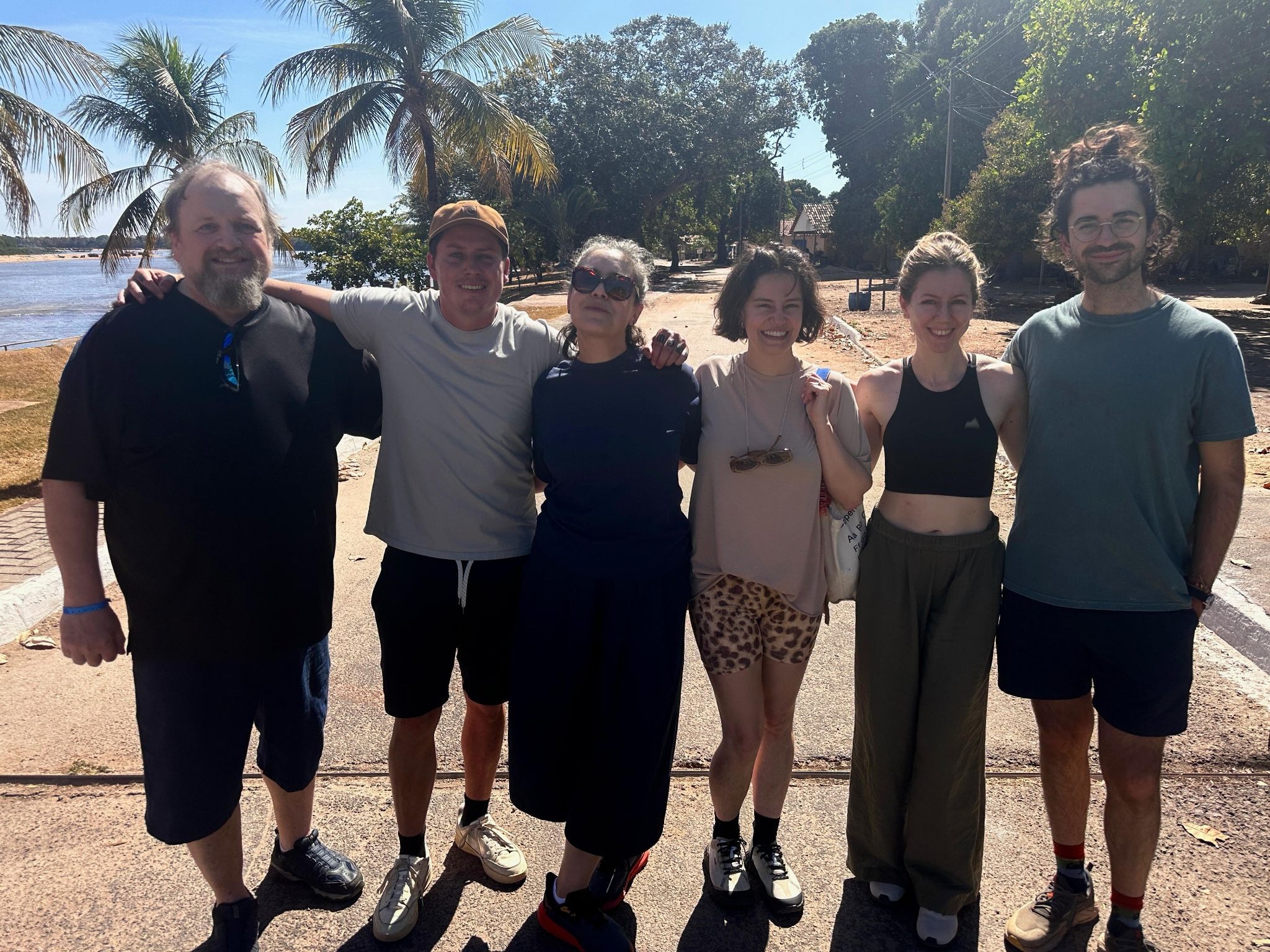
Derek Allen is a Ph.D. student in Luso-Brazilian Literature and Culture with a Designated Emphasis in Film. Liam G. Seeley is a Ph.D. student in Hispanic Languages and Literatures. Luíza Bastos Lages is a Ph.D. student in the Department of Ethnic Studies. Ana Claudia Simão de Oliveira Lopes is a Ph.D. student in Spanish and Portuguese Literatures and in the Critical Theory Program. All are part of the Coletivo de Tradutores Berkeley-Brasil and the Revista Pihhy translation project.
Leave a Reply