
By Leo Dunsker
My affiliation with the Center for Latin American and Caribbean Studies began during the 2023–24 academic year — the same year as the word “Caribbean” was added to its name. As a graduate affiliate of CLACS, my writing and thinking have been enriched by dialogue — both real and imagined — with other affiliated students and faculty members. Their research and scholarship, whether it involves fieldwork in Mexico City or the Peruvian Andes, or Indigenous language pedagogy right here in the Bay Area, always strikes me as dynamic and exciting, a change of pace from much of what goes on in my native Department of English. Like most scholars of literature, my own work tends to be a bit, well, bookish. A university library takes one a long way, and most things can be sorted out by the patient trawling of databases or digital archives.
My dissertation project focuses on a series of Anglophone Caribbean writers — Wilson Harris, Kamau Brathwaite, Derek Walcott, and Dionne Brand — who, I argue, turn to the supposedly archaic form of the epic poem in the wake of the region’s political decolonization to articulate a communal past distinct from monumental narratives of imperial endeavor on the one hand and the plantation’s economic data on the other. In order to construct a history for the region’s people, without recourse to either a reliable written record or inherited models for the epic endeavor, what I have called their “New World epics” engage the resources of a cultural tradition that emerged during the colonial period, but beyond the limits of colonialism’s written archive.
All to say: my own research has not required much that passes for fieldwork, in the traditional sense. These poems were, for all intents and purposes, composed and published in English. So let me confess here to something like “imposter syndrome”!
Following my colleagues’ more intrepid example, I thought I might dedicate this post to recounting a research trip of my own — albeit one whose destination may not be immediately identified with the work that is done here at CLACS. Last summer, with financial support from Berkeley’s British Studies Center, I traveled to London to conduct research in the archives of the George Padmore Institute — named for the Trinidad-born communist and Pan-Africanist intellectual, but owing its existence to another radical Trinidadian writer and activist, John La Rose. Housed in the rooms above the New Beacon Bookshop in the London neighborhood of Finsbury Park, the cornerstone of the GPI’s holdings are La Rose’s personal papers and correspondence. A towering figure in Caribbean and Black British cultural life, La Rose was the editor of New Beacon Books, founder of the bookshop of the same name, co-founder of the Caribbean Artists Movement and the International Book Fairs of Radical Black and Third World Books, and an early member of the Black Parents Movement — to name just a few of his many achievements and roles.

My primary objective in visiting the GPI had been to review their collection of transcripts and recordings from the Caribbean Artists’ Movement (CAM), active mostly between 1966 and 1972 — a collection originally assembled by Anne Walmsley for her indispensable monograph on the subject, published by New Beacon in 1992. In its early days, the nucleus of CAM was a small group of Caribbean writers and artists then living in England, including La Rose and Kamau Brathwaite, already mentioned above, along with Andrew Salkey, Orlando Patterson, and Aubrey Williams. From the remove of London, they sought to articulate a common cultural identity for the Anglophone Caribbean following the collapse of the West Indies Federation in 1962. At its height, CAM held monthly symposia at the West Indian Students’ Centre in Earl’s Court and convened conferences at the University of Kent. This creative ferment is documented thoroughly in Walmsley’s book.
But what interested me most was what happened next. After many Caribbean writers and intellectuals returned to the region to participate in the building of postcolonial academic and cultural institutions, the historical record thins out a bit. Accounts of cultural life in the post-Independence West Indies are more fragmentary, more anecdotal, and — when published — often less accessible. One exception is Brathwaite’s “The Love Axe/l: Developing a Caribbean Aesthetic, 1962-74,” initially serialized in the Barbadian “little magazine” Bim; a longer version remains unpublished, although La Rose once planned to bring it out under the New Beacon imprint. In “The Love Axe/l” (or LX, as Brathwaite was wont to call it), he recounts efforts to establish a Jamaican “branch” of CAM following his appointment as lecturer in the Faculty of History at the University of the West Indies, Mona. These efforts yielded less favorable results. Within a metropolitan milieu, the shared experience of racial otherness and anomie furnished writers from different islands with a common point of reference. But, upon returning to the differently stratified societies of the post-Independence Caribbean, the same figures found themselves divided from the masses (or, more controversially, the “public”) by their education and social mores.
For this reason, I was particularly interested in the correspondence between Brathwaite and La Rose in the GPI’s archive. These letters record Brathwaite’s ambitions for CAM and its journal, Savacou, his grapples with metropolitan editors, and his frustrations at UWI during a turbulent era marked by growing economic disparities, the rise of Black Power ideology across the region, and the banning of Walter Rodney from Jamaica — a fiasco for the UWI in particular, sparking Jamaica’s own theater of a global 1968. Ironically, to learn more about this period in Jamaican history, I had to travel to the U.K. — to read letters sent from Jamaica — echoing the same fraught tropes of exile and displacement whose centrality to the historiography of West Indian literature I had been hoping to query.
In her meditation on “archive fever” in Dust, the historian Carolyn Steedman describes the fervor of the researcher who, after “a grey exhausted day in the record office,” leaves at closing time with her work incomplete, and endures a journey home marked by “strange dislocation from all the faces, stations, connections, [and] delays” only to awake in the middle of the night with a headache thinking, of the people about whom she has been reading, “it was their dust that I breathed in” (19). It was certainly a long journey to Finsbury Park from our digs in Peckham, but I usually spent it in a more invigorating sort of abstraction; the dust of history would hang in the air as I walked to and from Peckham Rye station, past the former home of Dr. Harold Moody, founder of The League of Coloured Peoples, at various times housing such lodgers as the Jamaican writer and broadcaster Una Marson and Moody’s own brother, Ronald, a member of CAM whose sculpture Savacou was namesake to the movement’s aforementioned journal. The GPI itself had nothing of the record office’s bleak impersonality; my conversations with its dedicated archivist Sarah Garrod, who knows the collection inside and out, turned up a number of unexpected connections which shifted the course of my project. I was also fortunate enough to share the reading room on my first day with the renowned composer Dominique Le Gendre, who was herself engaged in reading the La Rose-Brathwaite correspondence. After the GPI closed for the day, we spoke over coffee about her two-month residency in the archives, her search for a musical form in which to render the experiences she found narrated there, and her own reflections on the La Rose-Brathwaite correspondence. (Happily, she records some of her thoughts on these subjects on the GPI’s blog here and here.)
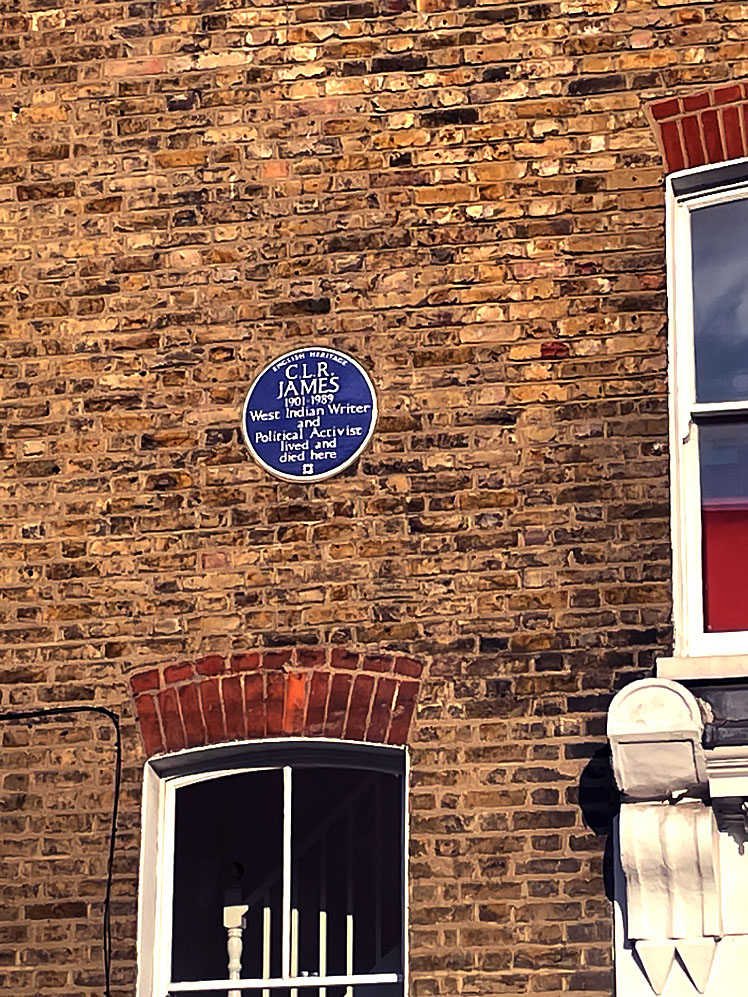
One found the dust of this history elsewhere south of the river as well. Within walking distance of Peckham was Brixton, already a hub of Black British cultural life by the time of CAM’s founding. On one of many trips there, I made my pilgrimage to the offices of Race Today, another cornerstone of radical Black British print culture and a force behind the aforementioned International Book Fair. One of the few relevant photographs taken on my trip can be found below: a rather mundane shot of the blue plaque above RT’s offices, commemorating the place where C.L.R. James spent his final years. And while constraints of time precluded any deep dive into the periodicals collection housed at Brixton’s Black Cultural Archives, I made my visit just the same, full of plans and schemes for next time.
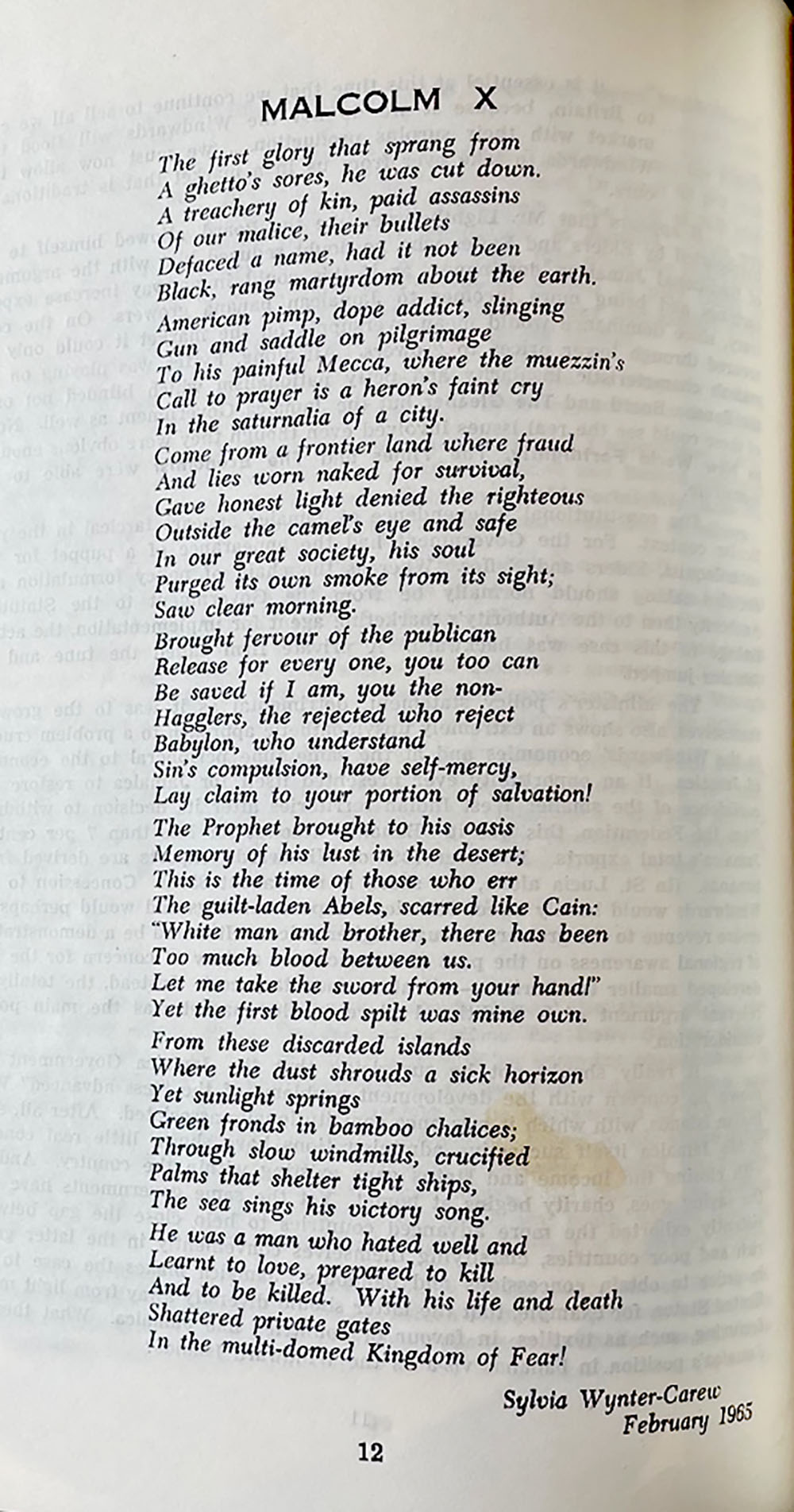
I’ve been thinking back to these weeks as, in advance of an ACLA seminar titled “Comparative Caribbean Modernisms,” I prepare a paper about the Trinidadian writer Merle Hodge’s unpublished translations of the Guianese poet Léon-Gontran Damas, based almost entirely on research I conducted at the GPI. In a 1969 lecture to CAM later reprinted in its newsletter, Hodge offered a reading of Damas’s Pigments that distinguishes his poetics of Negritude from those of Aimé Césaire, more widely known and available in English. In “The Love Axe/l,” Brathwaite calls Césaire’s Negritude “too metropolitan a product and reaction to bear effective praxis on the islands.” By emphasizing Damas’s dedication to the collection and dissemination of literature from folk traditions, Hodge aligns him with Anglophone Caribbean writers like Brathwaite and Sylvia Wynter, who — working within a Caribbean rather than metropolitan milieu — turned to vernacular forms to unsettle the “official,” assimilated cultural frameworks of their own intensely segmented societies. Hodge’s gesture, I argue, enables a new reading of Damas’s Pigments based on its attunement to the schism between intellectuals and the subaltern classes of their native societies — an attribute it shares with the “New World Epics” I examine in my dissertation.
The foregoing pales next to many of the posts I’ve read on the CLACS blog; if anything, it only verifies the disclaimer of bookishness ventured above. Still, I hope it gestures toward a new and unexpected vector for the kind of work CLACS has made possible.
References
Steedman, Carolyn. Dust: The Archive and Cultural History. Rutgers University Press, 2002.
Leo Dunsker is a Ph.D. candidate in the Department of English and the Program for Critical Theory, where he was a dissertation fellow in Spring 2025. His dissertation project is about the reinvention of the epic poem by modern Anglophone Caribbean writers as a vehicle for narrating supposedly unnarratable histories. He co-organizes the Contemporary Poetry and Poetics Working Group at the Townsend Center for the Humanities, as well as the Poetry Colloquium and Postcolonial/Global Anglophone Colloquium in the Department of English. Leo was a CLACS Graduate Affiliate in 2024–25.

Leave a Reply