
By Lily Medina
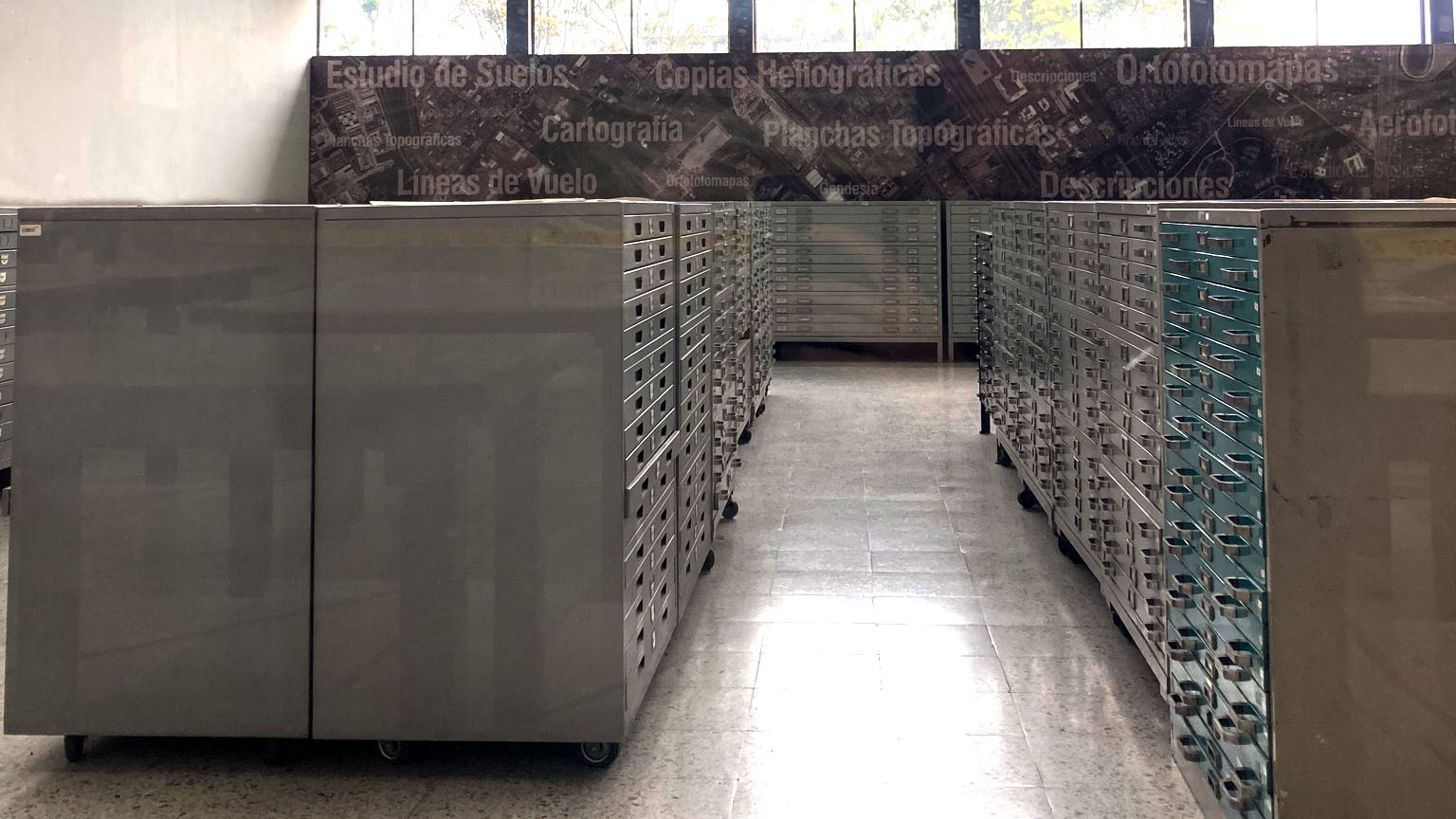
In February 2024, I visited the offices of the Superintendence of Surveillance and Private Security in Bogotá for the first time. In Colombia, the procedures for requesting information are done online and, under normal conditions, they are answered in about 15 business days, a deadline that tends to be met. However, in my case, it had been 13 months since I filed my first Peticiones, Quejas, Reclamos y Sugerencia (PQRS, Petitions, Complaints, Claims, and Suggestions) request on December 22, 2022.
Having information that I requested through the PQRS system is fundamental for my thesis. In my research I seek to explain, through inequality in the distribution of land, the emergence of the Convivir (officially Servicios Especiales de Vigilancia y Seguridad Privada, Special Vigilance and Private Security Services), a phenomenon that I refer to as “state-sanctioned militias.” Convivir was a government program that authorized citizens to organize surveillance cooperatives. The idea was for the Convivir groups to work locally to provide counterinsurgency intelligence to public security forces. What happened in many cases, according to versions of former paramilitaries, was that the Convivir facilitated the penetration of paramilitarism into civil society, since some used them as a legal front for illicit operations.
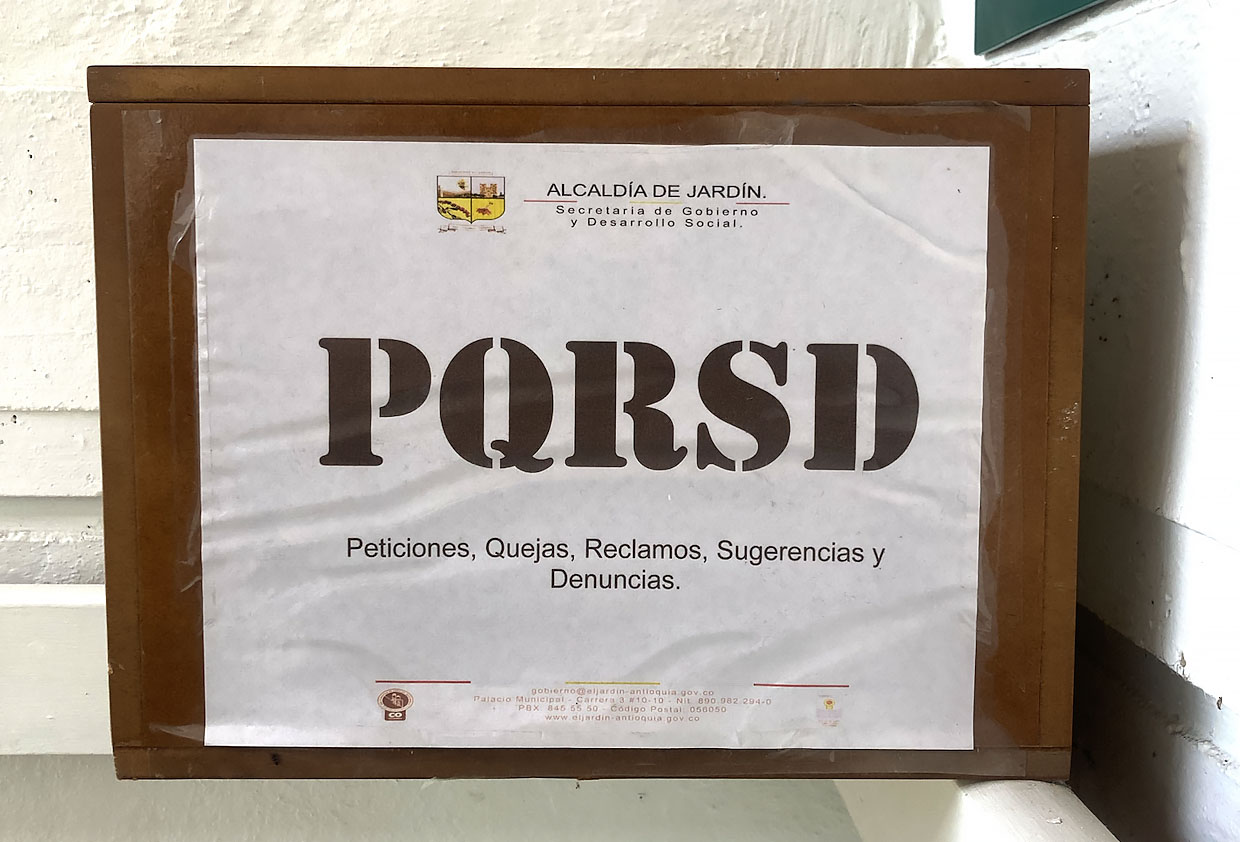
When I arrived at the Superintendence offices that day in February, I was not very clear about the process to follow. I struggled to find the right words and felt completely unjustified in my need for information. I had always seen the Colombian information bureaucracy as something so alien and virtual that, until that moment, I was not sure that it was possible to interact directly with a public official. Just as I was about to explain the reasons for my visit, the person at the window asked me for my ID, scanned it, and told me that I should go to the third floor.
On the third floor, I spoke with the person assigned to my case. She assured me that no later than that Friday I would receive the information I had requested. Five months later, I finally received the email with the requested archival documentation. For much of that period, the Superintendence’s website was not functioning, and I was not in Colombia, so I could not access the bureaucracy either virtually or in person during that time.
Much of my fieldwork has been about finding data: what exists, where it is, and how to access it. I have searched for records of land ownership, counts of violence, and other socioeconomic data, but the most fundamental data for my research come from the Superintendence, data which indicate in which municipalities the Convivir groups were established. In order to understand their emergence, I need to know where they were formed and where they were not, and to try to explain that difference.
When I returned to the country in July 2024, it was clear that I had to get that data to ensure the viability of the project. Journalists and academics whom I spoke to assured me that the data must exist. Convinced of this, I visited the offices of the Superintendence again, to follow up on my case in person.
The Superintendence’s offices are in the Ciudad Salitre neighborhood of Bogotá, on the third floor of a modern building entirely covered in glass panels, reflecting the sometimes-clear sky of Bogotá. The building contains hundreds of offices and cubicles. To enter, it is necessary to register by presenting an ID. It seems they keep a record of every visit; if so, after returning to Colombia that July my name should appear on nine of those entries. When you reach the third floor, you enter a space with marble floors and neutral tones, featuring a large sign that says SuperVigilancia (SuperVigilance). To be served, you turn to the left, away from the institutional entrance, to a lobby with seven citizen service windows.

The people who attend the windows probably process about thirty requests a day. My request was one among many. Perhaps in one of my nine visits I managed to arouse some sympathy in one of the officials. I explained to her, as I had done in other visits, that I was researching the Convivir groups, that I had made the request so many months ago, that I had spoken to such and such a person, and that I was waiting for them to send me the data. She called someone on her cell phone and, after hanging up, she repeated what I had already been told on other occasions: “no later than Friday you will have the information.” However, despite the sympathy I aroused in her, that Friday I still did not receive the data I needed. I would still have to wait a couple more weeks.
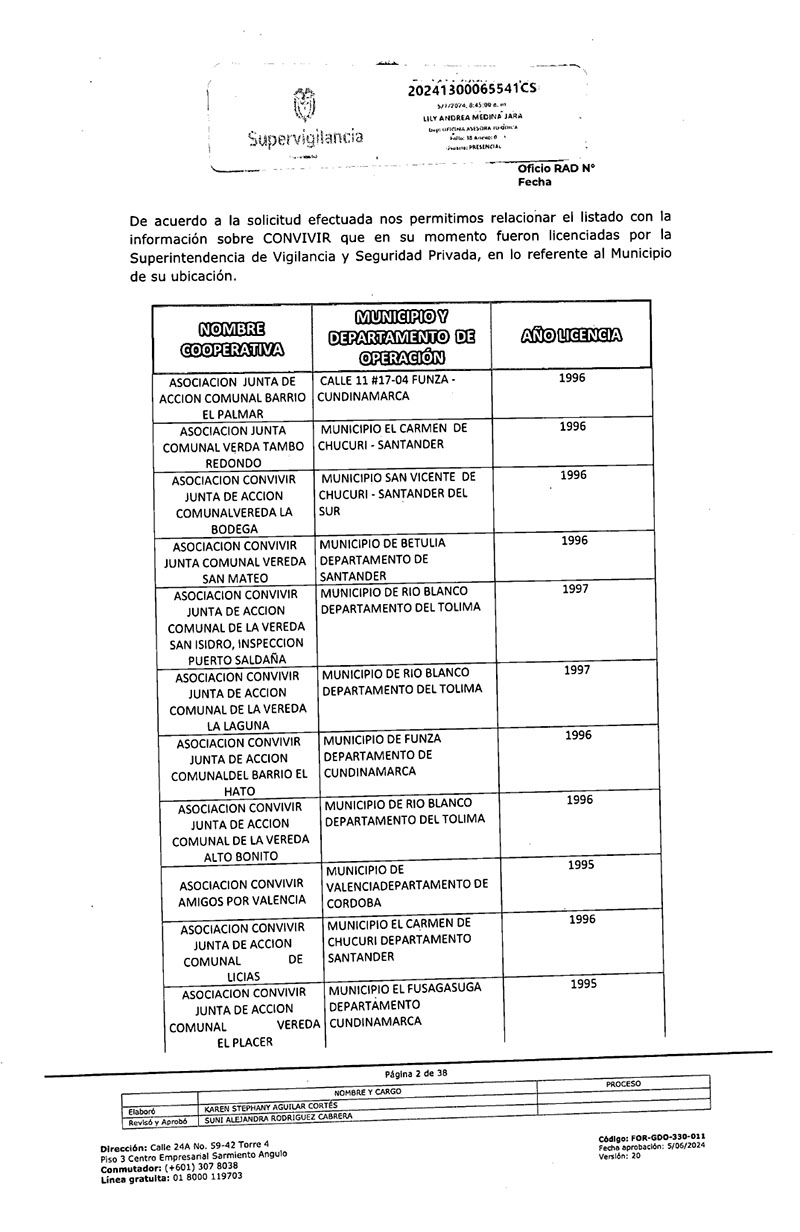
When the wait was finally over, I received a 38-page pdf file with a table — probably created in Word — with the following information: the name of the Convivir group, the geographical department, the municipality and, in some cases, the village where they applied for the license to operate. In other entries, only the department appeared, which made it difficult to carry out the analysis he wanted to carry out at the municipal level. Fortunately, thanks to the outstanding journalistic work — especially by the news outlet VerdadAbierta — on these groups in Colombia, I was able to gather the missing information..
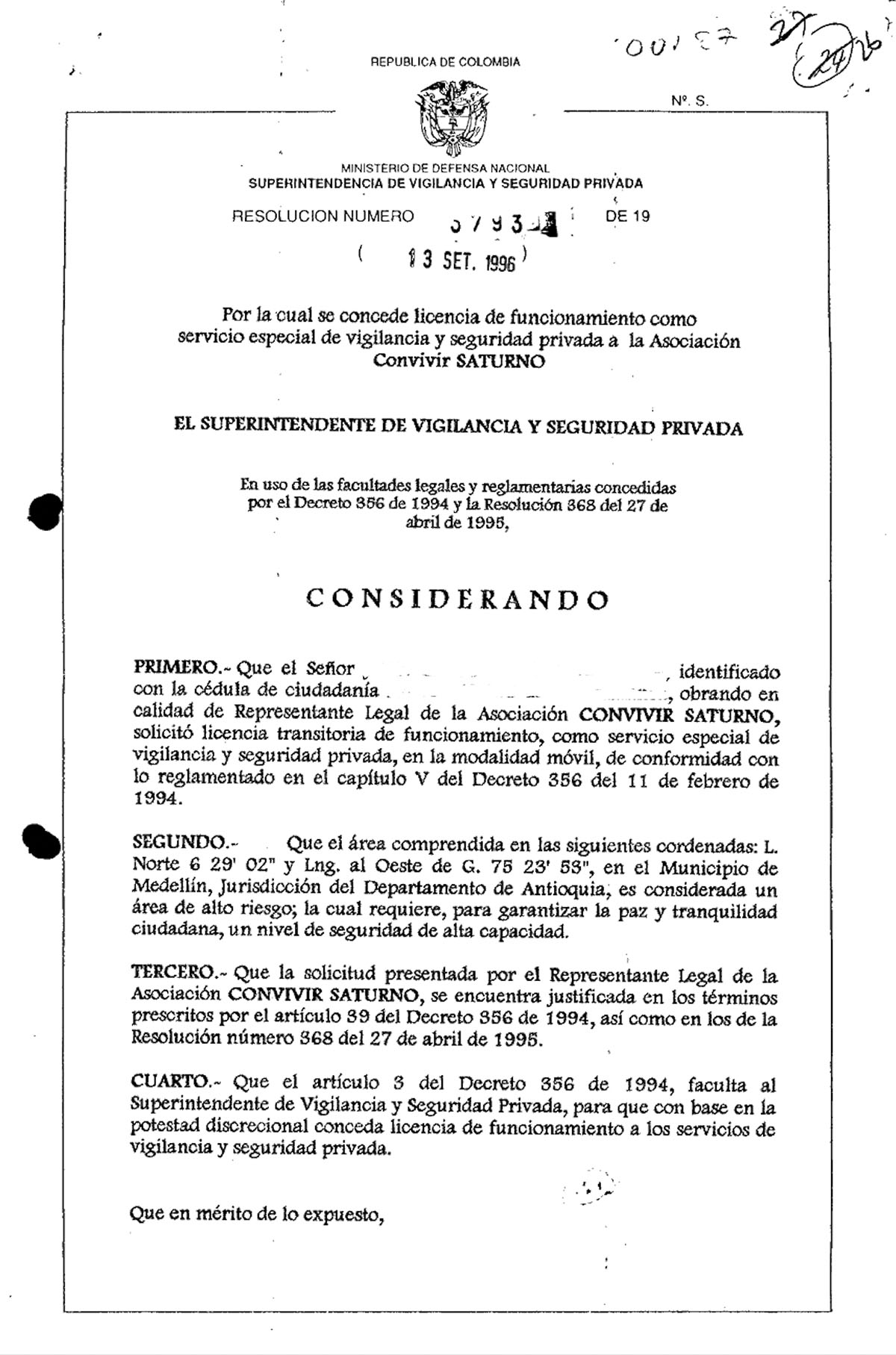
The Convivir groups played a key role in the expansion of paramilitarism in Colombia.1 For example, in the third session of the arraignment hearing before the Justice and Peace Chamber on March 17, 2011, Fredy Rendón Herrera — former paramilitary leader and commander of the Elmer Cárdenas Bloc in northern Urabá (in Antioquia and Chocó) — commented the following:
Si ponemos las Convivires sobre el mapa de Colombia, en la zona donde estaban las autodefensas, va a coincidir extrañamente o coincidencialmente que son los mismos sitios.
(If we put the Convivir groups on the map of Colombia, in the area where the paramilitary groups were, it will strangely or coincidentally coincide that they are the same places.)
This statement coincides to a certain extent with what I have found, especially when analyzing the Urabá region of Antioquia and Córdoba. However, in other regions, there have been cases in which the Convivir were created without there being a geographical coincidence with the paramilitary structures. However, this absence in those particular regions does not deny that the Convivir groups have contributed to the expansion of the paramilitary phenomenon in Colombia.
Likewise, in both interviews and documentary archives, there are testimonies that indicate that some Convivir groups did perform their original function of surveillance and rural security, operating within the legal framework and without proven links to paramilitary structures. This suggests that their role was not uniform, and that their impact depended on the local context in which they were created and operated.
I never fully understood why it took so long to process my application for documents, or what ultimately led to me getting the data I was looking for. I think it was a combination of luck, perseverance, and knowledge that I acquired on each visit. Fieldwork sometimes requires a certain faith and devotion. One has to arrive at the study site with curiosity, discipline, and the willingness to accept that, most likely, things will not turn out as one originally imagines them. You have to be open to what you find.

Lily Medina is a Ph.D. candidate in political science at UC Berkeley, studying how civilians respond to armed conflict — why they sometimes mobilize, form militias, ally with the state, and what happens when they do. Her work focuses on state-sanctioned militias and the politics of recognition in civil wars. She has a background in statistics, with an M.S. from Humboldt University of Berlin, and industrial engineering, with a B.S. from Universidad de los Andes in Bogotá. Prior to arriving at Berkeley, she was a pre-doctoral researcher at the WZB Berlin Social Science Center, working in the Institutions and Political Inequality unit. She received a CLACS Tinker Field Research Grant in 2024.
References
- Republic of Colombia, Special Jurisdiction for Peace. (2024, October 22). Chamber for the Recognition of Truth, Responsibility and Determination of Facts and Conduct. Case No. 006 AT349GSM. Bogotá D.C.
↩︎

Leave a Reply