
By Franchesca Araújo
There’s something sinister about Santo Domingo’s Zona Colonial. It goes beyond the obvious history of colonial dispossession, Indigenous genocide, and African dehumanization and enslavement. It is palimpsestic — it is as much in its contemporary role as a touristic zone as it is in its history as the “first city” in the New World. Within 3 days of being there, I had already been verbally harassed by two white women tourists inside the area’s grocery store, one frequented by both tourists and residents, as the Dominicans around me just watched quietly.


On almost every corner there is a policia turistica (Politur), police specifically for the safety of tourists, but not for that of the black girls for whom those protected white tourists have come to the island. The figure of the Politur is often that of a young black person, and when locals come and ask me for a few pesos, they approach to scold them and say “aqui no sepide, aqui no se molesta a los turistas y no se pide” (“There is no begging here, tourists are not to be bothered there’s no begging here.”) In short, this is a colonial zone in true uncreative accordance with its name.

Living here allowed me to be closer to the national archive than living in my family’s neighborhood would, and also to spend time sensing the daily life and dynamics of the area as part of my research centers on its history and contemporary disturbances. That experience reminded me of how immersive and emotional research can be, if your research is based in political and personal commitments and values.
Being in the Zona Colonial feels like a different world. I have been coming to the Dominican Republic in the summers for my entire life, and I am now finding out that my vision of life there is extremely limited.1 Even if I already understood this logically, and had already decided to write a dissertation that contends with these realities, I saw ocularly that there is a middle class as one might say, that there is such a thing as peace and quiet, that there are places you can walk without needing to sketch cartographic strategies for survival due to the crumbling infrastructure and state violence/divestment that plagues it. And that those places are not just resorts.


But their ‘safety’, which is often used to dispel what is seen as an unfair and dominant narrative of Dominican poverty, incivility, and danger, is not safe for all. It is not value-neutral, and it does not create its conditions without violating others.
Although my referent for the different world of Santo Domingo is where my family lives, across the Ozama River, you don’t have to travel very far to get a sense of the multiple geographies at play, of the black geographies at play in contradistinction with the geography of touristic value and what Katherine McKittrick would call “mans overrepresented geographies,” following Sylvia Wynter, that I see in this area.3 The Zona Colonial, as Alicia Medina of Junta De Prietas, an anti-racist decolonial Black feminist collective, tells me, is surrounded by peripheral barrios.
That is all to say that the experience of simply living here will color my work just as much as my time reading historical documents, looking through digitized collections, and piecing together the scraps and residues about Haitian-Dominican poet Jacques Viau Renaud from newspaper clippings, conversations, poetry books, and the occasional article.

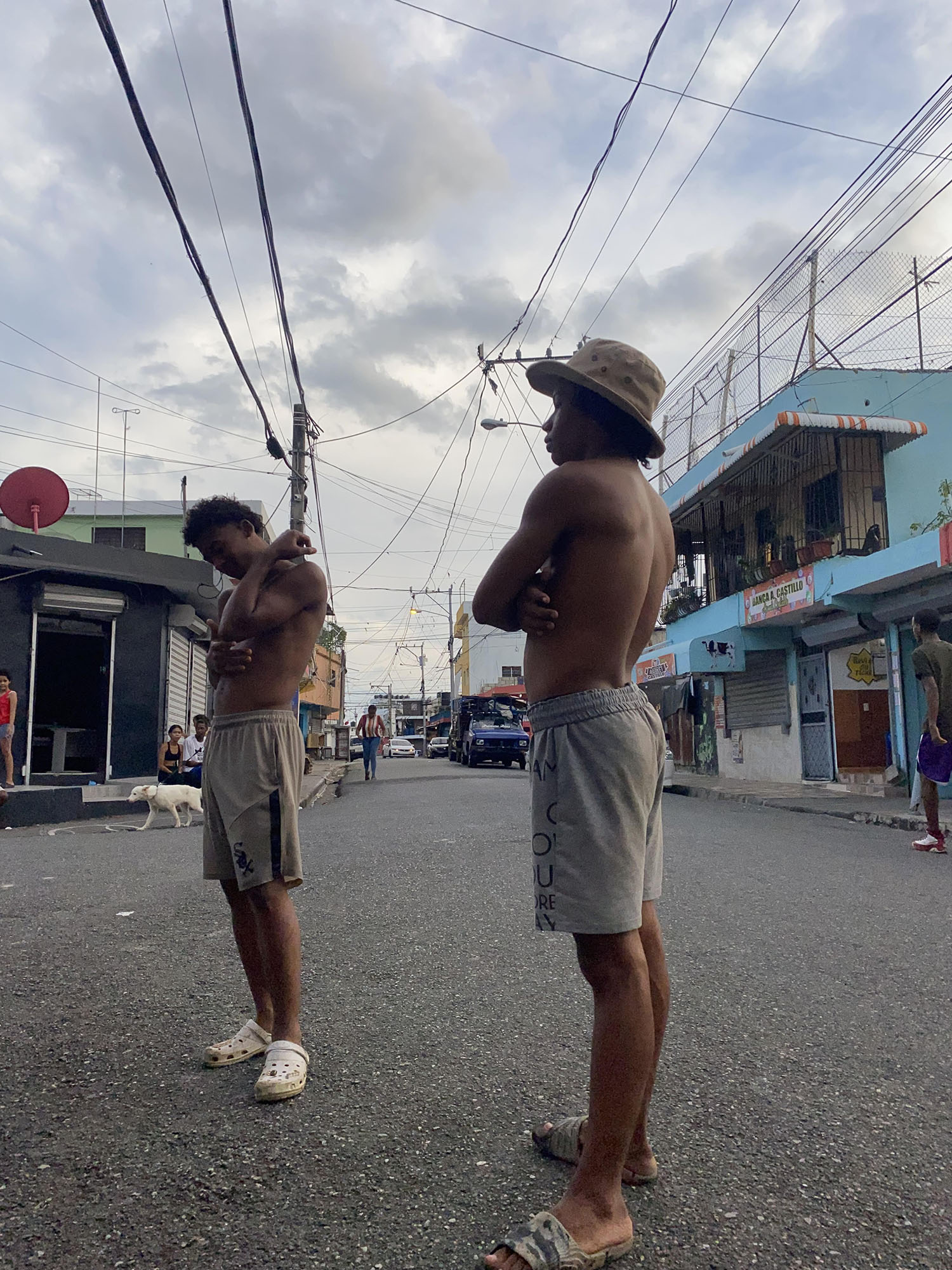
My field research was an interdisciplinary mix of qualitative work, archival work, and, perhaps most intensely, observational work. I searched the archives for any stories about the first iterations of dialogues and developments that turned the Zona into a paper town for tourists, I followed the hints of Jacques Viau Renaud’s life as if it were a treasure hunt, and I talked to people — a lot. In the context of scholarly work, it can be hard to find support for anything that might be coded as “identity-based” (although that is not the work I do, it is the work many of us in Black studies are assumed to be doing). To add a layer to that devaluation, it can be hard to get people to understand the importance and centrality of part of an already small island — if Charles de Gaulle called the Caribbean islands specks of dust, then part of an island must be a negligible particle.
But like Glissant says, I believe in the future of small nations. I would amend that to say I believe in the future of small geographies, of ways of thinking that lean into the fringes, of not striving to be continental. But, most importantly, of ways of thinking that commit themselves to blackness as an analytic, to anti-colonial values, to anti-colonial interruptions, or at least inconveniences and irreverence, and to black life from the hoods of Santo Domingo, from Haiti, from the historical and sustained mundane and spectacular intimacies between black Dominicans and Haitians despite the disciplining, anti-black clutches of the state, colonial modernity, and the necessities of a national sovereignty bound by post-enlightenment ideals, and oftentimes precisely because of those things, and from the clutches of the violently fascist Dominican State, its deportation trucks, detention centers, and neoliberal allegiances.4
Through my archival research here and through my immersive observational methodology, I reaffirmed those commitments. I leave with more questions than answers, but with enough answers nonetheless.

Franchesca Araújo is a Ph.D. candidate in Black Studies at UC Berkeley. Rooted in Caribbean studies and political theory, her dissertation is about Blackness through the vectors of deviance, deficiency and, excess vis a vis the nation-state as a political project. She focuses on the Dominican Republic, considering how Black geographies, Black cultural productions, and ephemeral occurrences disturb, taunt, and put into tension the states’ needs and desires as they manifest through narratives of economic progress that mask anti-Black and classed violence and the neoliberal touristic paradise that blankets the country.
Notes
- By limited, I am not referring to limitations due to living in the United States, which is an easily accessible and expected refrain used by white mestize and middle-class Latin Americans when questions of racial violence, inequity, and their directly related other side — the better life chances, the comparatively higher resources or potential for upward mobility, and the power that whiteness affords in Latin American contexts — come up. In weaponizing an otherwise important distinction of positionality, white mestize and resourced Latin Americans, those who benefit from standards of humanness and propriety that result in conditions of sufferation for others, continue the long and silencing tactic of suggesting that it is an American imposition to identify anti-blackness and the structures of society that create conditions of poverty and disempowerment for some, and relative comfort for others. Instead, I use “limitation” as a signifier of precisely my proximity to the working poor, urban barrios, to Dominican blackness considered too excessive to be in the image of proper “Dominicanness” in the eyes of the state and middle class society. As such, much of my research shatters the mythology of a coherent national experience, meaning a non-Black subject who has always lived in the DR but in a wealthy neighborhood, for example, might have limitations of seeing and knowing that a Black diasporic subject does not and vice versa. By doing so, I reject narratives that collapse Dominicanness, or any national identity for that matter, into a coherent experience at all — an act that necessarily silences anti-Black and anti-Indigenous violences and capitalist stratification. Instead, I offer that a nation-state comprises different felt experiences for different subjects. ↩︎
- Edmondson, Belinda. Public Spectacles: Caribbean Women and the Politics of Public Performance. Small Axe: A Caribbean Journal of Criticism, 7(1), 1–16. https://doi.org/10.1215/-7-1-1, 2003. ↩︎
- In Katherine McKittrick’s, Demonic Grounds (2006), she reiterates that “we produce space we produce its meanings, and we work very hard to make geography what it is”. Attentively reading Sylvia Wynters thesis in “Unsettling the Coloniality of Being,” she reminds us that Wynter demonstrates historically and epistemologically, how Humanness became a “classificatory text”–a descriptive statement that orders the world– distinguishing white, native (nonwhite), African from one another and identifying subtypes of human Otherness, such as class, gender, sexuality. She goes on “this model, traceable into the present, comes to pivot on the middle-class model of Man2 (a continuous discontinuous rupture from the previous schematic as Wynter argues) and guarantees a foundation for what constitutes a “normal being” and therefore a normal way of life”. Then, assessing the geographic dimension of this colonial production, she reminds us that It was precisely the geographic location of the New World (of Which I might add, Santo Domingo was the first colonial site), radically outside the conceptual/imaginary categorical models of Christian Europe, that disclosed the worldviewsof indigenous/black populations in local-cultural terms, as what she calls uninhabitable, demonic grounds. ↩︎
- Among other literature you can read more about those solidarities, relationships, and intimacies in Anne Eller’s important book We Dream Together and Sophie Marinez’s new book Spirals in the Caribbean. ↩︎

Leave a Reply