
By Christián González Reyes and Miroslava Guzmán Pérez
Throughout the series, it wasn’t just Mesoamérica that unified the slated talks and readings, but much more. One common practice that stood out from all the talks was the speakers’ acts of storytelling. Stories filled each and every minute of the series. Stories related knowledge and sparked interrogations. Stories drove the research and art that came together to form this series. Mesoamérica, stories, research, art, movement, space, place, community, future-building, history. All these ideas and practices were interwoven over the life of the series, and brought to materialization an idea we had over a year ago.
Mesoamérica, a geographical zone that spans what today is known as Central México to Panamá, has nurtured incredible writers, thinkers, and practitioners. Mesoamérica is a place that, at its core, (re)imagines connections, community, and future-building. It has left its mark across time and space. So why wouldn’t it leave its mark at Cal?
What started out as an idea became a proposal, and then materialized into invitations, replies, and planning — the idea had become a process, a reality. Something we had constantly asked ourselves was “Why isn’t there much of a presence of Mesoamerican studies at Cal?” And with that question and our excitement to engage numerous scholars and artists, we began to craft the program for the year.
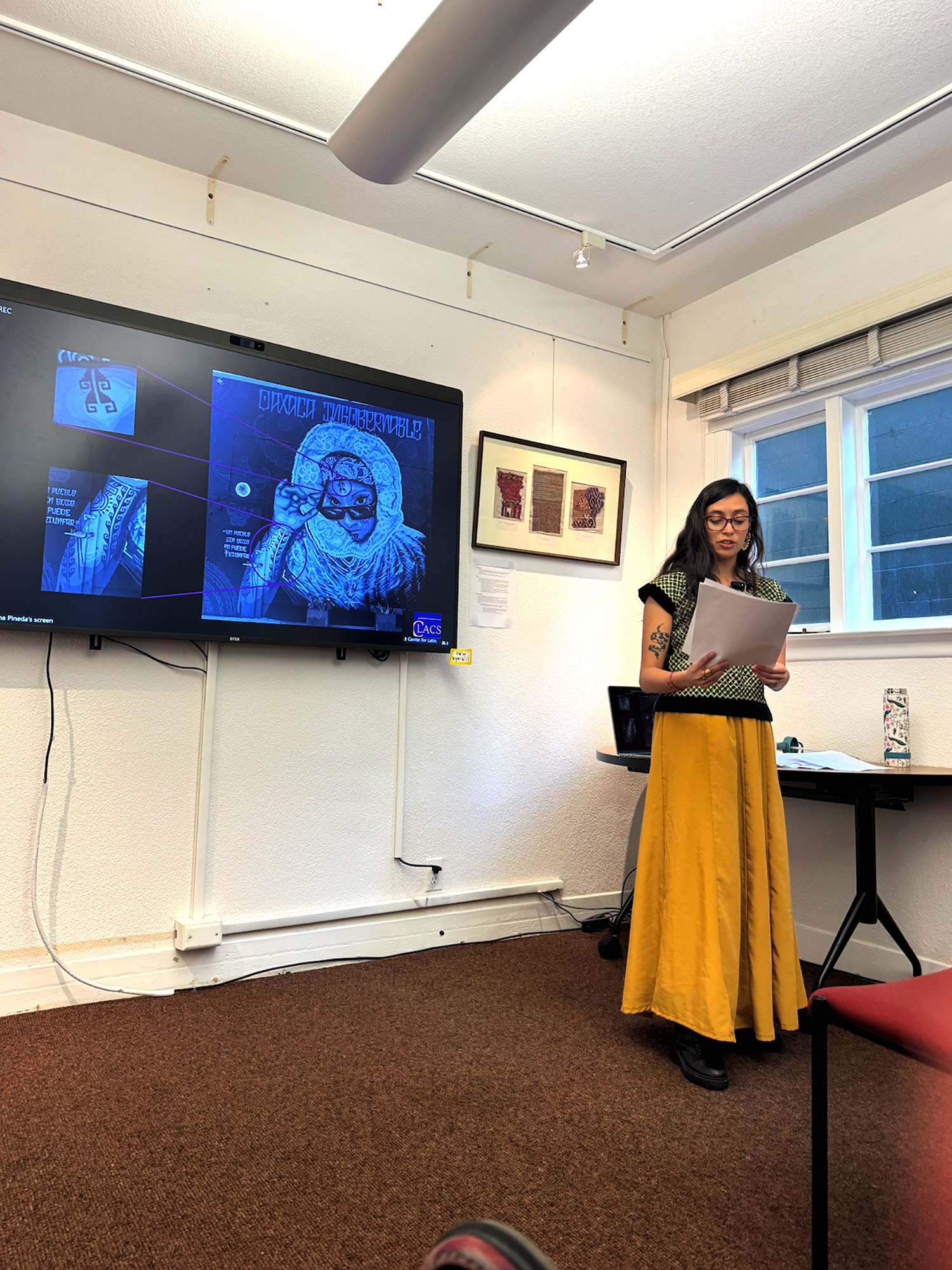
With planning, you never know what’s going to happen, and we certainly didn’t know how well-received the speakers would be at Cal. Our program started with Professor Paulina Pineda in November 2025, and her attention to questions of Zapotec identity and cultural production both in Oaxaca and in the diaspora set the tone for the rest of the series. Her work in the language Diidxazá, a variant of Zapotec, demonstrated the deep connections between Professor Pineda and the community with which she worked, and tied to questions about resistance against Western conceptions of history and geography. We knew that Mesoamérica, as a theoretical and methodological area concept, has allowed Indigenous communities to make critical interventions both in artist and academic spaces, and Professor Pineda left us wondering and anticipating what subsequent speakers would bring to our vision and idea of the series.
In Spring 2026, a rapid series of events featured Professors Rita Palacios and Abelardo de la Cruz, as well as an event with poets Martín Tonalmeyotl and Negma Coy. Oh, how time flew! Before we caught our breath, all three events had passed, and the speaker series was over. In part, it went by so fast because we had three events this term, but, for the most part, time flew by because each speaker had so much knowledge and experience to impart to all of us.
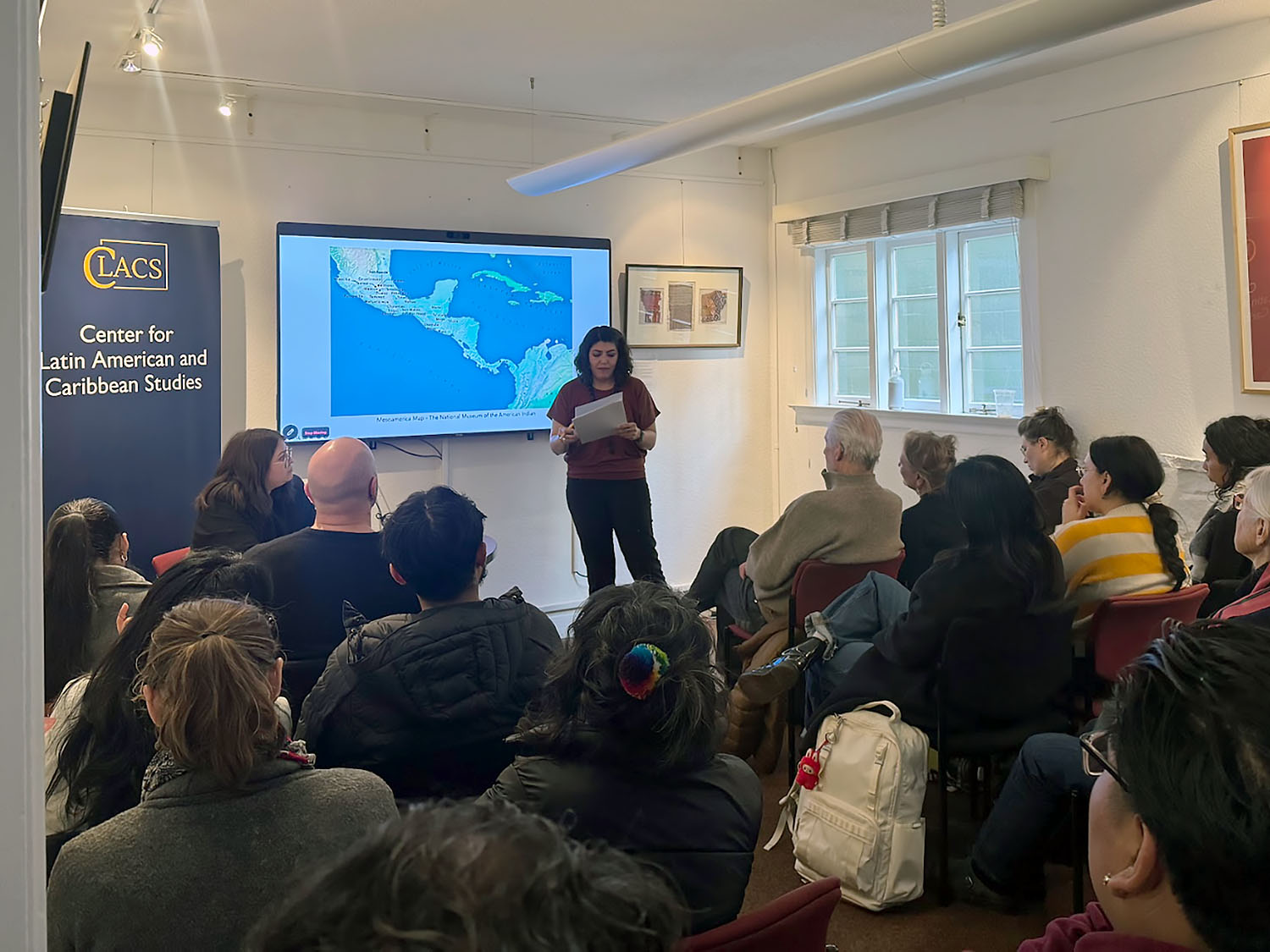
Rita Palacios challenged us to rethink what Mesoamérica is, by quite literally positioning her talk as “Mesoamérica undone.” She began her talk with a story about three sister bells in a small town which believes that the bells communicate with each other. The town’s tradition to dress the bells and celebrate led to deeper questions about beliefs that challenge Western notions of life, time and place. Her interrogations of the term and her desire to think of Indigenous methods and theories made the audience think about how Maya communities have continuously challenged ideas and concepts that originate outside their bounds. Her attention to storytelling made the talk flow to include other Indigenous communities outside Maya lands, and she asked us to think about how we engage our scholarship and community building. In the end, her talk required us to reflect, reimagine, and reenvision.
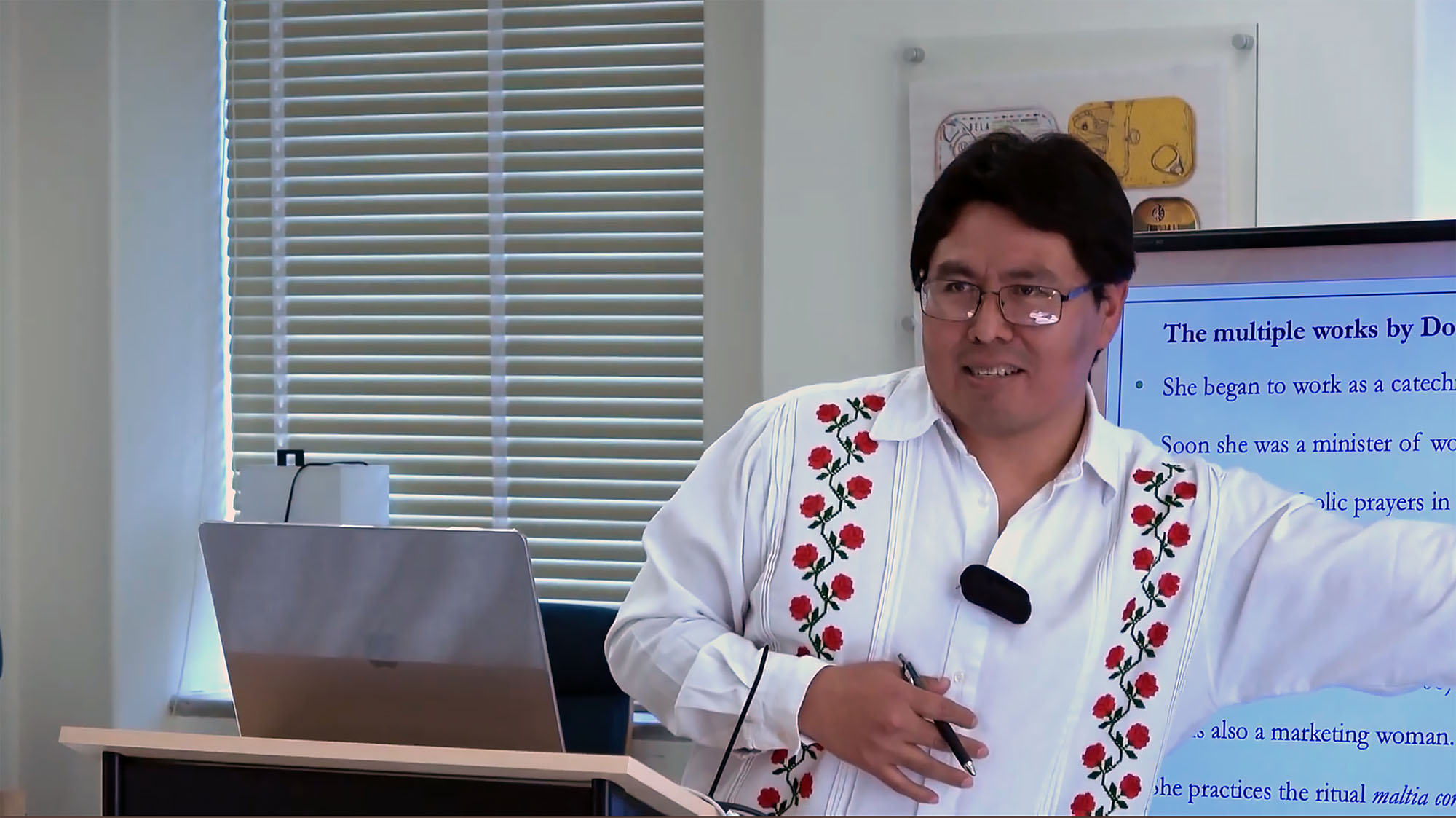
In March 2026, Abelardo de la Cruz joined us in the maze that is Dwinelle Hall. Professor de la Cruz was our first speaker not trained in literary studies. He is an anthropologist who works on Nahua communities and religious practices. His talk attracted a plethora of diverse scholars from across campus. His attention to the importance of prayer specialists sought to make sure that non-Western forms of knowledge and cultural practice could inform how we engage in our work and lines of inquiry. At Berkeley, he brought to life the stories, practices, and questions from hundreds and hundreds of miles away in Veracruz. He made apparent to us not only the importance of language but its subtle but important differences that represent the connection of his people to religious practices and also how, through the Nahuatl language, the Catholic and Nahua traditions continue to coexist and harmonize.
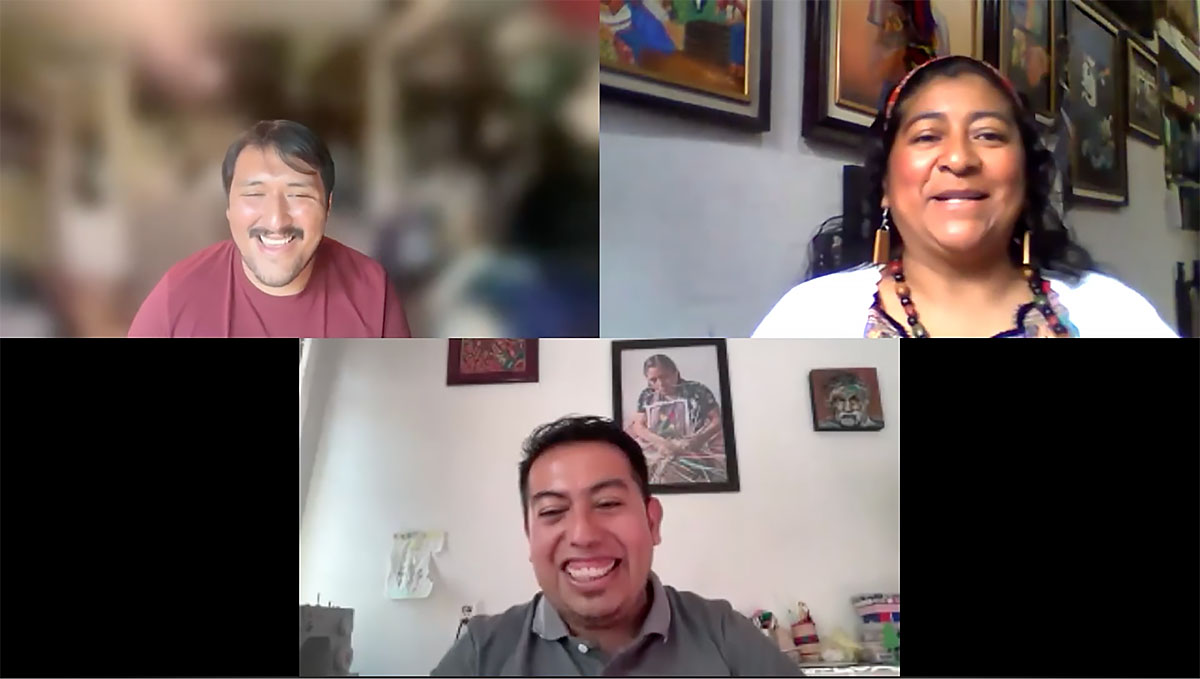
In April 2026, we wanted and planned to end the year with an event pivoting away from research. Up until this point, we had engaged different Mesoamerican communities and topics of inquiry but there was something missing: artistic practice. In particular, we reflected on the fact that poetry has played an important role for Mesoamerican nations. Poetry has been instrumental in storytelling, philosophy, worldbuilding, historiography, and so much more for Mesoamerican communities; accordingly, we thought it would be productive and enlightening to bring two poets into dialogue with each other. So, we invited Nahua poet Martín Tonalmeyotl and Kaqchikel poet Negma Coy. Given the current political climate and the federal bureaucratic forces that be, Martín Tonalmeyotl and Negma Coy were not able to obtain visas to enter the country for the event. While they couldn’t be at Berkeley in person, we were able to create a sense of community in the virtual world. Their lively poems and narration style made the time fly by, and their discussions of their poetry taught us a great deal about Mesoamerican cosmovisions and placemaking. Like the talks before, the questions and comments that came from the audience enrichened the discussions put forth. Both Negma Coy and Martín Tonalmeyotl captivated the audience, and when we left the event, we left full of knowledge and empowerment.
The poetry readings and discussion wove together the stories and arguments that were made throughout the series. By closing with artistic practice, Mesoamérica, as a concept and space, was activated. More importantly, the series had invited us to build community across time and space. This was exemplified by the poetry read, in particular Martín Tonalmeyotl’s “Los caminos (The paths)” and Negma Coy’s “Sonidos de corazones (The sounds of hearts).” In fragments from each poem, we can read:
Los caminos (The paths), by Martín Tonalmeyotl
Construyamos caminos
con puentes de alegría
donde el hambre no pellizque a los niños,
donde la muerte sólo llegue con los años
y no con la cola del alacrán
y no con las armas de fuego
Let’s build paths
with bridges of happiness
where hunger doesn’t pinch the children
where death only arrives with the years
and not with the scorpion’s stinger
and not with guns
Sonidos de corazones (The sounds of hearts), by Negma Coy
mis manos hilan momentos
mis manos devanan sabiduría
urden el conteo del tiempo
tejen la historia
la fuerza de nuestras abuelas y abuelos
las luchas de nuestras madres y padres
tejen verdades
resistencia
comunidad
tejen conocimientos en espiral
my hands weave moments
my hands wind wisdom
they weave the counting of time
they knit history
our abuelas’ and abuelos’ strength
our mothers’ and fathers’ fights
they knit truths
resistance
community
they knit knowledge into spirals
In both poems, there’s a call to build bridges with and beyond our communities. The strength and generational knowledge conjugated in Mesoamerica allows Indigenous peoples to resist against the varied violence that afflict Mesoamerican communities. At the heart of these poems, and the series overall, are the narratives that are shared via stories, lessons that have been weaved together across generations.
Reflecting on the course of the year, not only did we learn so much, but we were also able to take an active role in ensuring that these thinkers and artists could come to Cal in some shape or form. We made sure that Mesoamérica could be a serious line of inquiry, bringing the community together to dialogue and debate and share and tell stories. And it did. Mesoamérica left its mark at Cal.
Christián González Reyes is a Ph.D. student in Comparative Literature, where they focus on 20th and 21st century Central American, Mesoamerican, Mexican, and Central American Diasporic literature and visual media. They ground their work in the theoretical and methodological frameworks established by Indigenous and Marxist-Leninist Studies.
Miroslava Guzmán Pérez is a Ph.D. student in the Department of Spanish and Portuguese at the University of California, Berkeley. She focuses on Nahua Literature from the colonial period to the present. Her research centers on revisiting Nahua manuscripts and translations to understand the Nahua cosmovision and to reposition Nahua thought at the forefront of their histories.


Leave a Reply