
By Anna Feign
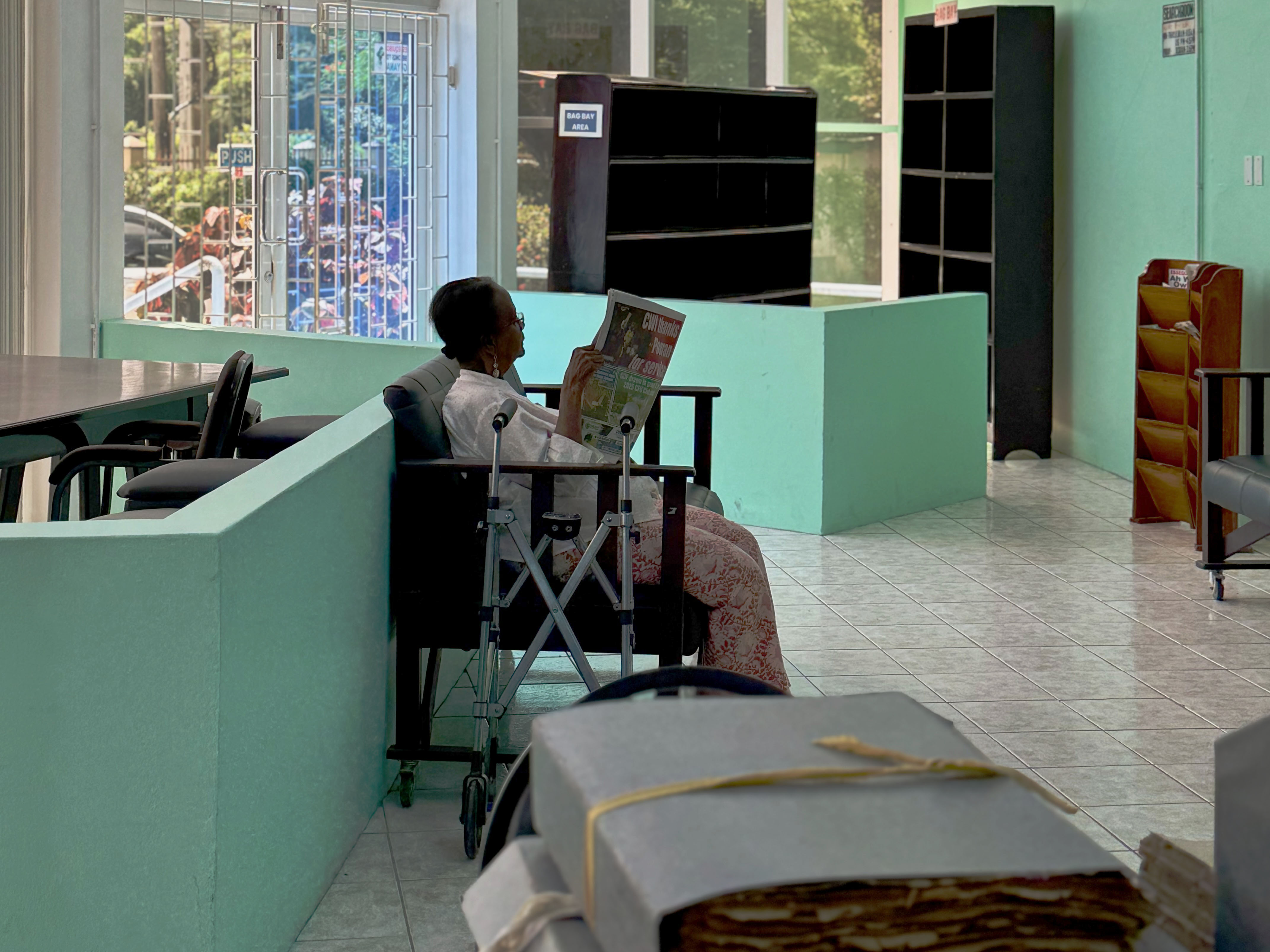
My first day at the Walter Rodney National Archives was shared with my grandmother, who settled in with the latest newspapers while I turned to the List of Holdings and requested British colonial-era papers from the 1930s. My research examines how extractivism and climate change come together; the archive offered a historical lens on the emergence of the oil industry and histories of climate. Working in Guyana this summer, I visited the Walter Rodney National Archives and the Parliamentary Library and conducted preliminary interviews across organizations and stakeholders. The day before that first day of research, the wet season’s heaviest rain flooded streets and roadside trenches, briefly submerging the city, a recurring refrain on a coast that sits roughly six feet below sea level.
“And the Rains Descended”
The realities of sea tides and flooding are a persistent feature of Guyana’s low-lying coastal landscape. In 1934, a major flood affected Georgetown and the entire East Coast — wiping out crops, threatening a food shortage, killing sixteen people, and causing $1.5 million in property damage — all news which made the The New York Times. In the British Guiana colonial newspapers, writers discussed the impacts of this flood in-depth in many long-form columns, but something else caught my attention. In the January 7, 1934 edition of the British colonial newspaper The Daily Argosy, an illustration titled “And the Rains Descended… and the floods came” stood out to me.

The illustration shows three men in the foreground next to an ark dubbed “drainage.” A caricature of a dark-skinned and shoeless “disconsolate villager” looks on to a flooded village and crops in the background, and says “Boss look whah come pon we now. Ah did read in de Bible say no mo’ flood” (1934:7). The colonist savior, “Eddie, the optimist” condescendingly asserts, “Cheer up sonny. We will have the Ark finished before the next Deluge” (1934:7). The colonial illustrator constructs the racialized Guyanese subject as ignorant, uncivilized, and powerless in the face of the flood. He must wait for salvation from his white colonial “boss.” The colonizer, Eddie, claims the authority to build the Ark. As the builder and thus as the savior, colonial authority claims control of time and the possibility of apparent salvation. The villager is told to “cheer up” and wait — the Ark “will” be finished “before the next deluge.” This places the villager in a permanent state of waiting, dependent on colonial benevolence.
The Ark, that is, the drainage, was already built, but not for the benefit of the village. Throughout the 18th and 19th centuries, enslaved African and indentured Indian laborers built systems by hand to support the plantation. They built seawalls (which prevented flooding at high spring tide), backdams (which blocked rainwater from lands behind the estate), side dams (which blocked floodwaters from neighboring lands), and drainage canals with sluices (known as kokers, which released surplus water from the estate).1 Yet this so-called Ark, the expensive drainage, irrigation, and sea defenses, were not maintained by estates.2 Indeed, in 1934, the Flood Investigation Committee “noted that the lack of maintenance by derelict or partially derelict estates contributed significantly to the flooding of villages as dams were not cleared in an ‘efficient manner.’”3 The Ark was abandoned, and so too were canal maintenance and sea defense.
Yet the cycle of waiting for salvation endured. Four years earlier, oil was promised as the way out of economic ruin.
“Oil-Minded”
In the November 18, 1930 edition of the colonial British Guiana newspaper The Daily Chronicle, J.P. Croal from the Engineering Department of the Venezuelan Gulf Oil Company in Maracaibo, wrote his first in a series of articles advocating for the development of the oil industry in Guyana. The headline exclaimed, “Every Man, Woman and Child in British Guiana Must Become Oil-Minded!” For Croal, oil-minded meant educating the population about the promise of black gold as the solution to Guyana’s economic problems.

With low returns on sugar and other industries due to the global Great Depression, he argued that oil was the way forward to economic prosperity. Pointing to neighboring Venezuela as the model, Croal emphasized speed: what oil did in five years for Venezuela is what sugar, coffee, and cocoa failed to do in 80 (November 23, 1930 Daily Chronicle Magazine Section p.1). The promise of speed and accelerated development is central to the imaginary of becoming “oil-minded” for Croal. It is with this speed, that Croal urges the Guyanese population to “Vote for Oil,” given that the oil industry “is the only industry… to save [the] country” (1930:7). This vote for oil played out in the 1930s. In 1938, the Trinidad Leaseholds Company Ltd received the first oil prospecting license, and, together with Investments Corporation and Central Mining, undertook the country’s first oil exploration program.4 The play was unsuccessful. Yet the colonial-era Daily Chronicle foreshadows the conversations today: that the oil industry will bring accelerated and unprecedented development, “galloping into modernity” as President Ali remarked in his 2023 Republic anniversary address.
And the Oil Ascended… and the floods continue
In 2019, oil finally ascended. The floods continued as well. When I set up an interview with Leroy (pseudonym), he mentioned that he wasn’t sure we’d be able to talk in his house because his home sits below road-level trenches that had recently flooded after unrelenting heavy rain. His floor dried enough and I joined him one afternoon. As I listen back to the audio recording, it’s hard to hear Leroy, between the omnipresent sound of the fans keeping us cool (a lesson learned about the location of the audio recorder!) and the rumble of heavy-duty trucks almost constantly passing by.

After we settled in for the interview, Leroy explained that with the emergence of the oil business and associated industries, there had been a significant increase in the traffic of heavy-duty trucks transporting building materials like sand. It’s not possible to track where these heavy sand-filled trucks were going on that particular day, but previous trucks carried sand to build the road for the Gas-to-Energy project, a key downstream feature of the oil- and gas-fueled value-chain for the country.5 The roads were not designed or constructed to handle the weight of those trucks, and the vibrations, combined with increasingly heavy rainfall, created cracks in the foundations of Leroy’s home and most of his neighbors’. Those foundations are a seemingly peripheral detail that, when you put it at the center of analysis, illuminates a key reality: that while the oil industry heedlessly races, accelerating down the road, there is no plan for where the water will go, for repairing the shaken foundations of the people still left off the Ark. Coloniality persists.
Not I with This Torn Shirt
Martin Wylde Carter (Guyanese poet and political activist, 1927-1997) (1950s)
They call here,
– Magnificent Province!
Province of mud!
Province of flood!
Plantation – feudal coast!
[…]
How are the mighty slain?
by this hammer of my hand!
by this anger in my life!
by this new science of men alive
everywhere in this province!
Thus – are the mighty slain!
Research supported by a 2025 Tinker Field Research Grant

Anna Feign (Palmer) is a Ph.D. student in Sociology at UC Berkeley. Her research examines the convergence of resource extraction, (post)colonial development, and the climate crisis through a qualitative and spatial lens. She is a 2025-2026 Mentored Research Award Fellow and a Global Democracy Commons Fellow. She is a co-founder of the Caribbean Coalition at Berkeley and a member of the Anti-Colonial Democracy Lab. Anna holds a BA in sociology from Occidental College and earned her MA in sociology from the University of California, Berkeley.
References
- See Daly, Vere T. The Making of Guyana. London: Macmillan, 1974. And Gray, Summer. 2023. In the Shadow of the Seawall: Coastal Injustice and the Dilemma of Placekeeping. Oakland, California: University of California Press. ↩︎
- See p. 9 in Rodney, Walter. 1981. A History of the Guyanese Working People, 1881-1905. Johns Hopkins Studies in Atlantic History and Culture. Baltimore, Maryland: The Johns Hopkins University Press. ↩︎
- See Kandasammy, Lloyd F. “A Brief History of Floods in Guyana.” Stabroek News (Guyana), February 6, 2006. as quoted on p. 55 in Gray, Summer. 2023. In the Shadow of the Seawall: Coastal Injustice and the Dilemma of Placekeeping. Oakland, California: University of California Press. ↩︎
- For an interesting abbreviated and illustrated history on Guyana’s history of oil exploration see Guyana’s Oil Odyssey, 1750-2019: A Concise Illustrated History of Oil Exploration in Guyana (2019) published by the University of Guyana Energy Think Tank, a book recommended to me by author Dr. Paloma Martin. ↩︎
- I learned this in conversation with an individual who helped build the road to the GTE project. ↩︎

Leave a Reply