
By Rafael ”Rafa” Santiago Meza Duriez
T.S. Eliot wrote once, “April is the cruelest month…”. In his view, that month represents for humanity the delusion of life; that is, the misleading belief that the cycle of life restarts, and with that belief, a renewed faith in humanity. If you are from Nicaragua, since 2018, April has been the cruelest month indeed. April 2023 marks the fifth anniversary of the student-led social revolt against the government of Daniel Ortega, a former leader of the Sandinista Revolution in the late 1970s. Why did April 2018 happen? In asking that question, we are also asking why a group of students rose up against a leftist leader whose rhetoric critiques oligarchy and neoliberalism.
Since 1980, Ortega has been the embodiment of the Frente Sandinista de Liberacion Popular (FSLN, Sandinista Popular Liberation Front), a leftist party that opposed the dictatorship of the Somoza family. He has been an important figure in understanding the power dynamics in Nicaragua for most of its modern history. He ruled Nicaragua from 1980 to 1990, the era of the civil war between the Sandinistas and the U.S.-funded insurgent “Contras.” He lost the 1990 elections, but promised to gobernar desde abajo (govern from below), despite the admission of defeat. For the next 16 years, the Partido Liberal Constitucionalista (PLC, Constitutionalist Liberal Party) controlled the government. Still, in keeping his promise to rule from the shadows, Ortega worked with different powers and actors behind the curtains to create a legal and political structure promoting his intention to regain power. He won the 2006 elections with the support of the Catholic Church and business elites. Between 2007 to 2018, Ortega reinstated indefinite presidential reelection, banned abortion, promoted environmental laws benefiting business elites to the detriment of the communal property rights of Indigenous people, silenced real opposition, gained control of all powers of the state (judiciary, legislative, and electoral), and appointed family members as part of his cabinet. He went as far as to designate his wife, Rosario Murillo, as vice president.

And then April 2018 arrived. Ortega’s corruption[1] contributed to the weakness of the Nicaraguan Social Security Fund, and that prompted a proposed reform that affected retirement pensions for senior citizens. Students across the country took to the streets in protest against the change. Ortega responded with brutal police repression. The first death occurred on April 19th, and more students were reported killed in the following days. By the time Ortega and Murillo realized they had gone too far, it was too late. The focus of the protests had shifted from changes to social security programs to a more general call for democracy and social justice. These broader protests led to more police and paramilitary brutality, resulting in the deaths of hundreds, including underage students and children.
Although Ortega had tried to project respect for democracy and its institutions to the international community before April 2018, after the uprising, he unleashed a full display of his powers as a dictator. He not only enabled murdering protesters, but also incarcerated anyone who dared to challenge him, regardless of their political ideology, gender, race, or social class. Ortega created laws that legitimized and justified lives taken, unfair imprisonment, and forced exile.
The list of Ortega’s crimes is endless, but much has already been written on this issue in the international media. Instead, I want to make sense of this brutality and honor the struggle of the Nicaraguan people. I need, today, to scream Álvaro Conrado’s last words: me duele respirar (it hurts to breathe). He was a 16-year-old boy who was shot in the throat while distributing water bottles to protesters. I struggle to understand the thinking that led the police to murder Teyler Lorío Navarrete, a 14-month-old toddler killed by a bullet while being carried by his father, who was trying to escape yet another attack against students and protesters. I try to comprehend what type of revolution can justify the death of Sandor Dolmur, a 15-year-old altar boy who dreamed of becoming a bishop. Their names and those of the over 300 people killed in 2018 must not be forgotten. They paid with their lives the historical debt that older generations accrued with democracy and freedom in Nicaragua. Katia Cardenal wrote in one of her songs Soy juventud/ Soy la energía que te mueve, soy una luz / Combinación de fuego, nieve, rabia y ganas sabías y si está caído/, Yo vengo a levantar el mundo. (I am youth / I am the energy that moves you, I am a light / Combination of fire, snow, rage and desire you knew and if it is down /, I come to raise the world.) These young people lifted the spirit of a country that had stopped resisting the dictatorship. They showed how to fight against the generations of powerful men and women who turned their backs and failed the Nicaraguan people, preferring to toe Ortega’s line. No soy de izquierda, ni de derecha, soy de abajo y voy por el de arriba (“I am not from the left, nor from the right, I am from below and I go for the one above.”), uttered a popular song composed during the uprising.
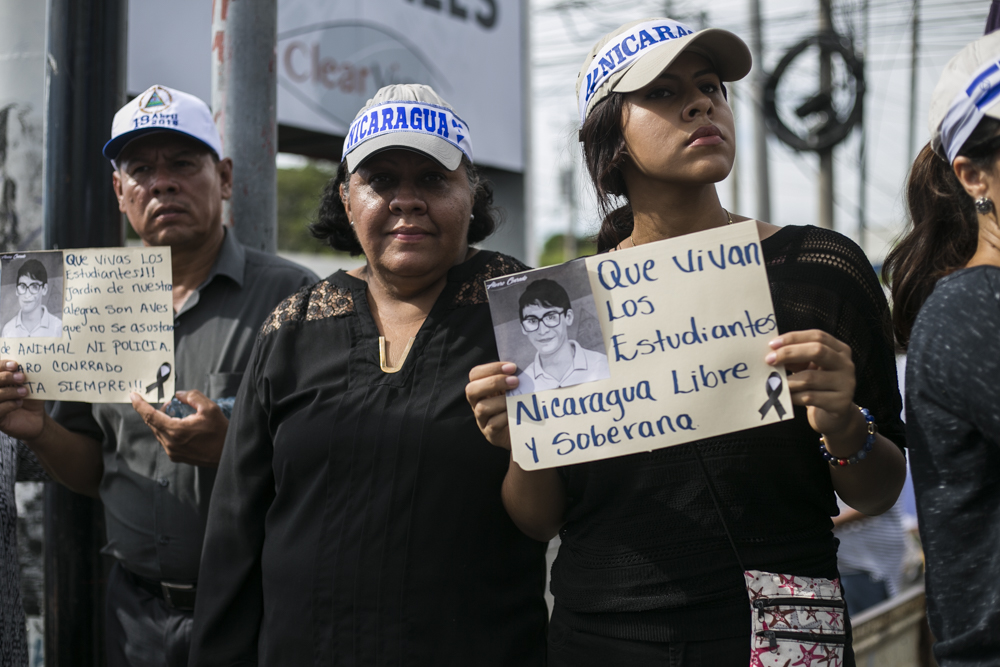
The April 2018 uprising and its effects push the limits of theory. Since arriving at Berkeley, I have heard the discourses on the importance of equity and social justice. Almost every week, I read an article or book about the segregated and racialized structure of the society of the United States. (I refuse to refer to the U.S. as “America.” I am American, too, by virtue of having been born on this continent, and I refuse to allow my and my country’s histories to be subsumed in a hollow fashion.) I have engaged with the theories of Marx, Althusser, Vygotsky, Fanon, Quijano, and Anzaldua. As Dalton said in one of his poems, I have been trying to “study the architecture of justice,” and yet I have failed to heal through theory.[2] How can one talk about “revolution” as a new ideological state that flourishes from the ashes of an ancient regime’s demise if I have seen how the revolutionary vanguard became the new oligarchy? How can I embrace revolution if every time I hear that word, Rosario Murillo’s voice invades my mind with her insults against the Nicaraguan people (she called us los puchitos, los vandálicos, los terroristas” – the insignificant ones, the vandals, the terrorists)? April 2018 taught me that “revolution” is either at best an empty vessel or at worst, a false and oppressive ideology that justifies violence based on race, gender, and social class.
How else, for instance, can you explain that such disparate people as feminist leaders, businessmen, ex-revolutionary generals, religious conservatives, journalists, student leaders, and the leaders of peasant movements were imprisoned for more than 600 days despite their ideological differences? My hypothesis is that ideology died in Nicaragua. Many years ago, some political science specialists used to call Nicaragua el país de las maravillas (the wonderland). It is a place in which the unthinkable happens. In such a wonderland, the people were stripped of the fundamental right to disagree with one another ideologically. Our students understand that, as long as Ortega and his family hold power, we cannot even disagree as a society by creating a political project. Issues of race, class, and gender are subsumed in the daily political violence. No opposition groups, such as the bourgeoisie-proletariat, can engage in a dialectical process to overcome a perpetual contradiction.
I do not want to romanticize the deaths, let alone theorize about them. Ultimately, these young people are dead because Nicaragua and Nicaraguans failed as a society, at least in my opinion. Families lost children, and no words I write can compensate for that. Those who keep struggling against Ortega are trying to bring justice to their executioners, at the expense of their security and well-being, because they know that only justice and historical memory can allow the Nicaraguan people to heal. Making this political and moral fight their own demonstrates outstanding bravery. However, I am afraid that Nicaragua might never heal. In my country, history has a vicious circle, and when I reflect on our past, present, and future, I feel an overwhelming sense that these victims were destined to die young by choices made before they were born. When Zelaya was reelected for 16 years in a row a century ago, when the U.S. supported first Somoza and then the Contras, when the Sandinista guerrillas displaced Indigenous communities during the Red Christmas and promoted a contradictory agrarian reform, when I celebrated the FSLN’s victory in 2006, when some of us decided not to notice or act when Ortega slowly dismantled the country’s institutions in front of our noses; we were all setting the stage for these children to die.
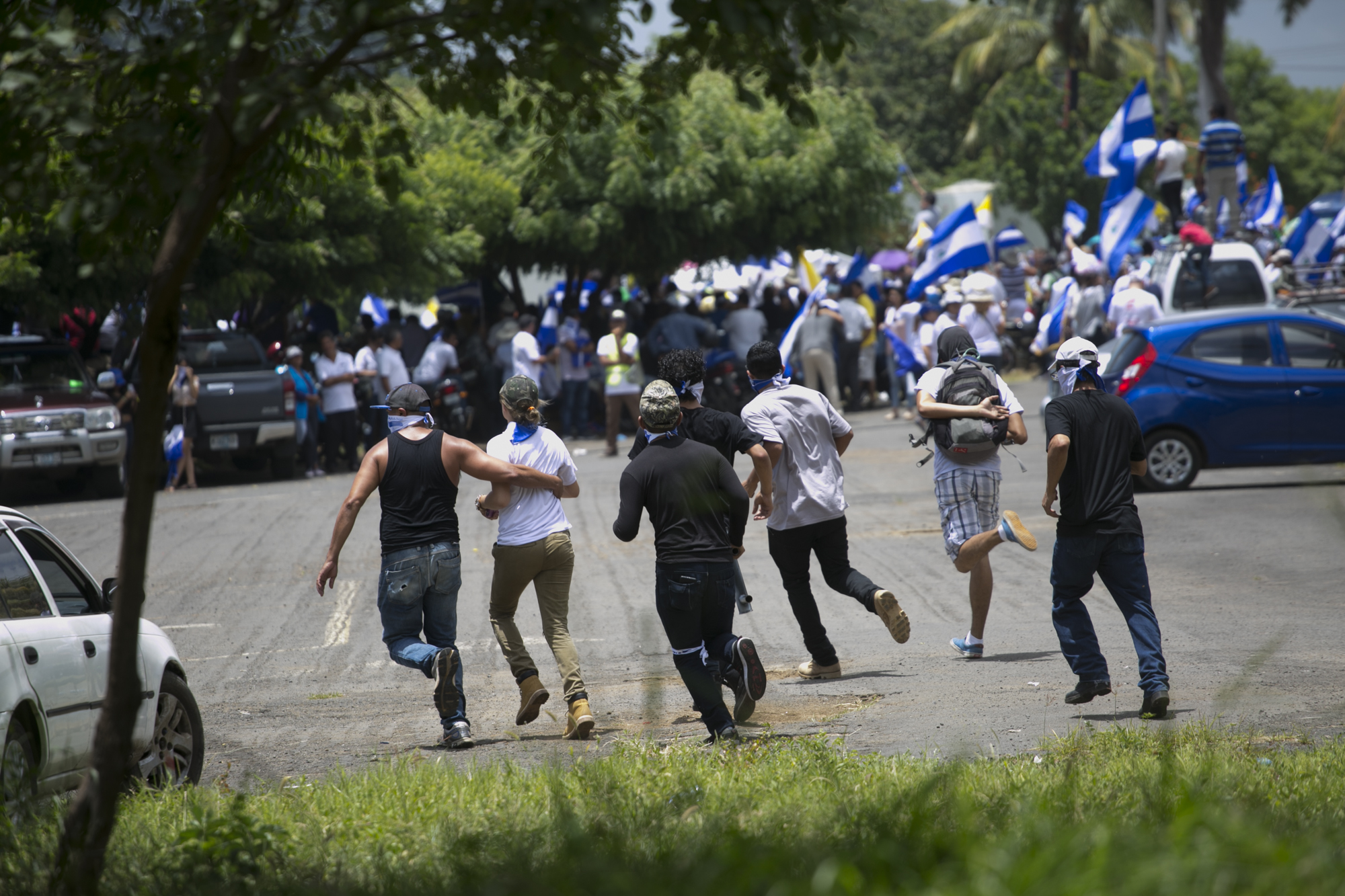
Nevertheless, I want to remember them this month because their memory helps me to keep moving forward. Remembering them is my way of holding myself accountable in this struggle against the government. I keep going forward because part of me died with them. Because I, too, need closure and the belief that justice will prevail, however delayed. I remember them because they ignited within me something unknown until 2018: unconditional faith in youth’s potential to besiege power perpetually. They projected the Nicaraguan essence. They represented el gueguense, the irreverence and mockery toward all sorts of solemnities. They brought back our rebellious history. We have been honored to be the stone in Uncle Sam’s shoe since William Walker tried to make Nicaragua into a slave nation. We have, as Anzaldua said, an untamed tongue; we are impolite, disrespectful, and stubborn against power. We have authority issues. These students read the world and decided to act upon it in a way we have not seen before in our history. They resurrected the old values of a failed revolution. Suddenly, el patria libre o morir (a free land or death) became patria libre para vivir (a free land to live). These newly emergent heroes ripped off the images of Fidel, El Che, and other old idols from their t-shirts. They used literacy and the Nicaraguan picardía (roguery or mischief) to attack their enemy, instead of trying to seize power with violence and armed conflicts. Thus, they were armed with irreverent songs and chants when weapons were used against them. While Rosario Murillo shouted in despair on national radio: ya dejen de joder (video) (Stop annoying us/Stop joking around), the students kept chanting: sobaco peludo, te vas con el trompudo (The hairy armpits witch will leave with the dick with big lips ) Ya dejen de joder, she kept screaming. La jodedera (being annoying) is our revolution. And as long as we remember these students, vamos a seguir jodiendo (We will keep annoying you). As long as they live in our collective memory, the dictator Ortega cannot put his mind at ease. While injustice and impunity prevail, those memories will make the never-ending April for him as well “the cruelest month.”

Rafael Meza Duriez is a Ph.D. student in the Graduate School of Education at UC Berkeley. A Fulbright grantee, he specializes in early grade literacy, specifically identifying how preschool and elementary teachers provide liberatory writing instruction. His research focuses on determining the underlying pedagogical discourse of the literacy education curriculum in Nicaragua and on understanding the challenges of teaching reading and writing in rural schools. He also developed programs for Teacher Professional Development in Early Grade Literacy across Central America and the Caribbean.
Please note: All posts on the CLAS Blog are the opinions and statements of the author, and do not necessarily reflect the views of either the UC Berkeley Center for Latin American Studies or the University of California.
[1] According to a regional report in Central America, Nicaragua has increased its level of corruption from 0.59 to 0.81, which puts it among the most corrupt countries in the region. See Sixth State of the Region Report (2021), The National Council of Rectors of Costa Rica, p. 43.
[2] bell hooks used this phrase in her book Teaching to Trangress. See hooks, b. (1994), Teaching to Transgress. Education as the Practice of Freedom. Routledge, p. 59.
