
By Gabriel Lesser
Political humor is booming in Brazil. It’s practically inescapable if you’re on social—or unsocial—media. Sérgio Augusto recently wrote in the Folha de São Paulo newspaper that the election of an extreme right-wing president who reveres Brazil’s most recent dictatorship (1965-1980) has resulted in a rebirth of anti-authoritarian, resistance-focused humor. My Facebook feed, for example, supplies me with daily memes mocking President Jair Bolsonaro and a variety of other government actors.
My CLAS Summer Field Research Grant project initially sought to explore the relationship between humor and political resistance in Brazilian literature. My focus was political satire and graphic humor during Brazil’s military dictatorship. I hoped to analyze continuities in resistance culture during times of political oppression by examining political cartoons in newspapers and humor magazines.
Once I started visiting archives, such as the State University of São Paulo’s (UNESP) Centro de Documentação e Memória (CEDEM) and the Mário de Andrade Library, a different picture emerged. Many political cartoons in well-known left-wing magazines such as O Pasquim, and lesser-known ones such as Ovelha Negra, attacked the dictatorship by mocking other marginalized groups. Stereotypes such as the horny, money-obsessed housewife or the wild, uncivilized person of African descent were often the punchline. What contemporary academic research categorizes as “resistance humor” seemed littered with contradictions to me. The humor criticized the country’s political shift towards authoritarianism while reinforcing many facets of the social status quo. A mostly white and male cast of humorists mocked politicians, women, immigrants, non-whites, the LGBT community, and anyone else they could caricature.
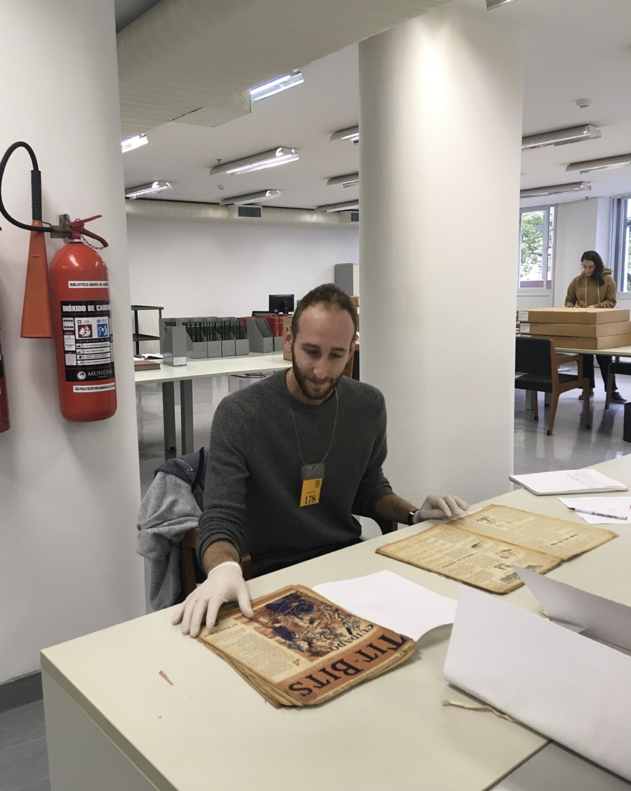
This new insight shifted my direction in the archives. I began to examine mainstream, popular newspapers and magazines published during and before the dictatorship, regardless of political orientation. In these publications, cartoons were not acts of humoristic resistance but of oppression: homophobia, sexism, and racism were performed through jokes that reached a wider audience than those in clandestine resistance humor periodicals.
Below is an example of a seemingly innocuous social cartoon that reinforces negative stereotypes about Afro-Brazilians, published in 1937 in Tit-Bits magazine. Tit-Bits did not have an explicit political orientation, claiming its goal was simply to entertain and spark laughter. In this cartoon, the Afro-Brazilian is a shirtless, uncivilized cannibal, who works as a cook, a stereotype found in Brazilian cartoons throughout the 20th century.

– Easy for you to say: you don’t realize that they are cooking me with raw onions!
(Tit-Bits. September 17, 1937.)
Another cartoon, published in Careta magazine in 1931, uses humor to criticize immigration and inter-marriage in Brazil. Careta was a weekly humoristic illustrated magazine with a large national readership. It lasted more than fifty years and published pieces by some of Brazil’s best-known writers. In the cartoon below, the different racial and ethnic groups are portrayed as the ingredients of a cocktail. When mixed, they create a repulsive, uncivilized creature, dressed similarly to the Afro-Brazilian in the Tit-Bits cartoon above. Jews, Arabs, Japanese, and Italians, among others, are caricatured.
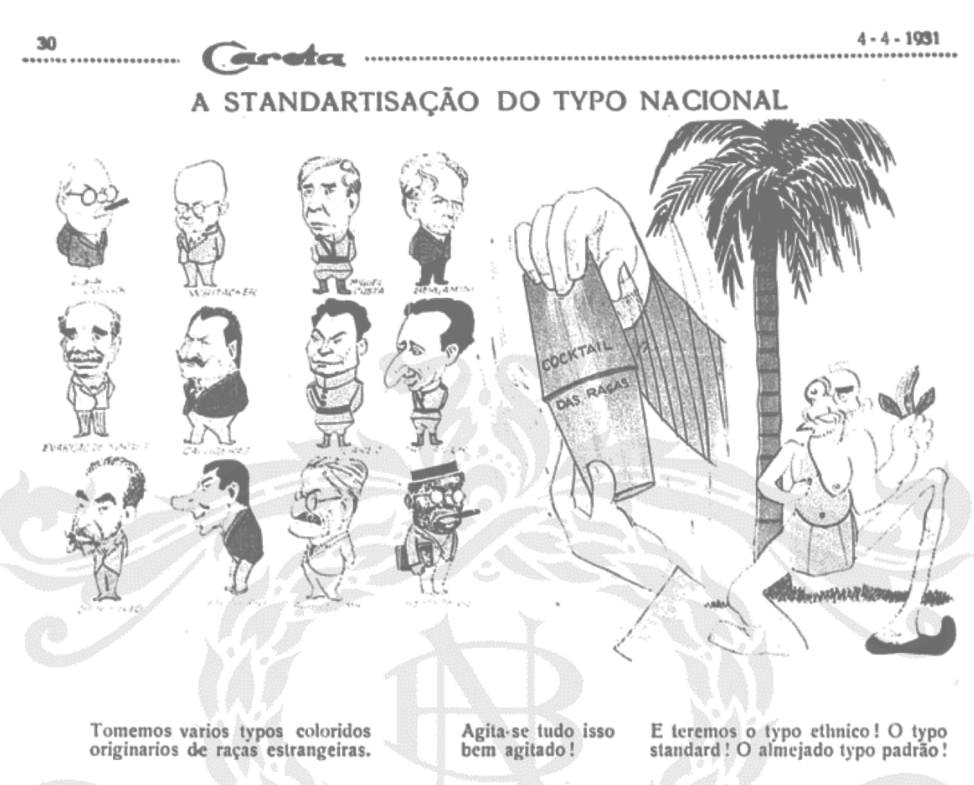
– Shake up the contents!
– And what you get is an ethnic person! A standard person! The desired standardized person!
(Careta. April 4th, 1931. From Brazil’s Biblioteca Nacional, available online)
Academic literature tends to focus on political humor as a form of resistance in Brazil. My thesis expands on these approaches by showing how social humor is used as a tool of oppression and exclusion. By making fun of the “other,” the jokester and their audience form a new type of community—often at the expense of the underclasses. These cartoons represent tendencies like racism and classism across the political spectrum.
My approach to studying humor will illustrate a weapon still common in contemporary acts of oppression, both in Latin America and the United States. It may point to continuities in elite Latin American culture and literature from as early as the 18th century. Canonical Latin American texts often make fun of the lower classes, indigenous groups, immigrants, and many other “others.” It’s time to take those quips seriously! Studying humor is no joke.

Gabriel Lesser is a Ph.D. student in Spanish and Portuguese at UC Berkeley. He earned his B.A. from Brown University, where he was awarded the Fichter Prize for best honors thesis in Hispanic Studies. Prior to starting his doctorate, Gabriel worked at the Hispanic Division of the Library of Congress and helped put together the Handbook of Latin American Studies. He has also published a travel guide, Piecing Together São Paulo. His interests include 19th and 20th century humor, visual studies, and cartoons in Mexico and Brazil. Gabriel is a recipient of the 2019 CLAS Summer Field Research Grant.
Leave a Reply