
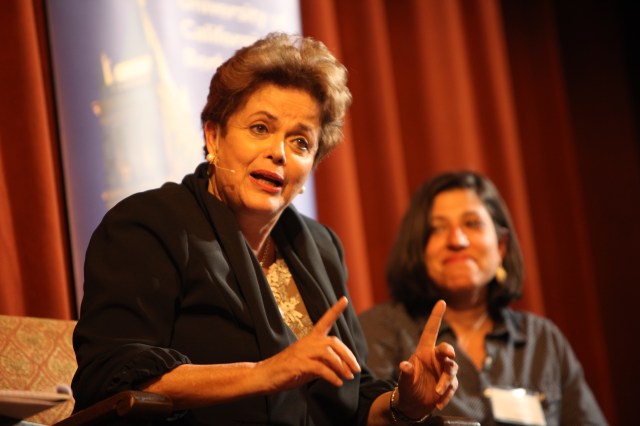
Dilma Rousseff (President of Brazil, 2011-16) gave a talk at UC Berkeley on April 16, 2018 titled “Challenges for Democracy in Brazil”. The event was organized by the Center for Latin American Studies (CLAS) and cosponsored by the Department of Sociology and the Charles and Louise Travers Department of Political Science. In this series, various scholars from diverse disciplines respond to the talk.

In her passionate discourse delivered at UC Berkeley, former President of Brazil Dilma Rousseff made a strong defense of the socio-economic policies advanced by her government before repudiating the “parliamentary coup d’état” that abruptly ended her second term in office.
After highlighting the remarkable achievements accomplished by the administrations of President Lula and herself —especially in terms of reducing poverty and diminishing inequality— Rousseff asserted that the impeachment procedure that ended her presidency, as well as Lula’s current imprisonment on corruption charges, were part of a conspiracy perpetrated by Brazil’s elites in order to reverse the egalitarian policies that the Workers’ Party (Partido dos Trabalhadores, or PT) had been enacting for over a decade.
Rousseff is understandably upset, since she was unfairly expelled from government through a bogus impeachment procedure. Indeed, although there is little doubt that her administration did engage in irregularities regarding some government accounts and the taking of loans without the required congressional approval, those were relatively minor offences that, furthermore, had been commonplace in the past. That’s why, although perhaps constitutional, her impeachment was profoundly unjust and disproportionate.
What’s puzzling is why Rousseff —who is widely regarded as an honest politician— was so adamant in her defense of Lula. Of course, one can sympathize with her loyalty towards a comrade that fought alongside her: first, against a brutal military regime, and then for social justice. But it is distressing to hear a seasoned politician suggest that the entire Brazilian judicial system is conspiring with business groups and mainstream media to not only impeach her, but also to unjustly imprison Lula on baseless corruption charges. Indeed, given that the Judicial Independence Ranking of the World Economic Forum —as well of other entities— regards Brazil’s judiciary as reasonably independent, and considering that a large majority of the justices of its highest courts were actually nominated when either Lula or Rousseff were in power, it is hard to believe that the courts are part of a larger conspiracy against the PT.
In a telling passage of her presentation, Rousseff asserted that “it was naive” to focus on the cases of corruption currently being investigated in Brazil, instead of focusing on the corruption behind the subprime crisis of the late 2000s. She is right in that there was lots of corruption behind the latter, but wrong in dismissing the scandals that have shaken Brazil in recent years. These corruption cases have been serious enough to erode the confidence of many Brazilians in the entire political party system, something which —in other latitudes— has favored the rise of right wing populists who promise to ‘clean’ the country of corruption, while destroying the basis of democracy and the rule of law. So, although humanly understandable, Dilma Rousseff’s suggestion that Lula is effectively a ‘political prisoner’ who has been sent to jail by a judicial system that is part of an elite conspiracy represents a serious mistake. One that could undermine the very entities that in the future may defend democrats from the sort of elected authoritarians that now rule countries such as Hungary, Poland and The Philippines.

JAVIER COUSO was a visiting scholar at the Center for Latin American Studies at UC Berkeley, where he also earned his Ph.D. in Jurisprudence and Social Policy. He is Professor of Constitutional Law at Universidad Diego Portales, Associate Researcher at the Center for Social Conflict and Cohesion Studies (COES) in Chile, and was holder of the Prince Claus Chair in Development and Equity at Utrecht University (2014-2016). Couso was as a constitutional adviser to Michelle Bachelet, President of Chile, from 2014-2018. An Associate Member of the International Academy of Comparative Law, his work focuses on comparative law and courts, with an emphasis on the interplay between constitutionalism, the rule of law, and legal cultures in new democracies.

A “reasonably independent” judiciary s the same as “reasonably biased” one. There were blatant, glaring violations of due process committred in the case brought against Lula.
It is fascinating that the author of this piece basically predicted the outcome of the Brazilian election half a year later in the final paragraph…